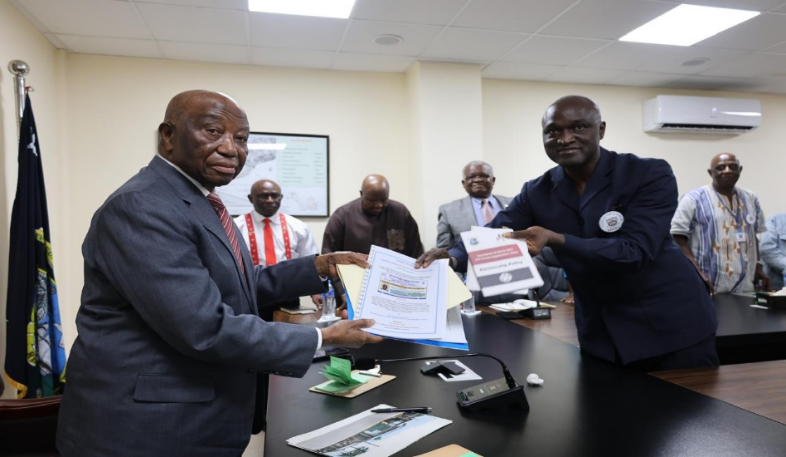
MONROVIA – Marking a monumental milestone in the socio-economic and political development of post-conflict Liberia, President Joseph Nyuma Boakai Sr. has formally received a historic petition and Executive Brief from Liberian Civil Society Organizations (CSOs) requesting a statutory 0.1% Legislative Budgetary Appropriation from the National Budget to address the acute sustainability crisis facing more than 2500 civil society organizations across the country.
By Augustus D.R [email protected]
The high-level presentation took place at the Executive Mansion on Tuesday, September 1 during a strategic consultative engagement organized under the umbrella of the Voices of The Elders (VOTE) – Republic of Liberia.
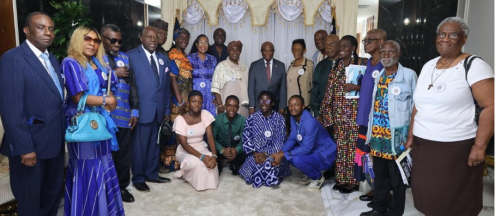
The petition was presented on behalf of the CSO Consortium Partners for Democracy & Good Governance (PdG) by Rev. Augustine S. Arkoi, Founder/CEO of the Better Future Foundation (BFF) and Co-Chair of VOTE-R.L., accompanied by an eminent delegation of 16 Elders and 5 youth representatives led by VOTE Chairperson Elder Maureen Johnson Hutchison, alongside distinguished statesmen and women including Sister Mary Laurene Brown, Dr. D. Evelyn S. Kandakai and Hon. Rupel Marshall.
This Executive Mansion engagement represents the culmination of a rigorous, transparent, and democratic process that commenced on December 12, 2025, during the CSO Consultative Forum, where the draft CSO Sustainability Bill was formally debated, adopted and signed by civil society leaders.
Following nationwide mobilization, the petition was formally submitted to the 55th National Legislature and subsequently adopted by the House Plenary on June 24.
The presentation to President Boakai on September 1 bridges legislative adoption with Executive endorsement, positioning domestic CSO co-financing for inclusion in the upcoming national budget debates.
The presentation of the CSO Sustainability Framework comes at a profound historical moment, coinciding with Liberia’s celebration of 23 years of unbroken peace since the signing of Liberia’s Comprehensive Peace Accord (CPA) in Accra, Ghana on August 18, 2003, as well as the global observance of the International Day of Peace on September 2, last week.
As articulated in the keynote address by Ambassador Blamo Nelson during the 62nd National Unification Day, that was organized by BFF and CSO Partners, the Accra CPA served as a 7-Point Roadmap designed to transition Liberia from 14 years of civil devastation toward political tranquility and constitutional normalcy.
The CPA called for seven mandatory actions:
- Ceasefire and cessation of hostilities; 2. Formation of the National Transitional Government of Liberia (NTGL); 3. Complete disarmament and demobilization of all armed groups; 4. Appointment of an independent National Elections Commission (NEC); 5. Organization and conduct of free, fair, multiparty democratic elections; 6. Inauguration of a democratically elected constitutional government; and 7. Establishment of statutory integrity institutions to enforce laws and good governance compliance.
All citizen groupings and signatories—perpetrators and victims alike—have fully complied with the terms of the CPA, establishing over two decades of uninterrupted democratic governance. However, civil society leaders emphasize that while the CPA successfully ended armed conflict, the total withdrawal of international peacekeeping missions (UNMIL) and the scaling back of major bilateral donor funding (including USAID and SIDA) have created a severe operational vulnerability for domestic non-governmental organizations.
Citing international best practices—such as statutory civil society funds established in Ghana, Sierra Leone, South Africa, and various European democracies—The CSO- PdG Consortium emphasized that domestic budgetary allocations are essential to guarantee national ownership and prevent civil society extinction.
The proposed 0.1% Legislative Budgetary Appropriation fulfills Section 7.2.1.5 of the GoL/CSO Partnership Policy and the GoL-CSO Accord (2016), which explicitly obligate the Liberian government to establish legal and financial mechanisms, including a dedicated Civil Society Trust Fund.
The framework incorporates rigorous accountability mechanisms, requiring audited financial statements, tax compliance, non-partisan affidavits, and competitive proposal evaluations by an Independent Evaluation Panel, as preconditions for CSOs to assess the funds .
Executive Brief Policy Recommendations
Alongside the CSO Sustainability Bill, the delegation submitted a comprehensive Memorandum/Executive Brief, detailing critical policy recommendations to solidify national stability:
- Promulgation of an Executive Order for an Interim National Peacebuilding and Reconciliation Commission (NPRC): The Executive Brief outlines the structural limitations of the current peacebuilding architecture, which operates as a minor unit (Liberia Peacebuilding Office – PBO) under the Ministry of Internal Affairs.
- An Executive Order establishing an autonomous NPRC will unify fragmented peacebuilding mandates, fulfill outstanding requirements of the 2009 TRC Final Report and the Strategic Roadmap for National Healing (2013–2030), adhere to Article 5 of the 1986 Constitution, and decentralize conflict resolution across Liberia’s 15 counties and diaspora communities.
- Institutionalization of Peace and Civics Education: The proposal calls for embedding Civics and Peace Education into school curricula nationwide to foster patriotism and civic duty among Liberian youth.
- Rapid Intervention on Environmental Security: The Brief alerts the administration to the existential threat posed by coastal erosion and Atlantic Ocean encroachment along Monrovia’s Sinkor–Congo Town land strip, urging immediate coastal defense projects to mitigate community displacement, trauma, and economic loss.
Conclusion
President Boakai expressed gratitude for the comprehensive presentations and called for a follow-up engagement with VOTE-R.L. leadership at his Rehab residence to further examine the actionable recommendations.
Speaking at the CSOs press briefing in Monrovia on Tuesday, September 29, Veteran Educator Mary Laurene Browne, former UNDP Development Economist, Dr. Anthony Barclay and VOTE’s Chairperson Elder Maureen Johnson Hutchison and Civil society leaders and Elders remain optimistic that Executive backing for the 0.1% Legislative Budgetary Appropriation and the interim NPRC Executive Order will seal President Boakai’s legacy as a transformative leader devoted to enduring peace, national unification and sustainable democratic development.
Support Independent Journalism
Your support helps FrontPage Africa continue delivering independent, credible, and impactful journalism. Every contribution strengthens our ability to investigate, inform, and hold power accountable while keeping quality journalism accessible to our readers.
Support our journalism or subscribe to receive the latest FrontPage Africa stories and updates.