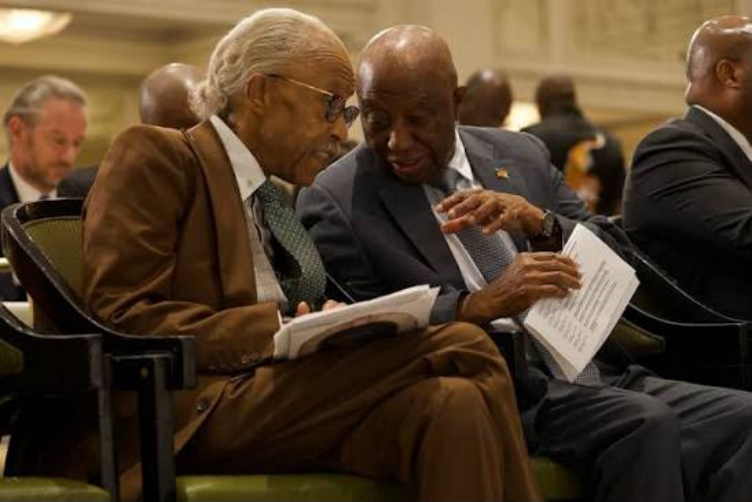
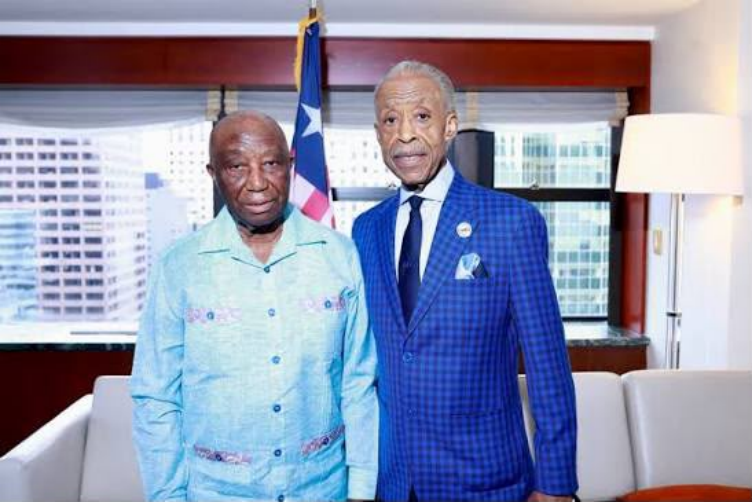
NEW YORK – When the Reverend Al Sharpton sat down with President Joseph Nyuma Boakai, Sr. on the sidelines of the United Nations General Assembly last week, the meeting fit a pattern older than the Republic of Liberia itself: Black Americans and Africans meeting to ask what they owe one another.
By Rodney D Sieh
Sharpton, the civil rights activist and founder of the National Action Network, described the encounter on Instagram as a “meaningful meeting” with the Liberian leader. The two, he wrote, discussed Africa having “a strong seat at the table,” strengthening the relationship between Africa and the diaspora, and the responsibility “to help build, invest in, and uplift the Motherland.” He called President Boakai and his staff “gracious and welcoming” and said Liberia “has an important voice on the global stage.”
Sharpton had earlier greeted the President at a high-level gathering on African cultural heritage. Ghana hosted that side event in New York on Wednesday, September 23, to review progress on reparatory justice and the restitution of cultural heritage, co-hosted with Germany and France, with UNESCO Director-General Khaled El-Enany among those expected to take part.  
Boakai’s heritage pitch
At that event, President Boakai proposed a Liberia–Ghana Cultural Heritage and Historical Recovery Cooperation Framework, under which institutions from both countries would digitize historical records, train archivists and museum professionals, research and preserve historic sites, and develop exhibitions and educational programs. He argued that “Restitution should ultimately be about more than the physical return of objects,” and suggested the two countries appoint a small technical working group to identify immediate areas of cooperation, leading eventually to a formal agreement. 
The President was in New York for the 81st UNGA, where he delivered Liberia’s national address on September 24 under the theme “Restoring Trust, Managing Transformation: A United Nations that Delivers for All.” 
A nation born of the diaspora
Few countries embody the diaspora story as directly as Liberia. Beginning in 1822, the American Colonization Society settled freed and freeborn Black Americans on the Grain Coast, and in 1847 Liberia declared independence as Africa’s first republic. The settlers’ arrival was not a simple homecoming: the divide between Americo-Liberians and indigenous Liberians shaped the country’s politics for more than a century and remains part of its unfinished reckoning.
Liberia also became a laboratory for Pan-African thought. Edward Wilmot Blyden, the Caribbean-born scholar who made Liberia his home, argued in the 19th century that Africans and their descendants shared a common destiny. In the 1920s, Marcus Garvey’s Universal Negro Improvement Association looked to Liberia for its back-to-Africa ambitions, while W.E.B. Du Bois traveled to Monrovia in 1924 as a U.S. envoy to the inauguration of President Charles D.B. King.
After independence swept the continent, President William V.S. Tubman helped shape the Organization of African Unity, founded in 1963. Its successor, the African Union, has since recognized the diaspora as the continent’s “sixth region,” and Ghana’s 2019 “Year of Return” drew thousands of African Americans to the continent.
Unfinished business at home and abroad
The conversation in New York comes at a sensitive moment for Liberians in America. Not every reaction to Sharpton’s post was celebratory: one commenter asked whether the meeting addressed Liberians who had lost protected immigration status.
That status has a long history. Since March 1991, certain Liberians have been eligible for either Temporary Protected Status or Deferred Enforced Departure (DED), allowing them to remain in the United States. In 2019, Congress passed the Liberian Refugee Immigration Fairness provision, opening a path to permanent residency for Liberians continuously present in the U.S. since November 2014. President Biden later extended DED through June 30, 2026, but according to U.S. Citizenship and Immigration Services, DED for Liberia expired on June 30, 2026. Neither Sharpton’s post nor available statements indicate whether the issue came up. 
From words to action
Sharpton closed his post by calling this “a moment for partnership, progress, and action.” For Liberia, which was built by people crossing the Atlantic in the opposite direction from their ancestors, the test will be whether such meetings produce more than photographs, whether in heritage cooperation, investment or protection for Liberians living in America.
Support Independent Journalism
Your support helps FrontPage Africa continue delivering independent, credible, and impactful journalism. Every contribution strengthens our ability to investigate, inform, and hold power accountable while keeping quality journalism accessible to our readers.
Support our journalism or subscribe to receive the latest FrontPage Africa stories and updates.