Monrovia-Liberia has delivered one of its strongest warnings yet on the changing face of terrorism, calling on the United Nations Security Council to abandon a largely reactive approach to
By Willie N. Tokpah
international security and invest aggressively in prevention before extremist violence reaches the doorsteps of more coastal West African states.
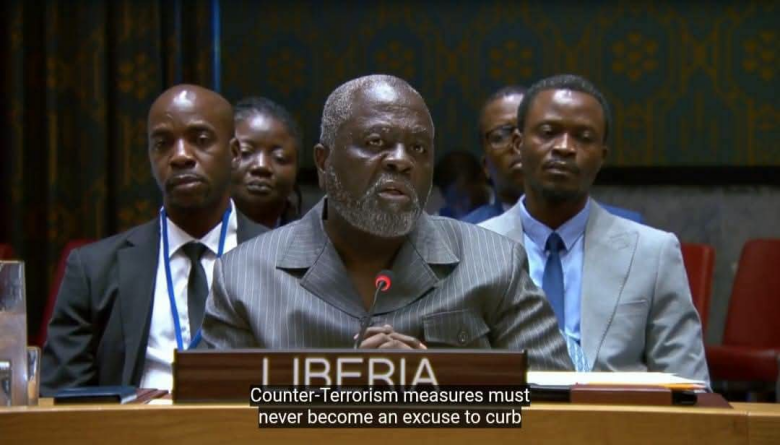
Speaking in New York for Liberia at the United Nations, Liberia’s Permanent Representative, Ambassador Lewis G. Brown II, warned that terrorism has undergone a profound transformation since the September 11, 2001 attacks, with extremist organizations increasingly combining conventional violence with technology, illicit financial networks and sophisticated communication systems.
The Liberian intervention places particular urgency on the security of the Gulf of Guinea, where countries once considered relatively insulated from the jihadist violence ravaging the Sahel are facing an increasingly complex security environment.
Brown’s message was blunt, waiting for terrorism to arrive before responding is no longer an adequate security strategy.
For Liberia, the warning carries particular weight. A country that emerged from more than a decade of civil war and became one of Africa’s most prominent examples of post-conflict recovery is now urging the international community to recognize that security cannot be reduced to soldiers, weapons and military operations.
‘The threat is changing’
According to Liberia’s Permanent Mission to the United Nations, terrorist groups are increasingly exploiting digital platforms, artificial intelligence, illicit financial networks and commercial drones to recruit members, raise money, communicate and conduct operations.
That evolution means that the battlefield is no longer confined to remote deserts, forests or conventional military frontlines. It is increasingly online, financial, technological and cross-border.
The United Nations itself has warned this year that terrorist and other armed groups operating across the Sahel are adapting rapidly, with growing use of drones, advanced communications and cryptocurrencies while expanding toward the coastal states of the Gulf of Guinea.
A recent UN counterterrorism publication also identifies the Gulf of Guinea as an area requiring stronger maritime surveillance, early-warning systems, border monitoring and technology-enabled security measures.
It specifically recommends the use of artificial intelligence, drones, satellites and other surveillance tools to anticipate and intercept emerging threats.
That development gives particular significance to Liberia’s warning.
From the Sahel toward the coast
The threat is no longer simply a problem for Mali, Burkina Faso or Niger. The geographic direction of extremist expansion is increasingly toward the coastal belt.
UN officials have warned that the threat remains acute in the central Sahel and northern Nigeria and is rapidly targeting coastal states along the Gulf of Guinea.
The implications for countries such as Benin, Togo, Ghana and Côte d’Ivoire are already being closely watched by regional security officials.
For Liberia, the question is therefore not whether the country should wait until an attack occurs.
The more important question is whether the country, its neighbors and international partners can build the necessary defenses before extremist networks establish themselves along the coast.
The United Nations Development Programme warned in June, that the Gulf of Guinea faces a convergence of security threats requiring a stronger prevention agenda and concrete regional action.
The African Union has similarly expressed concern about terrorist groups expanding their operational reach across the continent and specifically highlighted the increasing use of drones and emerging digital technologies for propaganda, recruitment and operational planning.
Brown’s tougher message, Build the defenses before the attack. Brown’s intervention goes beyond asking for more military assistance. Liberia is calling for greater international investment in border security, digital forensics, judicial systems and financial intelligence.
Liberia’s argument is therefore that counterterrorism must attack the ecosystem that allows terrorism to grow, not merely the militants who eventually emerge from it.
This means, strengthening border controls while simultaneously improving courts, prosecutors, investigators, financial intelligence units and cyber capabilities.
Support Independent Journalism
Your support helps FrontPage Africa continue delivering independent, credible, and impactful journalism. Every contribution strengthens our ability to investigate, inform, and hold power accountable while keeping quality journalism accessible to our readers.
Support our journalism or subscribe to receive the latest FrontPage Africa stories and updates.