The Drug Investigation Has Created a Powerful Case for Greater Financial Transparency
By Dr. Clarence R. Pearson, Sr.
Liberia’s widening confrontation with transnational cocaine trafficking has reached a point where fighting drugs can no longer mean simply intercepting cocaine, arresting suspects and prosecuting alleged traffickers. It must also mean following the money — wherever legitimate investigation leads.
That principle should apply without political distinction.
Former Vice President Jewel Howard-Taylor now faces serious criminal charges arising from an alleged transnational narcotics network. She is presumed innocent, and whether the government can prove its allegations is a matter for the courts.
But one allegation contained in the government’s own charging documents has implications extending beyond a single defendant.
Investigators allege that $75,000 originating from the hierarchy of a suspected cocaine cartel was provided through Sheik Bashiru Kante for Howard-Taylor’s Jewel Star Fish Foundation.
That allegation remains unproven. Yet it raises a legitimate governance question: Can foundations associated with powerful political figures become potential channels through which people seeking access, influence or protection move money?
If Liberia is serious about dismantling narcotics networks, that question deserves attention.
And the principle should include institutions associated with the highest levels of government.
The Joseph N. Boakai Foundation should therefore consider voluntarily publishing independently audited financial statements and providing meaningful disclosure of its material sources of funding, particularly covering the period surrounding the 2023 presidential election and subsequent years.
That is not an accusation against President Joseph Boakai, his family, his campaign or his foundation. No credible evidence presently available to the public establishes that the foundation received proceeds from drug trafficking. Government officials have also publicly rejected allegations connecting the President’s son, Joseph Boakai Jr., to recent major cocaine seizures.
But transparency should not begin only after evidence of wrongdoing emerges.
Liberia is confronting criminal organizations capable of moving enormous amounts of money. The recent seizure and destruction of approximately 4.2 metric tons of cocaine — valued by authorities at hundreds of millions of dollars — illustrates the scale of the threat. The investigation has also raised troubling questions about possible penetration of state institutions.
When criminal networks possess that kind of financial power, following money becomes as important as following drugs.
Politically connected foundations deserve particular attention because they occupy an unusual space between philanthropy, public influence and private financing. They can perform extraordinary humanitarian work. But their association with powerful officials can also make them attractive to donors seeking proximity to political authority.
The best protection against suspicion is transparency.
President Boakai has an opportunity to establish a national standard without waiting for legislation, investigation or controversy.
His foundation could commission a reputable independent external audit and voluntarily publish the resulting financial statements. Disclosure could identify material funding sources, major expenditures, significant in-kind contributions and related-party transactions, while appropriately protecting information legitimately shielded by law or reasonable donor-privacy considerations.
The foundation could also establish publicly available donor due-diligence standards designed to guard against accepting funds originating from criminal enterprises, money laundering or other illicit activities.
Such action would be especially meaningful concerning the period surrounding the 2023 presidential campaign.
The foundation demonstrated a highly visible level of public activity during that political period. Visibility itself proves nothing improper. But where an organization closely associated with a presidential candidate operates prominently during an election season, reasonable questions can arise about financial separation among philanthropy, political activity and campaign financing.
An independent audit can answer such questions far more effectively than political arguments.
That is the larger lesson emerging from the Howard-Taylor case.
The appropriate response should not be to presume that politically connected foundations are compromised simply because investigators have made allegations concerning one foundation. Instead, Liberia should recognize a structural vulnerability and strengthen safeguards across the political system.
If an alleged international narcotics organization was willing to cultivate relationships with senior political figures, as investigators contend, then Liberia should assume sophisticated criminal networks may seek legitimate-looking avenues through which to obtain access and influence.
Foundations, charities, political organizations, businesses and campaign structures associated with politically exposed persons should therefore maintain financial controls capable of demonstrating the legitimacy of significant contributions.
President Boakai could lead that transformation voluntarily.
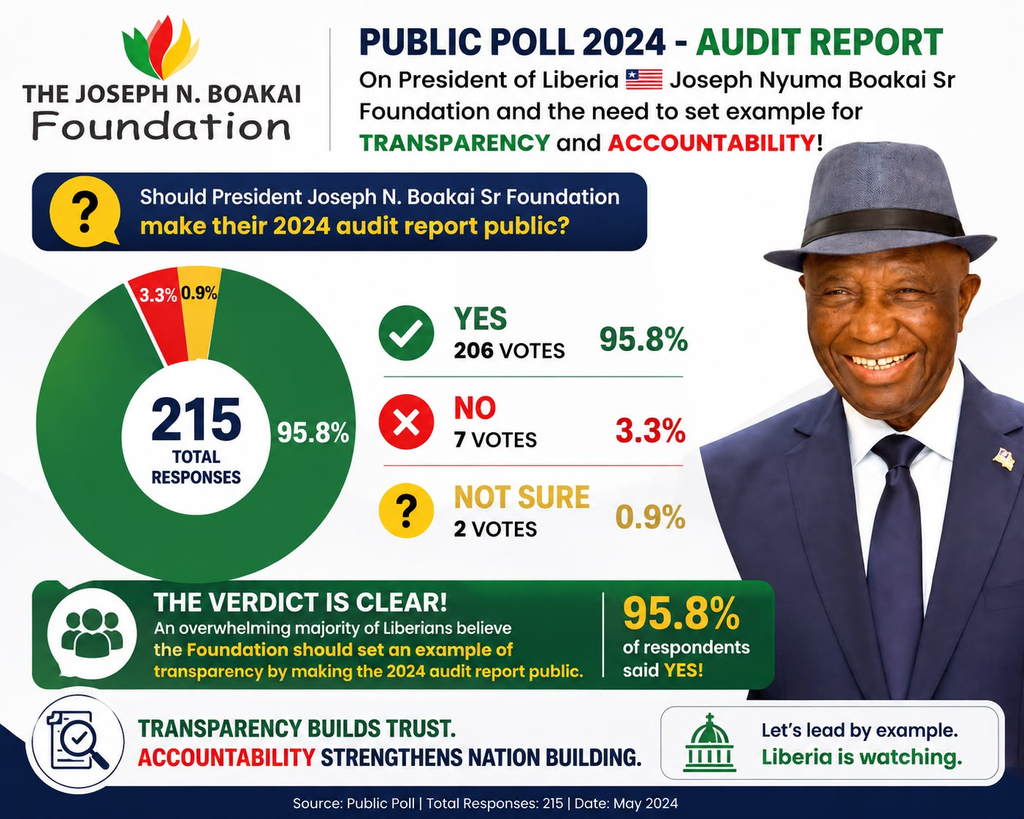
The public appetite for disclosure appears substantial. In a May 2024 I conducted a public poll asking whether the Joseph N. Boakai Foundation should make its 2024 audit report public, 206 of 215 respondents — 95.8 percent — answered yes. Seven voted no and two were unsure.
The poll should not be represented as a scientific national survey. But the overwhelming result among participants communicates something unmistakable: transparency matters to Liberians.
The government has repeatedly insisted that its narcotics investigation will leave no stone unturned.
That commitment deserves support.
But “no stone unturned” must become an institutional principle rather than a slogan applied selectively.
Follow the drugs.
Follow the networks.
Follow the money.
And build financial systems transparent enough that legitimate organizations can demonstrate the integrity of their resources before suspicion becomes scandal.
The Howard-Taylor prosecution may establish important legal precedents, but those determinations belong to the courts. The broader institutional lesson does not require waiting for a verdict.
Liberia now has an opportunity to recognize that financial transparency is itself an instrument in the fight against organized crime.
President Boakai can help establish that principle from the highest office in the Republic.
Publish the foundation’s independently audited financial statements. Provide meaningful disclosure of material funding sources. Strengthen donor due diligence. Welcome legitimate scrutiny.
Not because wrongdoing has been established.
But because leadership by example is most powerful when those holding the greatest authority voluntarily accept the transparency they expect from others.
If Liberia truly intends to leave no stone unturned in its fight against drug trafficking, there could hardly be a stronger place to demonstrate that commitment than at the very top.
Support Independent Journalism
Your support helps FrontPage Africa continue delivering independent, credible, and impactful journalism. Every contribution strengthens our ability to investigate, inform, and hold power accountable while keeping quality journalism accessible to our readers.
Support our journalism or subscribe to receive the latest FrontPage Africa stories and updates.