Monrovia – MONROVIA — For weeks, the question hanging over Liberia’s largest-ever drug bust was whether anyone would be formally charged at all. That question has now been answered, but the answer has raised a different one: why do the charges stop where they do?
By Rodney D. Sieh, [email protected]
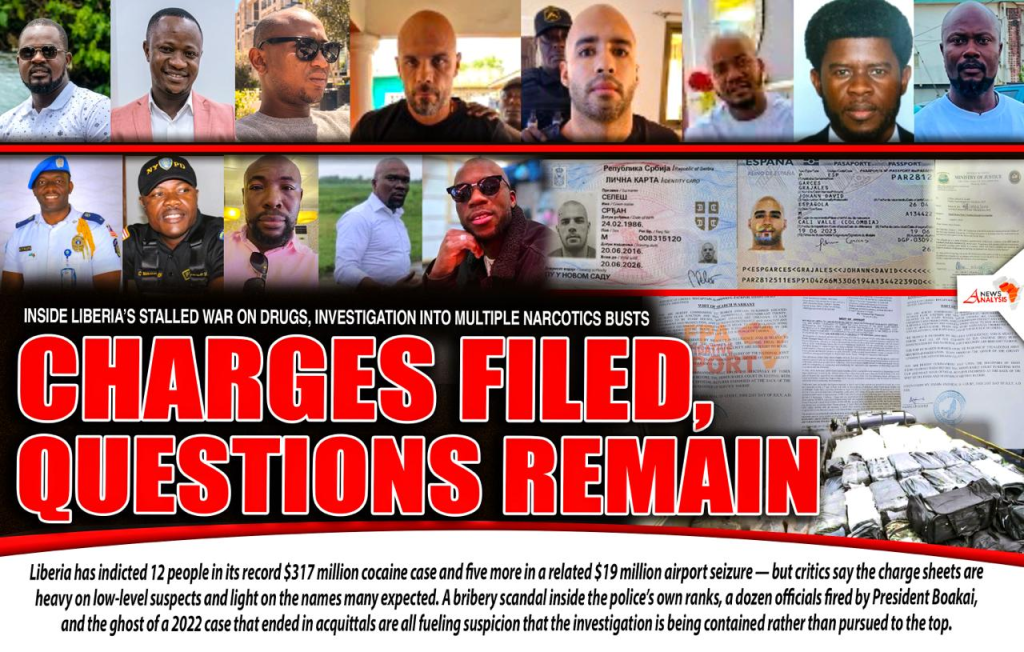
On July 29, prosecutors filed a charge sheet at the Paynesville City Magisterial Court naming twelve defendants in the case tied to nearly four tonnes of cocaine worth an estimated $317 million seized near Roberts International Airport in July. The document, filed before Stipendiary Magistrate William G. Saygah, lays out prosecutors’ account of the operation in more detail than had previously been public. But as multiple Liberian outlets have noted, the list is heavy on alleged foot soldiers and light on the “big names” the public has been waiting to see.
A pattern of slow, sequential charging
This isn’t the first time Liberia’s drug cases have moved this way. In the related $19 million Roberts International Airport seizure from June, it took nearly a month before police announced charges against five individuals and one logistics company, a delay that had drawn criticism as authorities initially declined to name suspects, citing a need to protect the investigation. Even then, only one of the five charged, Paul J. King, appeared in a Liberian courtroom in person — the case’s most elusive figure, Michael U.S. Browne, is believed to have slipped across the border into Sierra Leone and was charged in absentia.
Institutional rot inside the investigation itself
Part of what has slowed the $317 million case appears to be sabotage from within. Liberia National Police Inspector General Gregory Coleman announced in late July that Deputy Police Commissioner Johnny Bolor Dean had been relieved of his post after admitting to receiving $10,000 in bribes from the cocaine traffickers to compromise the investigation. Dean was accused of providing assistance and comfort to suspects already in police custody. President Boakai has since gone further: he dismissed a dozen government officials, including the airport’s deputy director for operations, the police commissioner for criminal investigation, intelligence and Interpol, and a deputy director at the National Security Agency, and referred others for further investigation.
The 2022 shadow
Liberian commentators keep returning to the same cautionary precedent. In the 2022 Freeport case — a $100 million cocaine seizure hidden in a container of frozen pig feet, with traffickers caught in the act of retrieving it — a jury nonetheless acquitted all four defendants, the foreign nationals left the country, and the court ordered the seized cash returned. One allAfrica commentary put it bluntly: Liberia’s borders might sometimes catch a shipment, but its courts rarely catch a trafficker. That history is why some observers are cautioning against confusing urgency with justice, arguing public confidence will only be restored by evidence and prosecutions that survive judicial scrutiny — not press conferences.
Why the technical case takes time — and why that excuse is wearing thin
Officials point to genuine complexity: investigators say they traced communications, financial transactions, shipping records and digital evidence linking the June seizure to an earlier shipment processed through the same logistics chain in May, which transformed the case from a single interception into what authorities believe is an organized, multi-shipment trafficking operation with international dimensions. That kind of forensic and financial tracing legitimately takes weeks.
But lawmakers are increasingly unwilling to accept that as a full explanation. Senators including Amara Konneh, Darius Dillon and Edwin Snowe have called for a broader inquiry into how seizures of this size resulted in no arrests before some suspects had already left the country.
A different kind of missing name
There’s also a structural reason big names may never surface in a Liberian courtroom. Unlike the 2010 case of Russian pilot Konstantin Yaroshenko — arrested in a joint DEA-Liberian sting and transferred to U.S. custody within weeks to face federal charges — nothing about the current cases fits that mold, meaning the pressure valve of American prosecution that produced a conviction in that earlier case isn’t obviously available this time.
The bottom line
Liberia has, in fact, indicted people — twelve in the largest case, five (plus one in absentia) in the airport case. The “shoved under the carpet” concern isn’t about a lack of paper; it’s about who the paper names, and whether the officials caught taking bribes to protect the network are a sign that the case is being contained rather than pursued to its source. Given the acquittals in 2022 and the bribery scandal already uncovered in this case, skepticism about whether formal charges will translate into convictions — or reach the people actually running the operation — is grounded in Liberia’s own recent record, not just public impatience.
Support Independent Journalism
Your support helps FrontPage Africa continue delivering independent, credible, and impactful journalism. Every contribution strengthens our ability to investigate, inform, and hold power accountable while keeping quality journalism accessible to our readers.
Support our journalism or subscribe to receive the latest FrontPage Africa stories and updates.