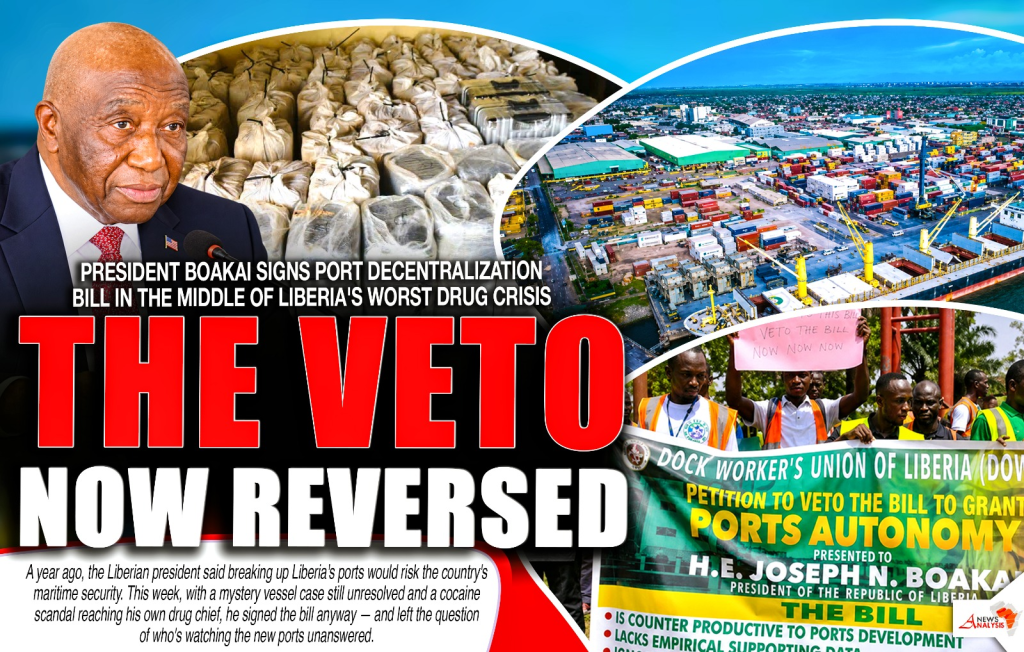
A year ago, the Liberian president said breaking up Liberia’s ports would risk the country’s maritime security. This week, with a mystery vessel case still unresolved and a cocaine scandal reaching his own drug chief, he signed the bill anyway — and left the question of who’s watching the new ports unanswered.
By Rodney D. Sieh, [email protected]
Monrovia – President Joseph Boakai has signed into law the legislation dismantling the National Port Authority’s decades-long monopoly, ending centralized control of Liberia’s ports and handing operational power to autonomous boards in Monrovia, Buchanan, Greenville and Harper under a newly created Independent Seaport and Inland Ports Regulatory Authority.
What is not yet clear is whether the final law includes the safeguards needed to keep four newly independent ports from becoming easier targets for drug traffickers than the single, centralized system it replaces.
The President had twice vetoed earlier versions of this legislation, citing legal conflicts, overlapping regulatory mandates, and risks to Liberia’s international maritime security obligations; the Senate responded by revising and repassing the bill, and the president has now signed the revised version. The timing is difficult to overstate: the signing comes as Liberia remains consumed by its largest drug scandal in years, one that has already produced a record $317 million cocaine seizure, criminal charges against an LDEA officer and a Paynesville bar owner, the recusal of the LDEA’s own acting chief over an unresolved vehicle allegation, and months of unanswered questions about a mystery vessel, the IB Atlantic IV, that first exposed how little visibility Liberia’s port and maritime system has over what moves through it.
A Reversal, Not Just a Signature
Somewhere in the Executive Mansion this week, a pen crossed a line the president himself drew twice before. That is what makes this signing newsworthy — not simply that a major piece of legislation became law, but that the man signing it is the same man who, on two separate occasions, told the Legislature in writing that it was not ready to pass. Boakai’s earlier vetoes of the port decentralization and autonomy bills were not procedural throat-clearing. He cited legal conflicts between the new port boards and existing regulatory bodies, overlapping mandates that risked institutional confusion, fragmentation of executive oversight, and — most pointedly, given everything that has happened since — risks to Liberia’s international maritime security obligations. Those were not small concerns when he raised them, and nothing about the summer that followed made them smaller. What changed, in the end, was not the risk. It was the political weather around it — enough pressure to pass some version of port reform that it eventually outweighed the president’s own stated reservations, at least enough to move his hand to the page.
An Eighteen-Month Runway
Two details emerged after the signing that reshape, without resolving, the questions surrounding it. The Minister of State, Samuel A. Stevequoah, confirmed to FrontPageAfrica that President Boakai signed the bill on the advice of the Minister of Justice — a detail that matters given the Justice Ministry’s own past warnings about the legislation’s legal conflicts, and one that suggests the administration’s internal legal objections were addressed, or at least set aside, before the president put pen to paper.
FrontPageAfrica has also confirmed that the legislation carries an 18-month transitional clause, meaning the new decentralized port structure will not actually take effect until 2028. That transition period cuts two ways, and which way it ultimately cuts is now the real story. Read generously, an 18-month runway is exactly the kind of window FrontPageAfrica previously argued was missing from the original, undelayed version of the bill — time to build a unified maritime security and counternarcotics framework before four independent ports go live, rather than discovering the gaps after the fact. Read skeptically, an 18-month delay is also a convenient way to defuse the immediate political pressure of signing security-sensitive legislation in the middle of a cocaine scandal, without requiring the administration to specify, today, what it plans to do with the time. Nothing announced alongside the signing indicates which of those two readings is closer to the truth. The next 18 months, not this week’s signature, will settle it.
What the Law Actually Does
The legislation ends the National Port Authority’s roughly 70-year monopoly over Liberia’s seaports, replacing centralized control with autonomous, county-based port boards responsible for the Freeport of Monrovia and the ports of Buchanan, Greenville and Harper. Overseeing the new structure is an Independent Seaport and Inland Ports Regulatory Authority, intended to regulate the newly decentralized system rather than run it directly. Supporters have framed the change as a long-overdue correction to decades of Monrovia-centered control that left Liberia’s secondary ports starved of investment and local say over infrastructure sitting in their own backyards — a legitimate grievance this newspaper has acknowledged even while warning against the timing of this fix.
The Missing Safety Net
Here is the question nobody in Monrovia seems eager to answer out loud, and it happens to be the one that matters most given the year Liberia has just had: does the final version of this law include anything resembling a unified maritime security and counter-narcotics framework spanning all four newly independent ports, or does security oversight now sit as fragmented as everything else the bill decentralizes? Neither the legislative history nor the president’s own remarks upon signing, as reported so far, make that clear one way or the other. A port system split four ways multiplies the number of doors traffickers can walk through, and multiplies the number of agencies each with a plausible-sounding answer for why detecting the next shipment wasn’t quite their job — precisely the dynamic this newspaper warned about when it urged caution on this bill last month, before the president had signed it and before the IB Atlantic IV had become a household name in Liberia’s drug scandal.
The mystery vessel case is not incidental background here; it is the clearest evidence available that Liberia’s current, centralized port and maritime security apparatus already struggles to answer basic questions about what is moving through its own waters. A ship sat off Liberia’s coast for the better part of a week before anyone acted, tied by a rejected letter to a now-dismissed RIA official, eventually chased by AFL boats that turned out to be too small to catch it once it ran for open water. If a single, centralized system produced that outcome, the burden was always on this bill’s supporters to explain, convincingly and in public, why four separate, newly formed authorities would do better rather than worse. Nobody has offered that explanation yet, at least not one this newspaper has been able to find.
Signed Amid the Worst Possible Timing
Whatever the merits of port decentralization as policy, the timing of this signature could hardly have landed at a more uncomfortable moment. Liberia is currently working through the fallout of a record $317 million cocaine seizure in Duazon, on top of a $19.2 million bust at Roberts International Airport in June. LDEA officer Moses Jallah and Paynesville bar owner George Harris are facing prosecution. The LDEA’s own Officer-in-Charge, Fitzgerald Biago, has recused himself from the investigation amid allegations he accepted vehicles from a bar owner tied to the case, with President Boakai personally giving the Minister of Justice 48 hours to report on the matter. Senator Amara Konneh has taken to calling the whole affair “Cocainegate.” Signing a bill that fragments port oversight into four pieces, in the middle of a scandal that has repeatedly exposed how poorly Liberia’s existing, unified institutions have policed themselves, is the kind of decision that will be read by critics as tone-deaf regardless of the bill’s underlying merits — and the administration has offered little public messaging so far to counter that reading.
What Critics Warned
Opposition to the bill was neither quiet nor limited to the presidency. Representative Musa Hassan Bility condemned the Legislature’s handling of the reform, calling the Port Autonomy Law “improper” and “dangerous.” The head of the Liberia Revenue Authority separately urged Boakai to reject the bill again, warning of revenue risks and unresolved legal conflicts between the new port authorities and existing agencies. Those warnings were about institutional and fiscal risk more than security specifically, but they reinforce the same underlying picture: a piece of legislation that even before its security implications are considered, drew sustained warnings from officials inside the government about how much this reform could go wrong in the execution.
The Question Nobody’s Answered
None of this means port decentralization was the wrong idea in principle, and FrontPageAfrica has said as much before. Buchanan, Greenville and Harper have real grievances about decades of Monrovia-centered control, and those grievances deserve a serious legislative answer eventually. But “eventually” and “in the middle of the country’s worst drug scandal in years, with the underlying security gaps still unaddressed” are not the same moment, and the president’s own vetoes once made exactly that argument. What Liberians deserve now, at minimum, is a clear public accounting from the administration of what changed between the version Boakai rejected and the version he signed — specifically, what safeguards, if any, will exist by 2028 to keep four independent ports from being four times as vulnerable as the single system that just spent a summer failing to catch a ship sitting in plain view off its own coast. The 18-month transition period is, in effect, the administration’s own self-imposed deadline for answering that question. Until it does, the safest assumption is the least reassuring one: that the law changed, and the vulnerability it was meant to address is being left for 2028 to sort out.
Support Independent Journalism
Your support helps FrontPage Africa continue delivering independent, credible, and impactful journalism. Every contribution strengthens our ability to investigate, inform, and hold power accountable while keeping quality journalism accessible to our readers.
Support our journalism or subscribe to receive the latest FrontPage Africa stories and updates.