MONROVIA— President Joseph Nyuma Boakai’s decision to replace the leadership of the Liberia Drug Enforcement Agency marks the latest turn in a revolving door that has seen the agency change hands five times in just over two years.
By Obediah Johnson, [email protected] and Gerald C. Koinyeneh, [email protected]
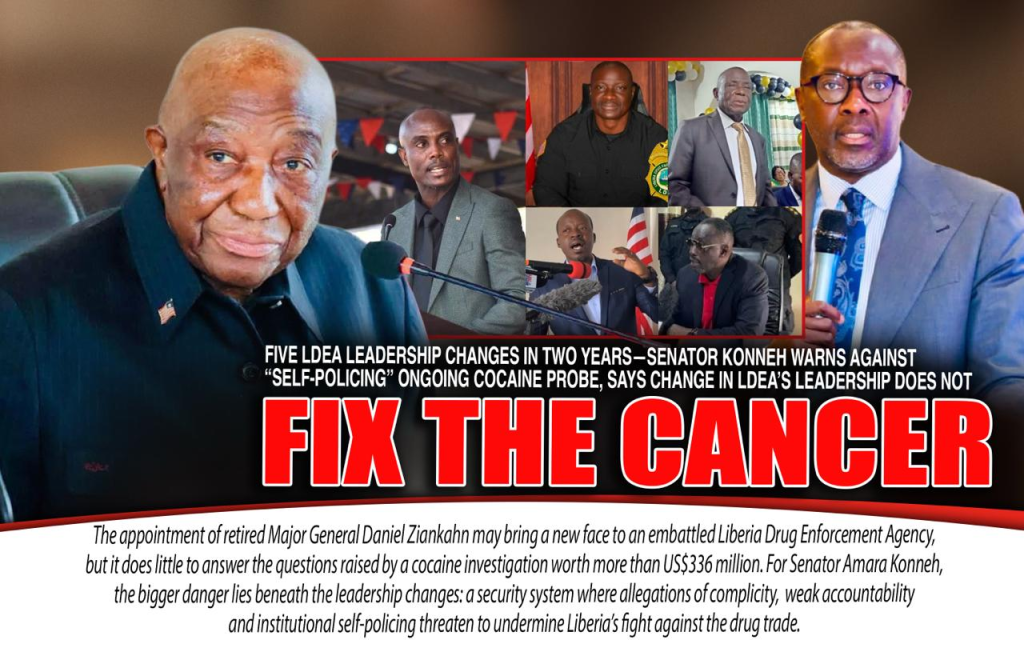
The appointment of retired Major General Daniel Dee Ziankahn, Jr. as Director General-designate comes as the LDEA and Liberia’s wider security establishment face perhaps their most serious credibility crisis in years.
But for Senator Amara Konneh, the latest change raises a question that goes beyond the credentials of the incoming director: Can Liberia fix a deeply troubled security institution simply by repeatedly changing the person at the top?
Konneh’s answer is no.
“Changing the leadership at LDEA does not automatically fix the cancer eating away at our security system,” the Senate Public Accounts and Audit Committee chairman warned Tuesday.
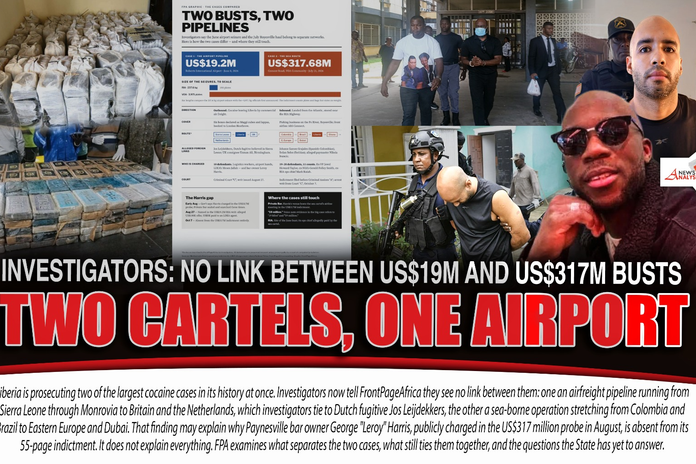
His argument goes to the heart of Liberia’s ongoing cocaine crisis. The country has recorded cocaine seizures valued at more than US$336 million, including an approximately US$317 million shipment intercepted in the VOA Community in Paynesville and a roughly US$19 million consignment seized at Roberts International Airport.
The investigations have generated allegations involving individuals connected to the security and law-enforcement establishment, triggered internal investigations and produced leadership changes.
Now, President Boakai has turned to Ziankahn, a retired military general and former Defense Minister, to restore stability and credibility to an agency that has experienced extraordinary leadership turbulence.
But the question remains whether another change at the top can address what critics describe as deeper institutional weaknesses.
Five Changes, One Troubled Agency
The significance of Ziankahn’s appointment is best understood against the backdrop of the leadership changes that preceded him.
Since taking office in January 2024, President Boakai has overseen five changes involving the top leadership of the LDEA—three director-general-level appointments and two periods in which officials served as Officer in Charge.
The revolving door is striking, particularly because the fight against illicit drugs was one of Boakai’s prominent campaign commitments.
After his inauguration, Boakai moved quickly to appoint Abraham Kromah, a veteran security officer who had previously served as Deputy Commissioner of Police for Operations under former President Ellen Johnson Sirleaf.
Kromah arrived with a reputation as a tough law-enforcement officer, and his appointment was initially welcomed by many Liberians who expected him to bring a more aggressive approach to the fight against drugs, particularly the synthetic drug commonly known as Kush.
Instead, his tenure became embroiled in an internal management crisis.
A public confrontation involving Kromah and his deputies, Hassan Fadiga and Gbawou Kowou, escalated into a physical altercation and resulted in their suspension. The administration subsequently ordered an investigation, and following the submission of the report, Kromah and his deputies were removed.
But the report was never made public. That unresolved issue continues to hang over the agency. For the public, the unanswered question is simple: What did the investigation find? The absence of a public explanation has contributed to a recurring problem within the LDEA—major decisions are announced, but the underlying findings are often kept from public view.
Peters Leaves With a Warning
Following Kromah’s removal, Christopher K. Peters Sr. was appointed Officer in Charge of the LDEA on June 4, 2024. Peters’ tenure was brief.
Although he pointed to drug seizures worth more than US$4 million and lengthy prison sentences secured against traffickers, he resigned only months after taking office.
His resignation letter, addressed to then-Minister of State Sylvester M. Grigsby (now deceased), offered perhaps one of the clearest diagnoses of the agency’s institutional weaknesses.
Peters argued that winning the war on drugs required strategic reforms, enhanced training, additional personnel, adequate funding and sustained support from key partners. He also stressed the need for leadership capable of promoting calm, maturity and teamwork within the agency.
His resignation became effective October 31, 2024. Whether his recommendations were fully acted upon remains an open question.
Souh Returns—Then Leaves
Peters was succeeded by Anthony Souh, another experienced law-enforcement officer and former LDEA Director General during the Ellen Johnson Sirleaf administration, when Boakai served as Vice President.
Souh returned to the agency with institutional experience and familiarity with Liberia’s drug-enforcement challenges.
But his return did not produce lasting stability. About a year later, the Boakai administration removed Souh and other senior LDEA officials, paving the way for another restructuring.
Again, the cycle continued.
Then Came Biago
The next major leadership arrangement brought Fitzgerald T. M. Biago, a Deputy Commissioner of Police, into the agency’s leadership.
On August 28, 2025, President Boakai appointed Biago, a Deputy Commissioner of the Liberian National Police, as Officer-In-Charge. He led an interim management structure alongside Ernest T. Tarpeh of the National Security Agency and Patrick B. Kormazu of the LNP following the removal of Souh and other senior officials.
Nearly a year later, his leadership was thrown into controversy after activist Martin K. N. Kollie alleged that Biago had received a vehicle as a gift from Leroy Harris, a suspect in the US$317 million cocaine investigation.
Biago denied involvement in the drug allegations and stepped aside to make himself available for investigation.
A Ministry of Justice review did not establish his involvement in narcotics trafficking. But the government said the review identified ethical concerns, prompting President Boakai to indefinitely suspend Biago from the Liberia National Police and order a more detailed investigation.
Again, the distinction is important: the government did not establish that Biago was involved in the narcotics trade, but it found ethical concerns serious enough to warrant further action. And again, the LDEA was left with a leadership problem.
Now comes Ziankahn.
The retired major general brings perhaps the strongest national-security credentials of any of the recent LDEA appointees.
He became the first post-war Liberian Chief of Staff of the Armed Forces of Liberia, appointed in 2014 after the restructuring of the military following the civil war. He had enlisted in the newly restructured Armed Forces of Liberia in 2006 and rose through the ranks before becoming Chief of Staff, a position he held from 2014 to 2018.
He subsequently served as Liberia’s Minister of National Defense under former President George Weah and later became Military Advisor to President Boakai.
Analysts say his appointment represents a significant shift in the profile of LDEA leadership. The administration appears to be betting that Ziankahn’s military and national-security experience can bring discipline, stability and strategic direction to an agency that has repeatedly struggled with internal turmoil. But that is precisely where Konneh’s warning becomes relevant.
A Revolving Door at the LDEA
Ziankahn’s appointment marks what amounts to the fifth leadership change at the LDEA in roughly two years under President Boakai—three director-general-level appointments and two individuals who have served as Officer in Charge.
The frequency of those changes raises a fundamental institutional question: If leadership keeps changing but the underlying vulnerabilities remain, is the problem really the person at the top?
The “Self-Policing” Problem
Senator Konneh argued that institutions implicated in allegations surrounding a major criminal investigation should not be left to investigate themselves.
“Institutions with heavy corruption and cartel allegations cannot investigate themselves,” he said, calling for an open, credible and independent inquiry into high-ranking individuals allegedly connected to the narcotics network.
That demand strikes at the heart of the cocaine investigations.
The magnitude of the seizures has transformed the issue from an ordinary drug-enforcement matter into a national security question.
A shipment valued at hundreds of millions of dollars does not move through international supply chains, ports, airports and local communities without sophisticated organization, financing, logistics and access.
That inevitably raises questions about whether criminal networks operated entirely outside the state—or whether individuals with access to official systems may have facilitated, enabled or shielded elements of the trade.
Those questions cannot be answered merely by replacing one agency director with another. They require investigators capable of following the evidence wherever it leads. And that means senior officials cannot be treated differently from ordinary suspects simply because of their positions.
Ziankahn’s Appointment: A Strong Man for a Weak System?
There is little doubt that Ziankahn brings considerable experience to the position. The retired major general previously served as Liberia’s Minister of National Defense and, more recently, as Military Advisor to President Boakai.
His background gives him significant exposure to national security operations and strategic decision-making. That experience could prove valuable to an agency that has been battered by leadership instability and public distrust.
But experience alone does not answer the central problem.
The question is whether Ziankahn will inherit an agency capable of functioning independently—or an institution whose credibility has been damaged by allegations that reach beyond its current leadership.
Konneh acknowledged Ziankahn’s credentials while making clear that his appointment does not erase the unresolved questions.
“We wish Gen. Ziankahn success in his Senate confirmation and in his tenure, but we will observe closely,” he said.
That may ultimately become the defining test of the new LDEA leadership.
Ziankahn will not merely be judged by the number of drug seizures under his watch. He will be judged by whether his tenure produces an agency in which investigations are insulated from political influence, evidence is protected, officers are held accountable, and no official is considered untouchable.
Support Independent Journalism
Your support helps FrontPage Africa continue delivering independent, credible, and impactful journalism. Every contribution strengthens our ability to investigate, inform, and hold power accountable while keeping quality journalism accessible to our readers.
Support our journalism or subscribe to receive the latest FrontPage Africa stories and updates.