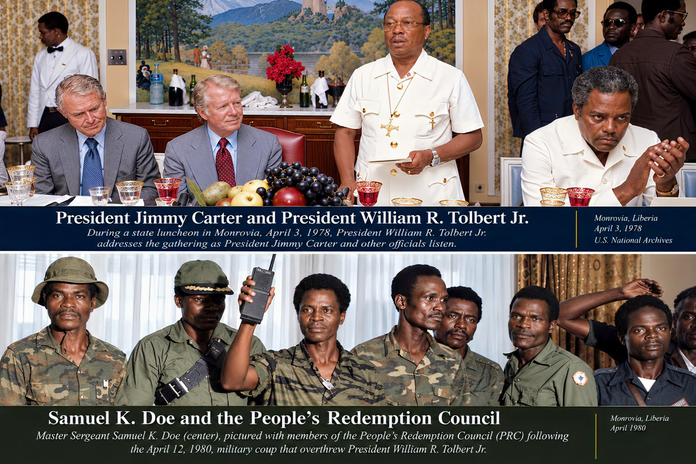
Liberia’s journey from the 2003 peace accord to the present day is often framed as a “diverging path”—a choice between a future of institutional stability and a return to the structural failures of the past.
On the Burden of Rebuilding
The transition from war to peace is not just about the absence of fighting, but about rebuilding a collapsed state from the ground up.
Ellen Johnson Sirleaf (Former President): “There was no roadmap for post-conflict transformation… We understood that our greatest responsibility was to keep the peace.”
Ellen Johnson Sirleaf: “We needed to take a step back, attend town hall meetings, talk about how we go into conflict and explain how we are going to get out of it.”
Joseph Boakai (Current President): “There is hardly a Liberian family that has not experienced the pain, violence, and injustice… We must sacrifice our individual interests for national interests.”
Ellen Johnson Sirleaf: “My biggest surprise was how devilish they [the legislature] were, my own party included.”
George Weah (Former President): “Many of those who founded this country left the pain and shame of slavery to establish a society where all would be free and equal.”
George Weah: (Upon conceding the 2023 election) “This election demonstrated that Liberians are peaceful people who respect democracy.”
Leymah Gbowee (Peace Activist): “People who have lived through a terrible conflict may be hungry and desperate, but they’re not stupid… they need to be asked [how peace can evolve].”
Leymah Gbowee: “The world used to remember Liberia for child soldiers, but they now remember our country for the white t-shirt women.”
Leymah Gbowee: “In Liberia right now, there are hundreds of thousands of unemployed young people, and they’re ready-made mercenaries for wars in West Africa.”
On the Fragility of Peace: “I cannot give that guarantee [that we won’t slip back] because we still have vulnerabilities… but the majority of Liberians… do not want to go back to war.”
On Unity: “We are a good people… but unfortunately, it is strangers and visitors who get to enjoy our hospitality and warmth, rather than each other
“Today, I see us gradually walking in those very prints that caused mass mourning for years. We are now living the days of the judges—where we take matters into our own hands.” — Philipbert Semogai Browne, via Facebook.
“When a war starts, it does not stop as quickly as one would think. Even when the guns are silent, critical times that are very hard to deal with will continue to arrive.” — Opinion in “I Am A Liberian Living In Liberia” Facebook Group.
“The ability to bring about reconciliation, facilitate an atmosphere of respect for differences, develop a culture of impartiality… must be displayed early on.” — UNDP report on “Leadership and Change in Post-Conflict States”.
By: Austin S Fallah – A True Son of the Planet Earth Soil: [email protected].
In an increasingly interconnected world, the disparate fates of countries that experienced civil wars during the same period outline a compelling narrative of human resilience and governmental efficacy.
Consider, for instance, the metaphor of a cow and a snake: both drink from the same water source, yet produce radically different outcomes.
The cow nurtures human life through its nourishing milk, while the snake generates fear through its toxic venom.
This analogy extends to national development trajectories in post-conflict countries, particularly in Liberia.
Why have nations that endured civil strife during similar periods achieved substantial progress while Liberia appears to be stagnating in persistent poverty?
The time to engage in profound critical analysis and self-reflection is now if the downtrodden citizens of Liberia are to be freed from the clutches of poverty.
The Civil War Legacy:
The scars of the civil wars that ravaged Liberia in the late 20th century are still visible in its ongoing struggles with poverty, governance, and infrastructure.
Liberia’s civil wars, lasting from 1989 to 1996 and then from 1999 to 2003, inflicted devastating consequences on its social fabric, economic stability, and institutional strength.
The war not only destroyed lives but also eroded trust in government, entrenched corruption, and fractured societal cohesion.
Compared with countries like Rwanda and Sierra Leone, which faced similar violent conflict, they have experienced remarkable rebounds in their post-war eras.
Rwanda, for instance, emerged from the ashes of the genocide against the Tutsi in 1994, witnessing impressive economic growth and significant improvements in infrastructure and health.
Sierra Leone, despite its civil strife, invested heavily in rebuilding efforts and has seen relative stability and development emerge within years of the cessation of conflict.
The stark contrast with Liberia raises an existential question: What lessons can Liberia draw from these countries, and how can its citizens demand accountability and better governance?
Governance and Leadership:
Central to understanding the differing post-war outcomes among these nations is examining governance and leadership.
The post-war governance structure is crucial for ensuring that lessons learned from past conflicts inform policy and institutional development.
Rwanda’s progressive leadership under Paul Kagame emphasizes a vision centered on national unity, accountability, and developmental strategies.
This is reflected in its policies, which prioritize agriculture and technology to enhance economic growth.
In contrast, Liberia has historically struggled under poor governance and corruption.
The failure of the state apparatus, from warlords to government officials, left citizens disillusioned and wary of centralized power’s influence.
This lack of effective governance has discouraged foreign investment and halted much-needed infrastructural development.
Leaders in Liberia have often sought personal gain rather than the collective good, perpetuating a cycle of poverty and stagnation.
The Importance of Accountability:
In striving for development, accountability remains paramount.
Countries that have emerged from conflict with healing and progress have often held their leaders to account, establishing transparent processes that enable citizen involvement in governance.
The Truth and Reconciliation Commission (TRC) in Liberia, intended to address past human rights violations, fell short of its potential.
Political elites have often evaded responsibility for war crimes and maladministration, leading to the persistence of the status quo, a situation that has directly impacted Liberia’s potential for growth.
In contrast, nations like South Africa have used mechanisms like their TRC to foster national healing, emphasizing truth-telling and reparative justice. Such measures cultivate a national identity rooted in reconciliation rather than division.
For Liberia to extract itself from the dungeon of persistent poverty, it must reform its political culture by establishing checks and balances that enforce accountability and transparency amongst leaders.
Economic Diversification and Development:
Another crucial distinction between Liberia and its more successful counterparts lies in economic strategy.
Rwanda’s economic recovery post-genocide involved a diversified approach, emphasizing sectors like tourism, agriculture, and information technology.
The national policy aimed at attracting foreign investment has flourished due to a focus on governance improvements and a business-friendly environment.
Liberia, conversely, has maintained an economy primarily reliant on the export of raw materials, such as rubber and iron ore, leaving it vulnerable to global market fluctuations. Insufficient strategic planning and a lack of commitment to industrialization have hampered sustainable economic growth.
The need for diversification cannot be overstated; Liberia must prioritize investing in education and vocational training to foster a labor force capable of thriving across industries beyond raw material extraction.
Infrastructure Development:
Infrastructure is the bedrock of any nation’s socio-economic development.
Civil wars leave a nation’s infrastructure devastated, yet the reconstruction phase presents an opportunity for rebirth.
Rwanda has notably prioritized infrastructural development since the end of its genocide, capitalizing on international partnerships and strategic investments.
By focusing on modern transportation, housing, and energy projects, Rwanda has stimulated both local economies and international interest.
In Liberia, however, the absence of coherent planning and execution in infrastructure projects contributes to ongoing challenges.
Over half of the roads remain in poor condition, severely limiting access to remote areas, curbing trade, and obstructing healthcare delivery.
Without robust infrastructural frameworks in place, Liberia’s potential remains stunted. Improving infrastructure must become a national priority, as it is an essential action in breaking the chains of economic stagnation and paving the way toward recovery.
Education and Human Capital:
The emphasis on education is indispensable for nation-building. Societies that have prioritized education after their conflicts have seen significant gains in human capacity and economic growth.
Rwanda’s investment in education, from primary schooling to advanced vocational training, has transformed its population into a highly skilled labor force contributing to rapid development.
Liberia, unfortunately, faces an uphill battle in this domain.
The educational system suffers inefficiencies, with many children lacking access to quality education.
The long-term implications of this educational deficit are dire, contributing to high unemployment rates and a cycle of poverty.
Comprehensive educational reform must be undertaken, encompassing not just access to schooling but also curriculum revamping to meet the needs of the modern job market.
Socio-Cultural Rehabilitation:
While economic and political strategies are crucial, socio-cultural healing also plays a fundamental role in the rebuilding process.
Nations like Rwanda have invested significantly in grassroots programs focused on reconciliation and fostering inter-community relationships.
Strengthening social cohesion helps rebuild trust among citizens and creates a unified vision for development.
In Liberia, decades of civil conflict have left deep-rooted animosities and societal divisions, which must be addressed for true national healing to occur.
Fostering dialogue among different communities and involving citizens in nation-building initiatives can help lay the groundwork for a more equitable and just society.
Moving from Reflection to Action:
As Liberia stands at a crossroads, the path toward emancipation from the dungeons of poverty requires a collective introspection of its national identity and governance practices.
Liberians must learn from the successes of other post-conflict nations, recognizing that the genesis of recovery lies in accountable leadership, strategic economic planning, infrastructural investment, educational reform, and the nurturing of social bonds.
The cow and the snake continue to drink from the same water, yet their outputs diverge significantly based on how they process their inputs.
The development opportunities are plentiful, but critical reflection and action are necessary to ensure Liberia’s output is akin to that of the cow, nurturing its people rather than remaining toxic to its future.
A reluctant acceptance of the status quo will only further entrench poverty.
It is time for Liberians to demand accountability, foster inclusiveness, and build upon their resilience to rise beyond the ashes of their past.
Maintaining a vision for a sustainable and prosperous future starts now.
Support Independent Journalism
Your support helps FrontPage Africa continue delivering independent, credible, and impactful journalism. Every contribution strengthens our ability to investigate, inform, and hold power accountable while keeping quality journalism accessible to our readers.
Support our journalism or subscribe to receive the latest FrontPage Africa stories and updates.