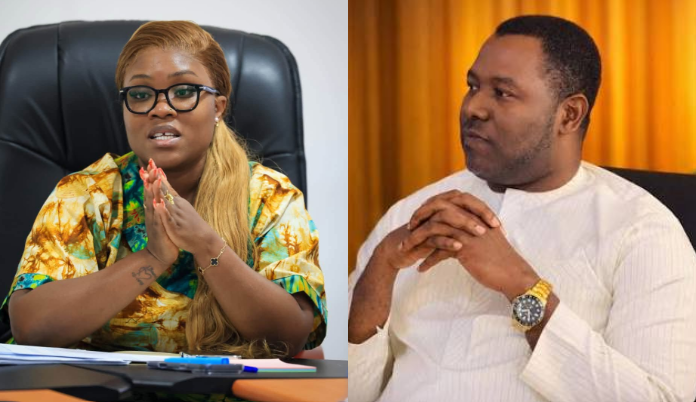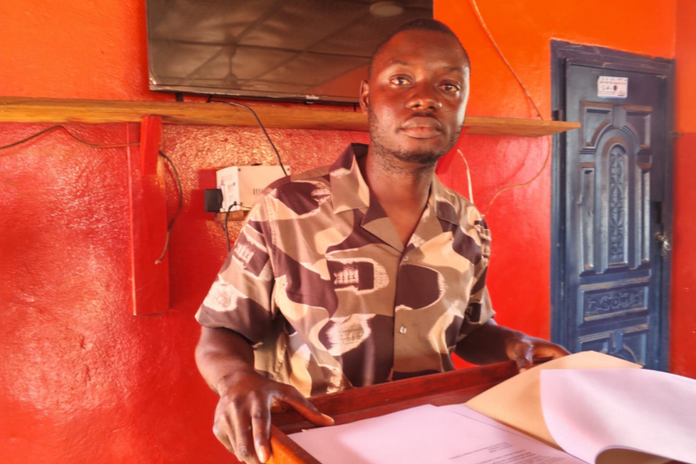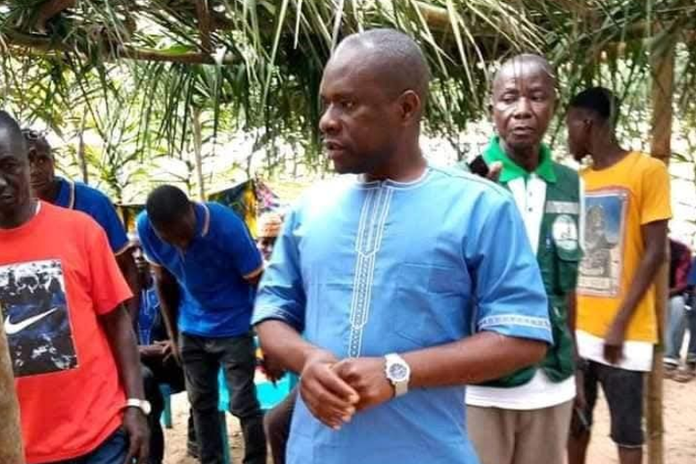

MONROVIA – Less than six months after winning a Senate seat backed by one of the country’s most powerful political alliances, Nimba County Senator Samuel G. Kogar has launched a public offensive against Vice President Jeremiah Koung — sending shockwaves through the Movement for Democracy and Reconstruction (MDR) and exposing a deep and dangerous fault line ahead of Liberia’s 2029 presidential race.
By Selma Lomax
[email protected] & Jaheim Tumu, [email protected]
This rift, long brewing beneath the surface, has now exploded into the open. The once-robust alliance — forged under the shadow of the late political titan Prince Yormie Johnson — is unraveling faster than many anticipated. And the consequences could reshape the country’s political landscape.
Vice President Jeremiah Koung’s meteoric political rise has always been closely tied to the legacy of his mentor and political godfather, Johnson. Vice President Koung, a former senator, found himself thrust into the national spotlight following Johnson’s death in 2024.
As the second most populous county in Liberia, Nimba holds a unique place in national politics — both as a vote-rich region and as a kingmaking powerhouse in presidential contests. Control over its political machinery is a prize every presidential hopeful would covet.
In this context, Vice President Koung was widely viewed as the late Johnson’s natural successor. His endorsement of Kogar in the 2025 senatorial by-election was not just a show of political strength but a public attempt to affirm his leadership over Johnson’s political estate — the MDR, and by extension, Nimba.
And on the surface, it seemed to work. Senator Kogar’s win — aided by Vice President Koung’s vigorous campaigning across Nimba’s nine districts — was hailed as a consolidation of MDR’s dominance in the county. The narrative was that Vice President Koung had cemented his grip, preparing for a 2029 bid launched from a position of homegrown strength.
But that story seems to now be falling apart.
In a stunning reversal, Senator Kogar took to the BKS online platform over the weekend, launching a direct attack on Vice President Koung and accusing him of authoritarian control within the MDR. Senator Kogar alleges that Vice President Koung — who, notably, is not a registered member of MDR — is running the party like a personal fiefdom, sidelining senior members and subverting internal democracy.
“I am from this party, and let me make it clear that we are not blind to what is happening,” the Senator declared. “We don’t care whether you stand inside or outside the party — I will stand firmly with MDR.”
The flashpoint appears to be Vice President Koung’s role in handpicking Kortor Kwagrue as MDR’s candidate in the recent District 5 by-election, a seat vacated by Senator Kogar. Senator Kogar reportedly had another candidate in mind, but was reportedly ignored — a move he interpreted not just as political overreach but as an effort to neutralize his growing influence in the county.
The animosity has only grown since. Senator Kogar has accused the Vice President of marginalizing him in national decision-making, including reportedly blocking his recommendations for appointments under President Boakai’s Unity Party-led government. “If the Vice President wants to treat me like a bag boy, I won’t agree,” Kogar said pointedly.
These aren’t just internal party squabbles — they are political tremors that could upend national calculations.
Vice President Koung is widely rumored to be eyeing the presidency in 2029. With President Boakai yet to confirm whether he will seek re-election, the race is quietly but clearly underway. In this early pre-campaign stage, regional strongholds matter more than ever — and Vice President Koung’s presumed control of Nimba was supposed to be a major pillar of his platform.
But that assumption now seems precarious. The public fallout with Senator Kogar signals that Nimba is no longer a unified bloc behind the Vice President. And that seems to be a serious political problem.
Senator Kogar is no minor figure. A three-term former representative and now senator until 2033, he is one of the most experienced politicians in the region — and crucially, he is not up for re-election in 2029. This means he can operate freely, unburdened by immediate electoral calculations. In the high-stakes game of presidential politics, Senator Kogar could become either a kingmaker or a spoiler.
And the political winds may already be shifting.
Whispers of Senator Kogar’s potential alignment with the opposition Coalition for Democratic Change (CDC) — led by former President George Weah — are growing louder. Posts welcoming Senator Kogar into the CDC’s orbit have begun circulating on social media, stoking speculation that he may be tapped as Weah’s running mate for 2029.
Such a move would be seismic. It would fracture the Nimba vote, historically influential in presidential elections, and weaken Vice President Koung’s home-county advantage — possibly fatally so.
At the heart of this conflict is a deeper question of What becomes of the MDR?
Originally created as the political instrument of Johnson, the MDR has always functioned more as a personality-driven platform than a structurally democratic party. With Johnson gone, the vacuum has left two competing claimants, including Vice President Koung, who seeks to inherit Johnson’s influence; and Senator Kogar, who claims seniority, legitimacy, and ideological commitment to the party’s founding principles.
Senator Kogar has now publicly called for reforms within MDR, denouncing what he calls “political tactics designed to divide and dominate.” But whether reforms are even possible in such a tense atmosphere is doubtful. The party is clearly adrift — without its founder, without internal consensus, and now, without unity.
Should the split widen, the MDR risks irrelevance. Its identity and direction are being contested not by grassroots debates or policy differences but by raw political rivalry between two ambitious men with conflicting visions.
The Kogar-Koung rift also poses a challenge for President Joseph Boakai. His fragile coalition, which brought together disparate political actors in 2023, now finds itself hosting internal battles that could derail its agenda. Senator Kogar’s allegations that his influence is being blocked from within the coalition — particularly regarding appointments — could put pressure on the president to intervene or risk alienating key regional actors.
At a time when the Boakai administration is struggling to consolidate public trust and implement reforms, infighting among his top allies could complicate governance. Nimba, far from being a source of stability, is emerging as a political minefield.
Vice President Koung’s own response has been subdued — at least publicly. In a brief statement to FrontPageAfrica on Tuesday, Prince Gbeiu, Chief of Staff in the Office of the Vice President, appeared puzzled by Senator Kogar’s accusations.
“Why does Senator Kogar mean he is not a bag boy? I don’t understand,” he said, defending Vice President Koung’s political experience. “This vice president… has vast knowledge on leadership, especially coming from the level of Representative, then Senator, and now Vice President.”
But silence may not be a sufficient strategy. Vice President Koung’s reputation as a calm and calculating operator is being tested. His ability to manage conflict, reconcile internal disputes, and maintain regional loyalty is now under scrutiny — and may ultimately define his viability ahead of 2029.
The rift between Senator Kogar and Vice President Koung is more than a personal feud — it’s a proxy battle for the future of Nimba, the identity of the MDR, and the direction of Liberia’s 2029 elections.
What began as a unified political movement under the banner of the late Johnson is now splintering under the weight of ambition and mistrust. And in a country where political loyalties are often fluid and alliances transactional, the next four years could see further realignments that few anticipated.
Support Independent Journalism
Your support helps FrontPage Africa continue delivering independent, credible, and impactful journalism. Every contribution strengthens our ability to investigate, inform, and hold power accountable while keeping quality journalism accessible to our readers.
Support our journalism or subscribe to receive the latest FrontPage Africa stories and updates.