Monrovia – With funding from the Government of Sweden, through the Swedish Embassy in Liberia, the Association Friends of Raoul Follerea (AIFO), an Italian organization involved in promoting the inalienable rights, educational and economic empowerment of Liberians living with disabilities, has engaged the Government of Liberia on promoting the human dignity and economic livelihoods of Liberians with disabilities.
By: Samuel G. Dweh—Freelance Human Rights & Education Journalist, +23188661896/776583266; [email protected]/[email protected]
For those with no knowledge on this “technical terminology”, disabilities refer to the following: visually impairment (called blindness by some persons), hearing impairment (called deaf by some persons), physically challenged (those who move about in wheelchairs or with crutches, etc.)
Disability results from the interaction between individuals with health condition, such as visual impairment, hearing impairment, depression, etc, with personal and environmental factors including negative attitudes, inaccessible transportation, public buildings and limited social support.
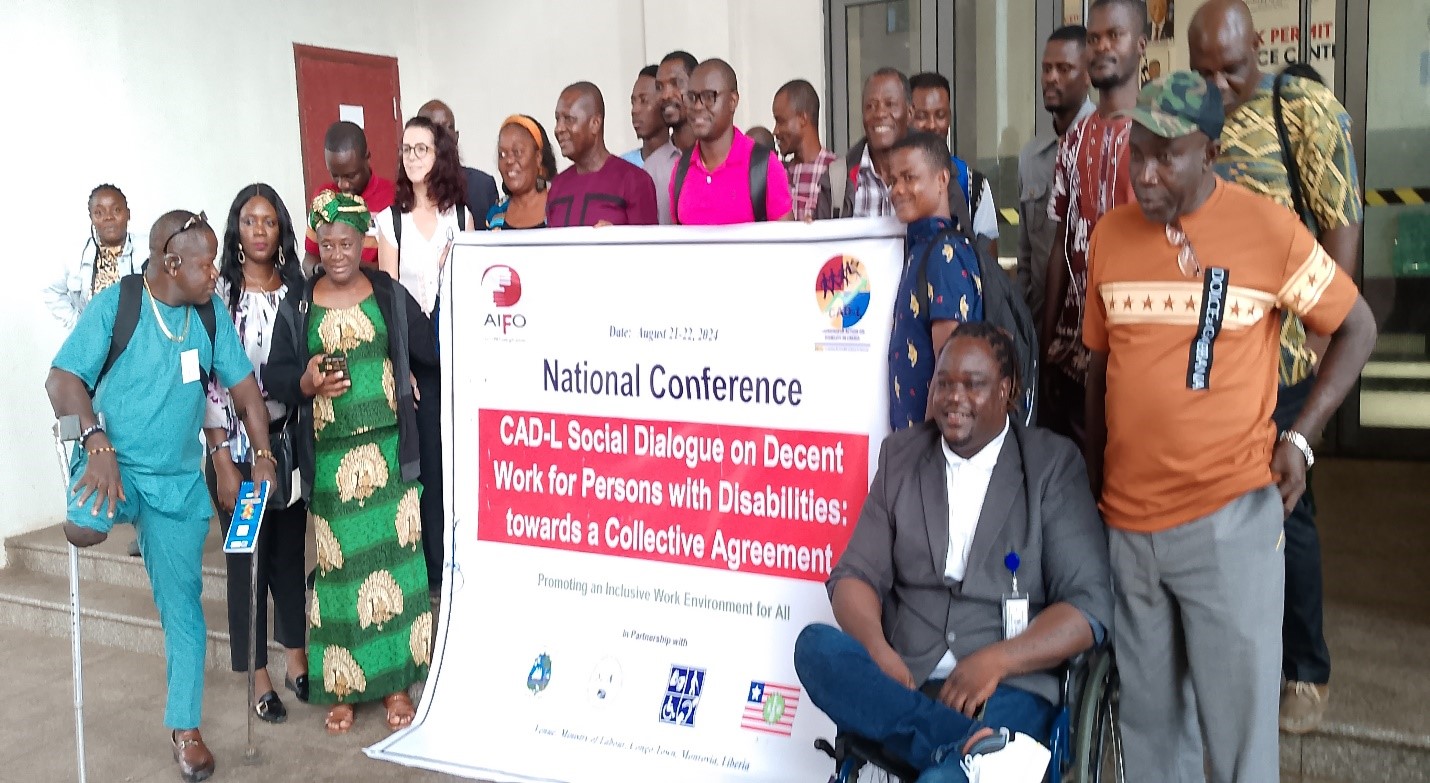
AIFO’s connection to the Liberian Government was done through a two-day (August 21-22, 2024) session titled “Social Dialogue: 1st National Conference on Decent Work for Persons with Disabilities”
The venue of the interaction was at the Ministry of Labour’s side of the EJS Ministerial Complex, located in Congo Town.
The Liberian Government was represented by: Ministry of Justice, Ministry of Labour, National Commission on Disabilities (NCD), Liberia Chamber of Commerce, Liberia National Police, and Liberia Immigration Service.
The Liberian private sector was represented by: National Union of Organizations for the Disabled (NUOD), and the Alliance on Disabilities.
The Diplomatic Community was represented by: European Union Mission in Liberia, Embassy of Sweden through the Swedish International Development Agency (SIDA), and Italy through AIFO.
On Day One, Speakers focused much on inaccessibility impediments for disabled persons in public buildings; on public vehicles; exclusion of disabled people on employment by public or private institutions looking for employees; and many other human rights issues.
The main session began with remarks by heads or representatives of invited institutions.
“Our disabilities should not be perceived as inability,” said Pastor Peter B.K. Flomo (visually impaired), president of the National Union of Organizations of the Disabled (NUOD)
Mr. Samuel Chu-Chu Dean, Sr., Executive Director of the National Commission on Disabilities (NCD) said past Governments often under-funded NCD.
“There is no Legislation now to mandate employers to add four percent of qualified persons with disabilities in their respective workforce as mandated by the NCD’s Act of 2005,” he said in a tone laden with lamentation.
The Liberia Labour Congress, through its female representative, Madam Ophelia N. Carpenter, Vice President for Operations, said the LCC had conducted interviews in five Counties—Montserrado, Bong, Lofa, Nimba, and Bomi—on non-disabled people’s negative perceptions about disabled people in agriculture, education, and other sectors.
She added that many of the non-disabled persons the LCC’s team spoke with in each County expressed the general mindset of incompetence by the disabled people, which is held by majority of other Liberians.
The representative of the Liberia Chamber of Commerce placed the task of ensuring disabled persons’ inclusion into each Governmental institution’s workforce squarely on the shoulder of the Civil Service Agency (CSA) of Liberia.
“The CSA is the Government’s arm charged with the responsibility to monitor all Government Ministries and Agencies on the number persons employed based on each person’s qualification. On employment of persons with disabilities, let’s start with Government’s institutions. Advocates on persons with disabilities with working qualification should engage the CSA on our brothers and sisters who are qualified to work,” he said.
The representative of the Coalition of the Alliance on Disability-Liberia (CAD-L) inclusion of persons with disabilities in a workforce automatically reduces their stress from being unemployed.
AIFO’s Chief of Party, Madam Laura Todescato, said her Institution will continue working with the Liberian Government, NUOD, and other Liberian pro-PWD institutions to improve the human dignity of Liberians with disabilities.
“Like disabled persons of other Countries, Liberians with disabilities can contribute to the development of their Country if the needed opportunities are afforded them,” the Italian indirectly urged Liberians in the audience.
The National Legislature, represented by a Chief of Staff from the Legislative office of Senator Thomas Yaya Nimely of Grand Gedeh County,
said the Lower and Upper Legislative Chambers sometimes discuss employments issues of Liberians with disabilities.
The LNP’s representative, officer Japheth Bayee Ja said a many of the human rights-related violation reports her institution receives from members of the public come from disabled people.
The representative of the United Nations Development Program (UNDP), Lovett Weah, visually impaired, stated: “We hope the discussions at this conference won’t remain on papers or in stakeholders’ mouths,” she said.
The representative of the Ministry of Gender, Children & Social Protection (MGCSP) advised people with no form of disability to treat persons with disabilities with empathy.
“The condition our brothers or sisters are in today might happen to any of us, with no disability, tomorrow,” he cautioned.
Mr. Ramon Tomza Vivanco-Mugarra, representing the European Union Delegation in Liberia, said the Diplomatic Mission has been working with the Liberian Government, AIFO, and Liberian Disabled People’s Organizations (DPOs) since 2021.
“Liberians with disabilities should be accorded dignified treatment anywhere they are,” he appealed to the community of bodily-intact persons.
The Swedish Embassy’s representative, who is the Embassy’s Program Officer, Madam Nikolina Stalhano, began by praising AIFO for producing the desired results from funding received.
The remarks session ended with the Ministry of Labour whose representative heralded the impartial inclusion-related supervisory role the Ministry had often played and will continue to do.
The Objective of the Workshop and Presentation Survey Results were handled by Madam Rebecca Stubblefield, AIFO’s Program Officer.
The Ministry of Justice, through its representative, Mr. Kutaka Devine Togba, Head of the MOJ’s Human Rights Division, suggested “creation of Laws that will mandate employers in both Governmental and private sectors to add qualified persons with disabilities to their workforce.”
The next segment was Panel Discussion: Presentation of results from Tripartite Partners’ Meetings. This session was coordinated by Mr. Sam McGill and Mrs. Ricardia Dennis (physically challenged), Tripartite Partners. Mr. McGill is former Regional Coordinator—for Bong, Lofa, and Nimba Counties—for the Independent National Commission on Human Rights (INCHR)
Several issues were flagged during the Presentations. Some of the issues were: barriers to entry for PWDs, Decent Work Act, the NCD Act, Challenges/barriers posed by the Liberian work environment for persons with disabilities, Human Rights Perspective, and attitudinal barriers.
Day One ended with Group Work/Presentation. This segment highlighted perceptual barriers against persons with disabilities for job and education.
The audience was divided into four groups.
One Group talked about Employment; another focused on Civil Society Organization’s involvement; another Group emphasized provision of Skill Trainings for PWDs; and another group stressed Publicity by the Media.
Day Two’s session began with recapitulation of Day One’s discussions and activities.
The recap was followed by presentations by groups—five. Group 1 was assigned to topic “Employment”; Group 2 took up topic “Public Finance”; Group 3 given topic “Awareness and Advocacy”; Group 4 accepted topic “Accessibility of PWDs in Public Places”; and Group 5 was given the topic “Education and Training”
Each group proffered solution to issues outlined in the Topic—like done with Group Presentation of Day One.
After each Presentation, members of the audience posed questions or proffered solution methods (recommendations)
“NUOD’s voluntary role will make its regular engaging public or private sectors on employment of PWDs difficult. The person appointed by NUOD won’t implement the engagement task if his or her family member is seriously ill on the day he or she is expected to meet the employer,” AIFO’s Chief of Party gave her opinion.
The event ended on the second day with remarks by partners.
“We hope the discussions during this conference won’t remain on papers,” said visually impaired Lovett Weah, representing the United Nations Development Project (UNDP).
“We will convene more conferences in the future. Our engagement should not only be in shade, but action” AIFO’s Chief of Party said during her end-of-conference remark.
Other speakers were: representatives of the UNDP; Ministry of Justice; NCD; and Elisha Nyuangar of the Sign Language Interpreters’ Union, and Madam Yaah Belleh Suah, member of the Nimba Couty-based Disabled People’s Organizations (DPOs)
Madam Josephine B.W. Geegboe served as Sign Language Interpreter of the event.
The Ministry of Gender, Children, and Social Protection has trained over fifty (50) Directors, Coordinators and Technical Staff of Gender and Social Inclusion Unit (GSIU) from five (5) implementing government ministries of the Liberia Women Empowerment Project (LWEP) under Component 4 of the project.
The Liberia Women Empowerment Project is a five (5) year US$44.6M women empowerment program implemented by the Ministry of Gender, Children, and Social Protection through a Project Management Unit and funded by the World Bank.
The training, which was held at the Corina Hotel in Monrovia from August 22-23, 2024, aims to strengthen public institutions involved in the project’s implementation to advance gender equality and women’s empowerment in Liberia.
The initiative brought together and enhanced the capacities of approximately 50 technical staff from the Ministries of Agriculture (MOA), Education (MOE), Internal Affairs (MIA), Health (MOH), and Finance and Development Planning (MFDP).
It highlighted key areas, including gender mainstreaming, monitoring, tracking and evaluating project outputs and outcomes indicators, conducting gender analysis using gender analysis frameworks, and understanding Gender-Based Violence (GBV) prevention and response mechanisms.
Speaking on behalf of the Minister of Gender, the Director for Research and Statistics at the Ministry, Samuel Ekyinabah stated that the achievement of gender equality which the project focuses on is a gradual process.
He recounted previous tasks specifically assigned to individuals according to their gender and in keeping with the tradition and norms of the society are now being collectively done by both genders irrespective of their affiliation.
“I want to encourage and challenge our participants to take advantage of the knowledge gained through this training and positively impact the society; these are little things that matter a lot,” Mr. Ekyinabah said.
At the climax of the training, the participants lauded the Liberian government through the Ministry of Gender, Children, and Social Protection for organizing the event as they individually shared their experiences with the media.
The Director for the Gender and Social Inclusion Unit (GSIU) at the Ministry of Agriculture Madam Catera Woods stressed that one major aspect of gender-based violence that is not overlooked by many in the society is attempted rape. “The most dangerous rape is attempted rape because once you make an attempt to rape the person, the person becomes vulnerable to self-harm due to the trauma”.
She also promised to take the knowledge acquired during the training to mentor others at the Ministry and train, adding that the trainer of trainer (TOT) initiative will educate those farmers involved in agriculture activities across the country about the kinds of Gender-Based Violence (GBV).
Also sharing her thoughts was the GSIU Director for the Ministry of Health, Madam Quitina Cooper-Davis. She stated that the training was timely and will enhance the way the GSIUs at all government institutions work with others and help identify the different forms of violence.
“The awareness for the kinds of violence is not at the peak that we as a government or even the public want it to be, and apparently that is why others see these kinds of violence as customary,” Madam Davis recommended to the government to amply and accelerate awareness on the forms of violence and the consequences for perpetrators.
She further called for the empowerment of women who, according to her, are mostly vulnerable or exposed to social and economic violence. Madam Davis believes the empowerment of women and girls will make them self-reliant and stable in providing their needs and wants thus reducing their challenge of social and economic violence from their male counterparts.
“If a woman or girl is doing something economically to empower herself, the old people have a way of calling that lady by attaching the name of her business or work at the end of her name, such as ‘Mary the bread seller’ or ‘Ma Korpo the mechanic’,” she stated.
Also, the GSIU Director at the Ministry of Education, Madam Lorpu G. Mannah promised to champion the training of others with the knowledge acquired, and take the message across all government high schools with the purpose of minimizing Gender-Based Violence in those learning institutions.
She also called on the Liberian government with support from its international partners, to decentralize the training in the remaining 14 political subdivisions of the country. “Taking this kind of training to the other counties will educate others who may not be aware of the existence of gender based-violence in schools”.
Madam Mannah further recommended to the Ministry of Gender, Children, and Social Protection to engage its international partners, including the United Nations Development Program (UNDP) to bring into effect, the Sexual Exploitation Abuse Police for the protection of all genders – males and females.
Support Independent Journalism
Your support helps FrontPage Africa continue delivering independent, credible, and impactful journalism. Every contribution strengthens our ability to investigate, inform, and hold power accountable while keeping quality journalism accessible to our readers.
Support our journalism or subscribe to receive the latest FrontPage Africa stories and updates.