Washington D.C. – The controversial rail-access deal between the Government of Liberia and Ivanhoe Atlantic—now before the Legislature for ratification—has suffered a major setback after a senior member of the United States Congress warned that the project could deepen China’s control over critical minerals in Africa.
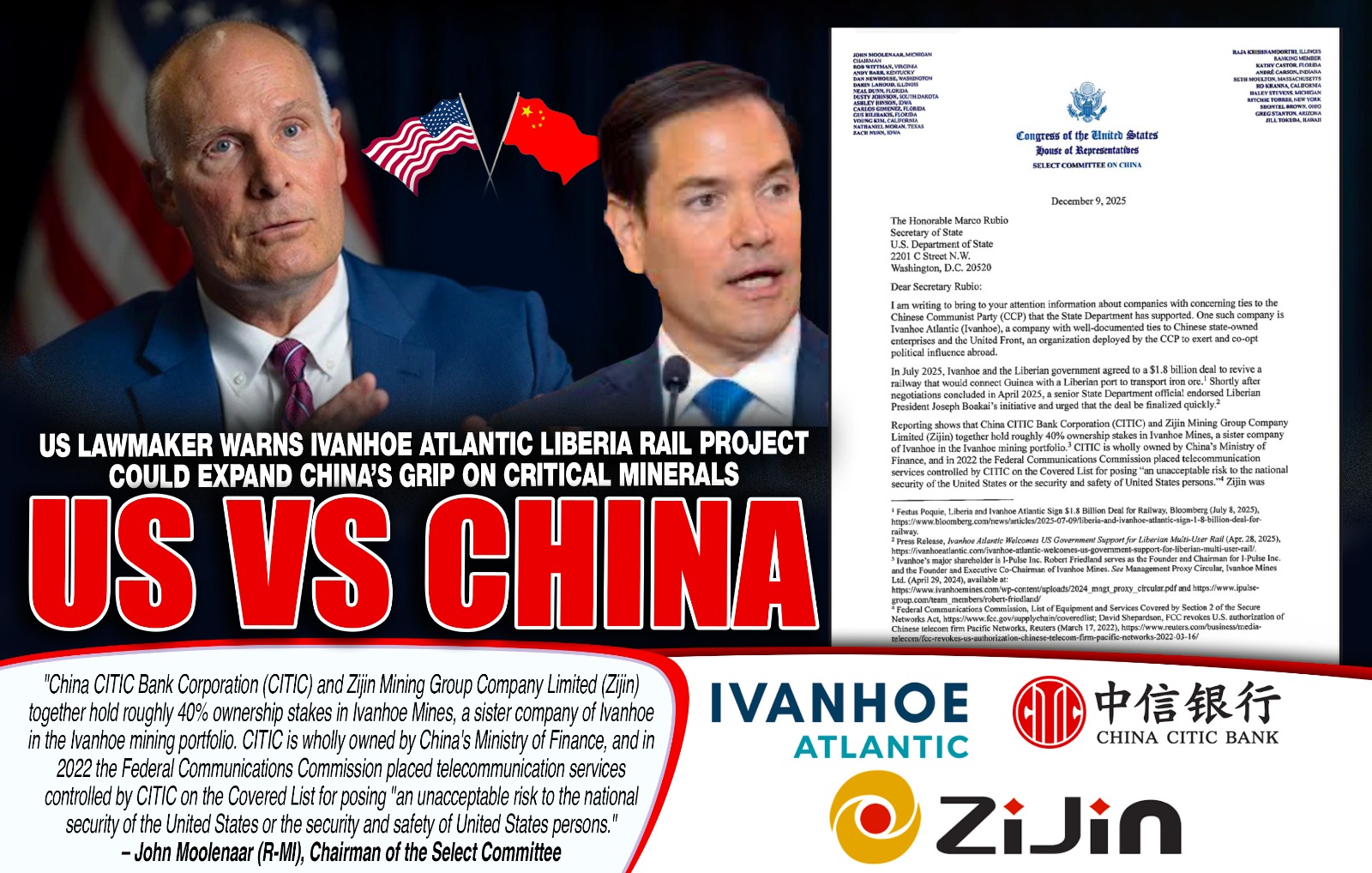
Congressman John Moolenaar (R-MI), Chairman of the U.S. House Select Committee on the Chinese Communist Party (CCP), raised alarms over the multibillion-dollar rail corridor, cautioning that U.S. government support for the project could “unwittingly strengthen Beijing’s global mineral chokehold.”
In a letter sent Tuesday to U.S. Secretary of State Marco Rubio, Moolenaar questioned the State Department’s favorable posture toward Ivanhoe Atlantic. The company is pursuing an ambitious rail-and-port system in Liberia and has reportedly received positive signals from American officials.
The project could be financed in part by the Millennium Challenge Corporation (MCC)—meaning U.S. taxpayer funds may be involved.
Moolenaar argued that Ivanhoe’s ownership structure includes major stakes held by Chinese state-linked companies, posing what he described as “serious geostrategic risks” at a time when Washington is attempting to reduce dependence on Beijing for global minerals.
Chinese State Influence at the Center of the Warning
According to Moolenaar, companies tied to the Chinese government collectively hold nearly 40% of the equity in Ivanhoe Mines, a sister company in the broader Ivanhoe portfolio.
He specifically cited: China CITIC Bank Corporation (CITIC) – wholly owned by China’s Ministry of Finance.
In 2022, the U.S. Federal Communications Commission placed CITIC-controlled telecom services on its national-security Covered List, calling them “an unacceptable risk.”
Zijin Mining Group Company Limited (Zijin) – one of China’s largest mining conglomerates.
In 2025, Zijin was placed on the Uyghur Forced Labor Prevention Act (UFLPA) Entity List over allegations of forced labor in Xinjiang.
“These intertwined ownership stakes demonstrate how the CCP uses indirect, minority-share investments in foreign mining firms to advance global dominance in mineral supply chains,” Moolenaar wrote. He described the strategy as part of Beijing’s long-standing “Two Markets, Two Resources” doctrine.
Why Washington Is Worried
The letter underscores growing U.S. unease over major African infrastructure deals—particularly those that affect minerals such as iron ore, lithium, gold, and rare-earth elements.
Liberia’s proposed rail and port corridor aims to unlock mineral exports from the country’s interior and serve neighboring Guinea. Its scale and location make it a strategic geopolitical asset.
Moolenaar urged Secretary Rubio to reconsider any U.S. government backing for the initiative until the implications of Chinese-linked ownership are fully examined.
Ivanhoe’s Structure and Expansion
Ivanhoe Atlantic operates within the broader Ivanhoe Mining portfolio, a multinational conglomerate known for major copper, nickel, and platinum projects. Despite marketing itself as a Western-led entity, a significant portion of its financial power comes from Chinese state-linked investors.
Analysts argue that the 40% equity held by CITIC and Zijin in Ivanhoe Mines gives Beijing indirect but meaningful influence over the entire Ivanhoe ecosystem.
The Liberia Rail Project: A High-Stakes Deal
In July, Liberia and Ivanhoe signed the Concession and Access Agreement estimated at US$1.8 billion to build and control a multibillion-dollar rail and port corridor intended to move iron ore and other minerals from Liberia and Guinea to global markets.
Backers argue the project will support Liberia’s multi-user rail policy, draw new international investment, boost regional trade and create jobs and open new economic corridors
However, the project’s potential reliance on MCC financing has placed it under heightened congressional scrutiny.
Mixed Reactions Back Home
In Liberia, debate over the Ivanhoe agreement continues to intensify. Senator Nya D. Twayen Jr. has openly rejected current form of the deal. In a statement, he said his office completed a comprehensive review of the Ivanhoe concession—alongside the ORANTO Petroleum agreement and a pending ArcelorMittal arrangement—and found the Ivanhoe deal scored just 77% compliance, far below his 85% threshold for approval.
He cited multiple concerns, including paving the Nimba–Guinea haulage corridor. Twayen insists the route must be fully paved, not left as dusty laterite.
- US$37 million advance payment: The senator warned that Liberia must not be held liable to repay this amount due to legislative delays.
- Rail operations framework: He demanded a clear, jointly agreed governance framework involving Liberia, Ivanhoe, and ArcelorMittal.
- Community Development Fund (CDF): Twayen called for stricter oversight and insisted the fund remain under direct government and community control.
“Effort has been made, but effort is not enough when the welfare of our people is at stake,” he wrote. “We will not endorse any agreement that does not fully meet required standards.”
Senate Inquiry Postponed
Meanwhile, the Liberian Senate on Monday suspended its public inquiry into the Ivanhoe Atlantic concession after Finance Minister Augustine Ngafuan and Justice Minister Oswald Tweh failed to appear.
The Senate Joint Committee on Transport, Lands, Mines & Energy, Natural Resources and Concessions was expected to examine whether Liberia complied with the Implementation Agreement between Liberia and Guinea, the governing instrument for all cross-border rail and port access.
The agreement outlines a strict two-step process including request for Eligibility vetted by Guinea and request for Access reviewed by Liberia.
It also established a joint Monitoring Committee, an Inter-Ministerial Committee, and a Technical Secretariat responsible for creating a standard access agreement template—designed to prevent unilateral action by either country.
What’s Next?
With pressure building from Washington and serious concerns emerging in Monrovia, all eyes are now on the Liberian Legislature. The central question remains: Will the Legislature ratify or reject the Ivanhoe concession?
Support Independent Journalism
Your support helps FrontPage Africa continue delivering independent, credible, and impactful journalism. Every contribution strengthens our ability to investigate, inform, and hold power accountable while keeping quality journalism accessible to our readers.
Support our journalism or subscribe to receive the latest FrontPage Africa stories and updates.