https://www.facebook.com/share/r/1GtHkh3SbV/
https://www.facebook.com/share/r/1J8JQHibou/
The Rule of Law: “Secret recordings do not become justice merely because they reveal a truth; their admissibility depends upon whether the law permits that truth to enter the courtroom. In every jurisdiction, the pursuit of evidence must remain subject to the rule of law.”
Privacy and Public Interest: “The courtroom must balance the public interest in discovering wrongdoing against the individual’s right to privacy. A recording may expose misconduct, yet its evidentiary value cannot, by itself, erase the legal protections surrounding its creation.”
Jurisdictional Differences: “What one jurisdiction admits as probative evidence, another may exclude as unlawfully obtained. The lesson is clear: justice is not governed by the recording alone, but by the legal principles that determine how, where, and under what circumstances it was made.”
Authenticity and Reliability: “A secret recording must still answer the ordinary demands of evidence: Is it authentic? Is it relevant? Has it been altered? And can its contents be fairly understood? The hidden nature of its creation neither proves its truth nor establishes its falsity.”
The Judicial Balance: “The admissibility of secret recordings is a test of judicial balance: protecting privacy without shielding wrongdoing, admitting relevant evidence without abandoning fairness, and ensuring that the search for truth never becomes a license to disregard the law.”
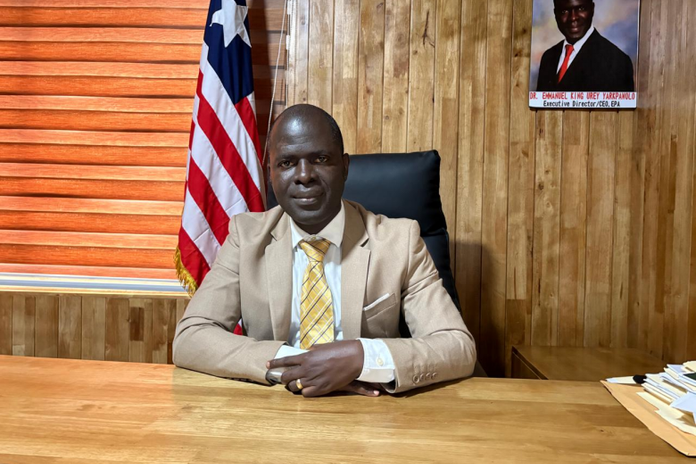
By: Austin S Fallah – A True Son of the Planet Earth Soil:[email protected]
In criminal justice, the rules governing the admissibility of evidence are fundamental to ensuring fair trials and just outcomes.
One intriguing topic within this framework is the admissibility of secret recordings, especially those made by private individuals, as evidence in a competent court of law.
The nuances of this issue vary across jurisdictions and can hinge on several factors, including the nature of the recording, the individuals involved, and the context in which it took place.
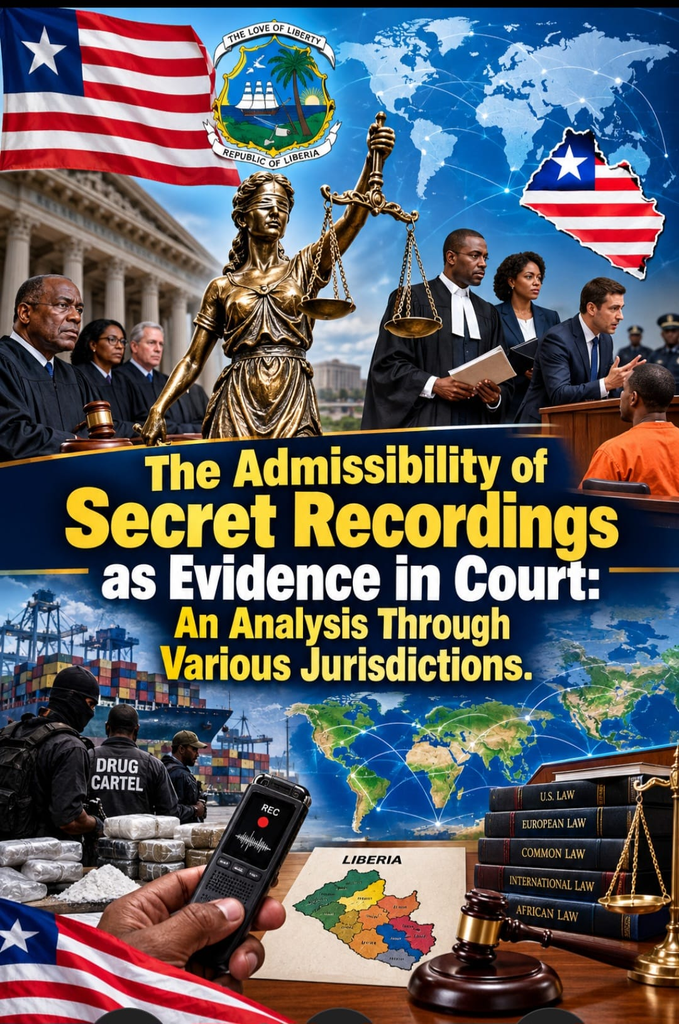
This disquisition will explore the admissibility of such recordings, the differences between law enforcement and individual recordings, and the specific implications of pursuing the legality of drug trafficking evidence in Liberia as a case study.
The Legal Framework Surrounding Secret Recordings:
Generally, the admissibility of secret recordings in court depends on national laws regarding privacy and consent.
In some jurisdictions, an individual can legally record any conversation they participate in without obtaining the other person’s consent.
This is known as “one-party consent.”
In the United States, for instance, federal law allows one-party consent recordings. Still, individual states have their own statutes that may require all parties in a conversation to consent to recording.
For example, California is a two-party consent state, meaning that all participants in a communication must agree to the recording for it to be admissible.
Conversely, other countries such as the United Kingdom employ stricter regulations, where recordings made without consent may not only be inadmissible but may also breach privacy laws.
Thus, the admissibility of secret recordings can fluctuate widely from one jurisdiction to another and may determine the outcome of criminal trials.
For instance, in R v. B (2018), the court held that audio recordings obtained without the permission of all parties involved were inadmissible because they violated privacy rights.
Examples of Recorded Evidence in Court Proceedings:
Despite stringent laws on secret recordings in various jurisdictions, courts have deemed notable instances admissible even when made unlawfully or without full consent.
In United States v. White, the U.S. Supreme Court ruled that a recorded conversation between a defendant and an informant, which did not require the defendant’s consent, could be used as evidence, highlighting an exemplary interpretation of one-party consent rules.
The courts reasoned that the informant acted within the law and that the overarching interest of justice required the evidence to be admissible.
Moreover, a common scenario occurs in drug trafficking cases where undercover operations lead to secret recordings of illicit discussions.
The notorious “Wire Taps” in United States vs. Scott, where law enforcement agents used electronic surveillance to gather incriminating digital evidence of organized crime figures, show how such recordings have been pivotal in securing convictions even when challenges arose regarding their legality.
Law Enforcement vs. Individual Recordings:
The difference between law enforcement recordings and individual recordings is substantial.
Law enforcement agencies operate under specific legal frameworks and protocols, often necessitating judicial oversight (such as obtaining warrants) before conducting surveillance or recording conversations.
Law enforcement’s primary focus is public safety and preventing crime, and they curate evidence to uphold justice.
Courts tend to view evidence collected by law enforcement favorably due to perceived accountability and adherence to legal procedures.
In contrast, secret recordings made by individuals may not have that same level of oversight or legal scrutiny.
These recordings can be obtained without following rigorous process-oriented guidelines, raising ethical and legal questions about privacy violations.
For example, if someone records a conversation without the other person’s knowledge, this may undermine the reliability of the evidence presented in court, given the potential for manipulation or selective use of the recording.
Hence, courts generally analyze the context of such recordings with critical scrutiny, focusing on privacy infringements and the motives behind their creation.
The Role of Video Recorders and Body Cameras as Evidence:
Video surveillance has become increasingly vital in contemporary legal proceedings.
Residential and commercial security cameras often provide invaluable footage of criminal activity that is admissible in court.
This is because of their objective nature; these devices record actions without bias or operator manipulation.
For instance, in the 2020 case of State v. Wright, CCTV footage was instrumental in securing a theft conviction because it provided unequivocal visual evidence of the crime in progress.
Similarly, law enforcement body cameras serve a dual purpose: they protect officers and act as a tool for accountability.
Footage from body cameras has been submitted as evidence in numerous trials, ensuring that proceedings are grounded in factual, unbiased recordings of interactions between law enforcement and civilians.
Body cameras not only strengthen cases against offenders but also help maintain public trust in law enforcement’s ability to exercise authority appropriately.
Limitations of Voice or Video Recordings in Court:
The admissibility of voice or video recordings can be limited for various reasons. Recordings from crime scenes, or those depicting illegal activity, obtained without proper authorization may violate privacy statutes and therefore be inadmissible.
The exclusionary rule, which disallows evidence collected through unconstitutional means, significantly limits prosecutors’ ability to use such recordings.
The challenge of providing reliable evidence through clandestine recordings is clearly illustrated in organized crime contexts. Often, recordings may be misconstrued or lack contextual clarity, raising questions about their authenticity.
For example, if a tape was edited or manipulated, its credibility could be significantly undermined, warranting its rejection in court.
As a general principle, courts prioritize the integrity of the evidence and, as such, tend to favor modes of acquisition tied to procedural protocols.
The Case Study of Liberia’s Drug Trafficking and the Legal Gray Areas:
When examining secret recordings within Liberia, particularly concerning drug trafficking and cartel activity, the landscape of legality becomes especially complex.
Law enforcement operations that involve placing an individual under surveillance to conduct recordings of suspected drug dealings raise critical legal questions.
In Liberia, as in many other countries, the legality of such actions centers on consent and the expectation of privacy.
Liberian law emphasizes protection against unlawful searches and seizures, though less explicitly than some Western legal statutes.
For instance, the Liberian Constitution protects citizens’ privacy rights.
However, exceptions are made regarding investigations into drug trafficking, which is one of the most pressing issues facing the nation, owing largely to the influence of powerful drug cartels.
As a case study, if law enforcement were to wiretap an individual suspected of drug-related discussions in Liberia, the legality of that action would depend significantly on whether judicial authorization was obtained before the recordings.
Given existing laws on privacy, a lack of such authorization could render the recordings inadmissible in court, potentially obstructing the prosecution’s case against drug traffickers.
Compared with international law, many nations have specific legal frameworks governing electronic surveillance, but the coherence of these regulations within Liberia remains somewhat ambiguous.
The international community, particularly in relation to drug trafficking, recognizes the necessity for aggressive law enforcement measures to combat the scourge of illegal drugs.
This requirement, however, must be balanced with the need to safeguard citizens’ privacy rights under the law.
Secret recordings made during criminal discussions can be admissible as evidence in court, provided they comply with jurisdictional laws on consent and how they were obtained.
The contrast between individual and law enforcement recordings highlights ethical and legal considerations that are paramount to the integrity of justice systems globally.
As illustrated through examples and case studies, the efficacy of such evidence is highly contextual and depends on the legal framework governing privacy, consent, and surveillance in each jurisdiction.
The interplay between the necessity for law enforcement to curb criminal activity and the corresponding need for individual privacy rights remains a subject of legal contention, particularly in settings such as Liberia, where drug trafficking poses significant challenges.
Through examining this complex issue, a deeper understanding of the nuances that define the admissibility of evidence in court emerges, one that will undoubtedly continue to evolve as societal norms and technologies advance.
Support Independent Journalism
Your support helps FrontPage Africa continue delivering independent, credible, and impactful journalism. Every contribution strengthens our ability to investigate, inform, and hold power accountable while keeping quality journalism accessible to our readers.
Support our journalism or subscribe to receive the latest FrontPage Africa stories and updates.