by Budoin-Brutus Cooper, CPG, PH.D.
- Abstract
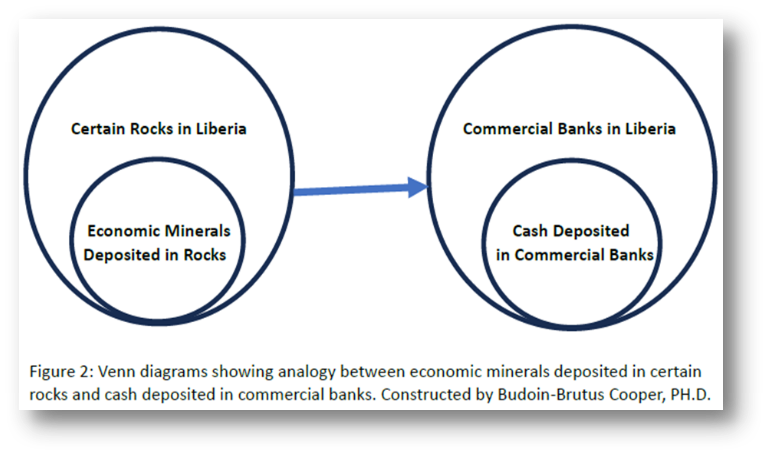
Instead of siting and waiting to collect annual royalty & taxes, Liberia should form a Natural Resources Investment Corporation (NRIC) for profit. This company should have four (4) main divisions: mineral exploration & mining; energy exploration and production; forest products & reforestation management; and human resources & marketing. Liberia should change or enforce existing laws to make NRIC easily competitive. Iron ore and gold deposits are associated with other rare minerals and rare Earth chemical elements-REEs. Some of these REEs and rare minerals are classified and listed as critical minerals and critical raw materials by developed countries. The current rate of continuous mining and exporting minerals is not sustainable for Liberia. Certain rocks in Liberia are analogous to commercial banks in Liberia. Economic minerals deposited in certain rocks in Liberia are viewed as analogous to inherited cash deposited in bank saving accounts. The “cash” aka minerals deposited in those “banks” aka rocks are inherited by and for Liberians today, and for unborn generations of Liberians.
Build, operate, & maintain a steel mill in Liberia. The steel mill should process iron ore to make iron & steel for value addition. Mineral development agreements-MDAs to mine iron ore should be substantially revised to include: building furnaces (e.g. electric arc or basic oxygen type) and necessary facilities to process iron ore into iron, steel, and products such as: structural beams, rebars, pipes, columns, sheet metals, pig irons etc. Processing iron ore here in Liberia to make iron and steel products would: 1) eliminate the cost of transportation to export; 2) create high paying jobs for Liberians; 3) generate more revenue for the Government; 4) recover and sell rare metals from processing iron ore to make steel.
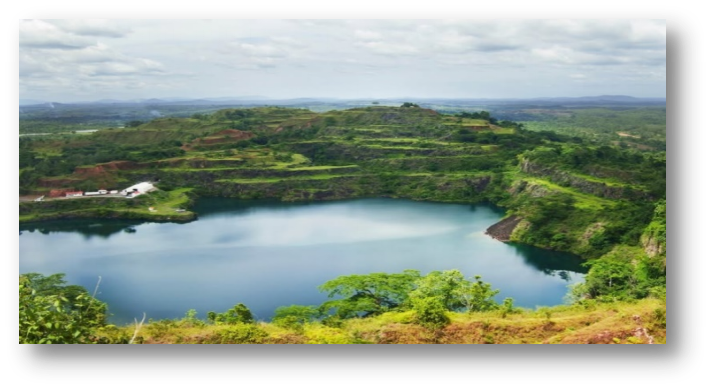
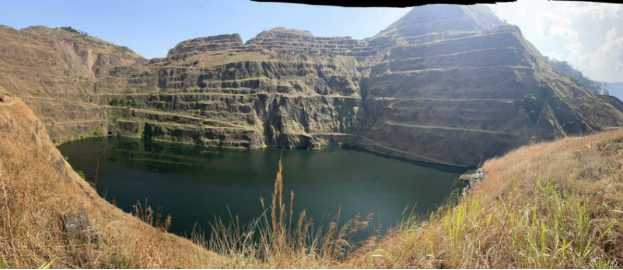
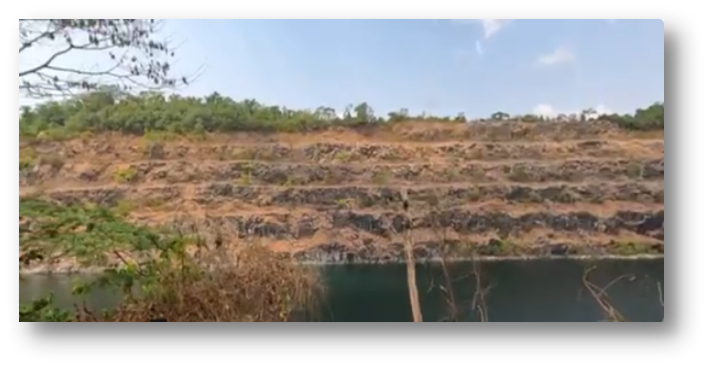
The MDA should be revised so that each mining company posts a contingency surety bond in the amount of one million dollars ($1,000,000) per year for 10 years at a minimum. When the mineral deposit at each mine is depleted, the mining company will have good reason ($10,000,000 on hold) to restore the former mine pit according to Liberia’s specifications; or forfeit $10,000,000 or its independently determined pro-rated remediation to provide environmental safety. Liberia should have required surety bond when Liberia Mining Company-LMC started mining at Bomi Hills in 1951. Since there was no surety bond requirement in 1951, LMC depleted high grade iron ore and closed the mine at Bomi Hills in 1977. Examples of several holes left at Bomi Hills, LAMCO and other mines are in Figures 5 to 7.
Banded iron ore formation similar to those at former LAMCO, Bong, and NIOC mines were formed by similar geologic processes worldwide. Banded iron ore formation at the Mbalam Iron Ore District in Cameroon, Congo, Gabon (Mavongou et al, 2023), and the Sherman Mine in Ontario, Canada (Bowins & Crocket, 2025) are associated with Monazite and Xenotime minerals and rare Earth elements-REE. Monazite and Xenotime minerals are sources of REE. REE have important applications in today’s technologies such aerospace, superconductivity, computers, batteries, catalytic converters, electric vehicles, and cell phones (U.S.G.S., 2014). What if gold, diamond, and iron ore mines operating under existing MDAs are also mining and exporting associated minerals and chemicals classified as “iron ore”, “gold” and “diamonds”?
Sustainable mineral deposits development in Liberia should replace the current practice of mining mineral deposits simply for exports. For each economic mineral deposit, policy makers should take inventory to determine the approximate total mineral need of the current Liberia generation; then institute honest conservation measures to account for the mineral needs of future generation of Liberians. That should help to minimize the risk of impairing, endangering, or jeopardizing the ability of future generations of Liberians to meet their mineral needs and goals.
Income from mining, exploration fees, exporting minerals, including land and ocean block leasing should be invested into sustainable energy sources such as solar, wind, and geothermal energies. The energy from this investment can then be sold for profits. Liberia should perform geologic mapping, geophysical surveys, update topographic maps and acquire new sets of aerial photographs. Accurate geologic information is essential to exploration and discovery of new minerals. Such cultivated information can be monetized for profit.
- Introduction
Due to geologic processes and most likely providence, the Liberian people inherited certain economic mineral deposits (aka mineral deposits). This policy brief hypothesized that policy makers are transient managers of all inherited economic mineral deposits in Liberia. Mining and exporting minerals for sale without processing them in the country to add values keep Liberia at the bottom of the global mineral supply chain. According to the United States Geological Survey-USGS (USGS, 2025), one fundamental characteristic of countries at the bottom of the Global Mineral Supply Chain is mining and exporting minerals to foreign countries for processing before sale. Leading mineral mining and producing countries tend to have very little to no mineral processing facilities. The same is also true for Liberia. This policy brief is intended to educate, advise, and help modify Liberia’s existing Mineral policy. Instead of waiting to collect nominal annual royalties, land rents, and other fees as the only means of earning income from inherited mineral deposits, this paper recommends the Government of Liberia form and operate Liberian Natural Resources Investment Corporation-LNRIC for profit.
Since all rocks in Liberia do not have anomalous concentrations of minerals such as gold, diamond, and iron ore, it is appropriate to take inventory and determine how much of each mineral deposit we have in Liberia. Reason follows. Each mineral deposit in certain rocks should be viewed as cash deposited in a commercial bank (rock) account. Each week of mining minerals should be considered as a week of withdrawing cash from the bank (aka rock). Before going to the bank to withdraw cash each week, it is reasonable to check your bank account balance first! To keep mining and exporting minerals without taking inventory of each mineral deposit amounts to withdrawing cash from the bank without first checking your bank account balance. Liberia should first take inventory of each mineral deposit before mining.
The goal of this research is to encourage the Liberian people (aka Government) to positively change from: a) waiting to collect insignificantly small annual royalty and taxes as the only means of earning money from the sale of our inherited minerals; b) lacking active participation (aka sit and do nothing) to form and operate the Liberia Natural Resources Investment Corporation-LNRIC for profit. c) watching and noting mining companies haul & sell our minerals weekly, while we wait annually to collect nominal royalty and taxes. In other words, foreign companies make huge sums (money) weekly from selling Liberia’s inherited minerals for themselves, and Liberia waits for the end of each year to earn insignificant income, a pure lose-win state.
Excluding the abstract, this policy brief is divided into 4 interrelated sections: 1) policy issue or problem description; this includes data and proposed policy research questions; 2) current state of research, is a summary of selected publications related to mineral production and short comings of existing research publications; 3) findings and discussions which contains a list of research findings, followed by analyses including scientific justifications for policy recommendations; and 4) policy options or recommendations.
- Policy Issues: Problem Descriptions
The Central Bank of Liberia-CBL published a quarterly report entitled: Financial and Economic Bulletin (Central Bank of Liberia, 2025). This research selected mineral export data from the Central Bank of Liberia quarterly reports, and compiled data as summarized in Table 1 below. Qualitative assessment of the data in Table 1 below suggests that from 2016 to 2025, yearly exports of gold increased substantially, whereas diamonds export peaked during 2018 and gradually decreased thereafter. Iron ore export appeared to gradually increase over this ten year period. Based on results from a review of selected data for the last ten years of Central Bank of Liberia quarterly reports, it appears that the current economic mineral management policy of Liberia is to mine and export minerals. The Government of Liberia published “Towards Liberia Vision 2030, National Development Plan (aka The Plan) 2025-2029 (Ministry of Finance and Development Planning, 2025). Page 11 of the plan acknowledged concession-driven economic growth in solid mineral and other sectors without value addition. In other words, solid minerals such as gold, diamond, and iron ore are exported without processing in Liberia for value addition, losing opportunity to create jobs and increase much needed government revenue.
| Table 1: Summary of Gold, Diamond, and Iron Ore Exported from Liberia | |||
| Year | Gold, Ounces (lbs). | Diamond, Carats | Iron Ore, Million metric tons |
| 2025 | 460,953 | 35,751 | 14.88 |
| 2024 | 442,165 (27,635.3 lbs.) | 48,073 | 5.24 |
| 2023 | 438,401 | 56,844 | 4.98 |
| 2022 | 276,974 | 55,392 | 5.05 |
| 2021 | 209,648 | 50,439 | 3.81 |
| 2020 | 129,314 | 50,778 | 4.881 |
| 2019 | 162,935 | 55,936 | 3.535 |
| 2018 | 234,911 | 75,554 | 3.508 |
| 2017 | 9,1685 | 60,637 | 1.605 |
| 2016 | 3,389 | 42,498 | 1.17 |
Important Notes: 1) As of July 7, 2026, second quarter report: Financial & Economic Bulleting for 2016 was not available on Central Bank of Liberia website. 2) 1 carat equals .2 gram and 454 grams equal 1 pound; 3) .0353 troy ounce of gold = 1 gram of gold. The CBL quarterly report did not distinguish troy ounce (ozt) from standard ounce (i.e. avoirdupois ounce). Troy ounce is used for weighing precious metal such as gold, silver, platinum, etc.; and standard ounce (avoirdupois ounce) is used for weighing food and shipping. One (1) Troy ounce = 31.10 grams, and 1 standard ounce = 28.35 grams. Which of the 2 units of ounce is used in the Central Bank of Liberia quarterly reports? The difference between the two units is 2.75 grams.
Page 79 of the National Development Plan 2025 to 2029 revealed that poorly negotiated Mineral Development Agreements (MDAs) which favor Investors (who are essentially Buyers turned Sellers / Suppliers in Liberia’s competitive landscape) resulted in environmental degradation, inadequate revenue capture, and limited community benefits. Based on professional work experience at the then Ministry of Lands, Mines and Energy, soil excavated from all major mining pits from the early 1950s (LMC mine 1951) to 1989/90 (closing of LAMCO/Bong Mine) were stockpiled near the same old mine pits. Similar to NIOC’s mudslide in Liberia where 160 people were reportedly missing, the risk of yet another mudslide is very high and imminent across the region. Reason follows. Computer models from climate change predicted very high rainfalls and soil erosivity in Liberia (Adeyeri, 2024). A summary of research questions follows.
- Without processing in Liberia for value addition, are the current rates of mining and exporting mineral deposits such as iron ore, gold, diamond and black sands sustainable?
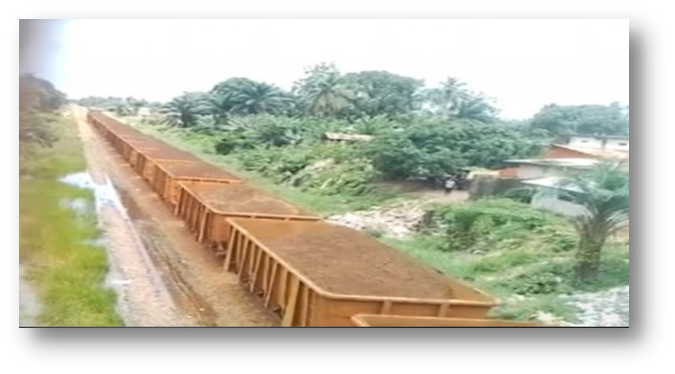
- Prior to exporting, is the Government of Liberia performing statistically representative sampling of “iron ore” and laboratory analyses for high value associated minerals and other rare Earth chemicals? In other words, how sure are we that the rail cars (see Figure 1 below) contain and are only hauling “iron ore”? Some rare metal elements such as manganese, niobium, vanadium, phosphorus, and minerals like monazite are contained in iron ore (Inoue, et al, 2010).
- How about: a) performing geologic mapping and geophysical survey to update existing information on minerals & petroleum potential of the entire Liberia; b) conducting an inventory of economic mineral deposits and approximating the mineral needs of the current generation of Liberians; and c) applying the principle of intergenerational equity to account for the mineral needs of future generation of Liberians.
The current rate of continuous mining and exporting minerals is not sustainable in the long term. The United Nations Sustainable Development goal #12 deals with responsible production and consumption pattern (https://sdgs.un.org/goals ). With respect to continuous mining and exporting minerals, and to minimize the risk of bankrupting future Liberian generations, Liberians today should first determine their actual need for each mineral deposits. How much gold, how much diamonds, how much black sand and iron ore do the current population of Liberia actually need?
- Does MDAs between the Government of Liberia and gold mining companies require the gold mining companies to report the weight of gold in a specific unit of weight measure? In other words, did the Liberian Government require gold to be reported in pound, gram, ton, ounce or kilogram? “The devil is in the details!”
Economic minerals deposited in certain rocks in Liberia should be viewed as cash deposited in commercial banks (i.e. rocks) saving accounts in Liberia. Prior to cash withdrawal from a bank account (a/c), it is reasonable to first determine how much cash is available in that bank a/c. To keep mining & exporting minerals without first quantifying available economic mineral inventory, amounts to continuously withdrawing cash from a bank saving account without checking available cash balance. In summary, 1) Liberians should first determine their approximate mineral needs; and 2) determine how much minerals are on hand for Liberians today and secured for its unborn generations. The principle of sustainability suggests that today’s generation should meet their needs without compromising the ability of future generations to meet their needs. Liberians today should comply with the principle of intergenerational equity (Kourides, 2025).
- Current State of Research
In March of 2010, the Government of Liberia published a policy document entitled: Mineral Policy of Liberia (MLME, 2010). The vision statement in this document is cut and pasted here for easier reference: “Equitable and optimal exploitation of Liberia’s mineral resources to underpin broad-based sustainable growth and socio-economic development”. This mineral policy document discussed a sustainable and well-governed mining sector that is inclusive, environmentally friendly, and socially responsible. The policy stated that mining in itself is not technically sustainable, as mineral deposits are not finite national assets. It is stated that mineral extraction can indirectly become justifiable in so far as it catalyzes sustainable economic activity in other viable sectors such as the re-investment of the resource rents into sustainable activities. This last statement is similar to item 6 under recommended Policy Options listed below. For the purpose of sustainable mineral deposit management and intergenerational equity, items 1 to 4 of the proposed policy recommendations were not found in Liberia’s National Mineral Policy document.
The United Nation Climate Action home page give a definition: “Climate change refers to long-term shifts in temperatures and weather patterns. Such shifts can be natural, due to changes in the sun’s activity or large volcanic eruptions.” (U.N. Climate Action, 2025). Temperature and weather patterns as used here refer to atmospheric temperature and weather on planet Earth. The impacts of climate change on Liberia and its development are the topic of a World Bank Group report (2024): “Liberia, Country Climate and Development Report-CCDR.” A statement on page 6 of the CCDR reads: “Changing precipitation patterns are expected to lead to more frequent and unpredictable intense rainfall events.” The executive summary of this CCDR concluded: “Global climate change poses an existential threat to peace and prosperity in Liberia.” Many factors leave Liberia particularly vulnerable to climate change. This review found no recommendation suggested to prevent dangerous landslide at former mining areas due to combination of excessive rainfalls and stockpiled unconsolidated soil. Complete reclamation of old mine pits was not discussed.
Adeyeri, et al (2024) published an article in the Science of the Total Environment: “Climate change is intensifying rainfall erosivity and soil erosion (i.e. natural removal of soil from one location to another) in West Africa.” Rainfall erosivity is the ability of rainfall to cause soil erosion or soil loss (Nearing, M. 2017). The 10 West African countries selected for this study were: Nigeria, Ghana, Liberia, Sierra Leone, Guinea Bisau, Ivory Coast, Senegal, Gambia, Togo, and Benin. This study used historical meteorological data (e.g. rainfall, major storm, air temperature) from 1982 to 2014. The focus of their study was on impacts of climate change, rainfall, and soil erosion in Liberia and selected West African Countries. Results from computer models concluded that the southern regions of Guinea-Bissau, Guinea, Sierra Leone, Liberia, and Nigeria are projected to receive the highest mean annual rainfall in both near- and far future periods. It was concluded that southern Nigeria, Liberia, Sierra Leone, and southern Guinea are identified as most exposed to soil erosion due to high erosivity. This review found no evidence of, nor mitigating recommendations for resiliency to overcome impacts of climate change on sustainable mineral deposit management. There were no mitigating actions to foster the prevention of dangerous landslide due to predicted excessive rainfall on unconsolidated soil stockpiled at all old mine pits in Liberia, nor suggestions for reclamation of old mines. Finally, Togbah (2024) published climate change vulnerability research results for Liberia. Results from Togbah’s are similar to Adeyeri (2024) and the World Bank Group (2024).
Towards Liberia Vision 2030: Liberia National Development Plan 2025-2029 (aka The Plan) is published by Liberia’s Ministry of Finance and Development Planning, 2025. Page 14 acknowledged Liberia’s rich natural resources like gold, diamonds, iron ore and other minerals; and, accurately argued that “Effective management and sustainable exploitation of these resources can significantly contribute to revenue generation and (national) development.” Last paragraph on page 55 includes an assertion that mineral beneficiation and other activities have potential for private sector investment. The plan suggests revision to MDAs. This review found no evidence of mineral inventory, construction of steel mill to process iron ore to make iron, steel, recover associated rare metals from steel making process, nor conservation efforts to account for the creation and establishment of sustainable intergenerational equity for Liberia.
Dieudonne C. et al (2013, p. 157) documented evidence of the occurrence of rare Earth elements within iron ore deposits in Southern Cameroun. Additionally, documentary evidence of the association of iron ore processing and rare Earth elements and minerals was reported by the United States Department of Interior-Bureau of Mine (Vierrethur & Cornell, 1993). Mine tailings (waste materials) from the processing of iron ore at Pea Ridge Mine in Missouri contained rare Earth elements-REEs such as Cerium-Ce, Lanthanum-La, Neodymium-Nd, Yttrium-Y and REE- minerals such as monazite, apatite, rutile and xenotime. It was concluded that iron ore mine tailings at Pea Ridge Mine contained elevated sources of REEs. Efficient recovery of REEs from the iron ore tailings was the main drawback in 1993. Inoue et al (2010) page 448 and Table 3 provided more documentary evidence that iron ore contains rare metal elements; and that manganese-Mn, Vanadium-V, and Niobium-Nb are recovered from iron ore using iron and steel making processes. In other words and during the processing of iron ore to make pig iron and steel products, critical REEs are recovered. Please see below under Findings for the applications of REEs which includes electric vehicles. Abaka-Wood et al (2022) also provided the most recent documentary evidence of the recovery of REEs from iron ore tailings. Finally, Djagre et al (2025) also documented that gold mineralization in the Ivory Coast are associated with higher concentrations or enrichment of REEs.
- Findings & Discussion
- Findings
- “Some rare metal elements such as manganese, niobium, vanadium, phosphorus, and minerals like monazite are contained in iron ore” (Inoue, et al, 2010). There is ample evidence that REE and other valuable chemicals are being recovered from iron ore processing to make steel.
- Liberia National Development Plan 2025 to 2029 acknowledged (page 11) that with respect to its solid minerals sector and other areas, Liberia’s economic growth is largely concessions-driven with no value addition. Table 5 (Mineral Production in Liberia) on page 79 of Liberia National Development Plan 2025 to 2029 listed primary minerals mined under existing MDAs. Notably, there is no account nor evidence of any recovery of associated valuable minerals nor REEs chemicals.
- This research found no evidence of the existence of a Liberia-owned and operated Natural Resources Investment Corporation-NRIC. The National Development Plan has no recommendation for such a government- owned and operated company.
- By processing iron ore to make iron and steel in Liberia, rare metals such as manganese, vanadium, niobium, phosphorus and mineral like monazite can be recovered. Monazite contain rear Earth elements-REE. Niobium and other REE in monazite have key applications in electronics, cell phone, aerospace, medical implants, electric vehicles etc. (Inoue et al, 2010; Balaram, V. 2019). Gold mineralization in the Ivory Coast is associated with REEs and other rare minerals (Djagre et al., 2025). The rocks and tectonic origin (i.e. forces, fracture, deformation, and structure) of Liberia and the Ivory Coast are similar (Brownfield, 2016).
- Developed countries such as the USA (U.S.G.S., 2025), and the European Union ( EU, 2022) maintained and updated lists of Critical Minerals and Critical Raw Materials. Some REEs and rare metals which are classified as Critical Minerals and Critical Raw Materials are also associated with iron ore and gold deposits.
- Summary of data (see Table 1 herein) from the Central Bank of Liberia quarterly reports indicate that gold, diamonds, and iron ore mined in Liberia are exported to foreign countries. Importantly, the weight of gold reported by the Central Bank of Liberia is ounce. In commerce, there are two significantly different types of ounces: One type of ounce which is called Troy Ounce (ozt) is reserved only for trading precious metals such as gold, silver, platinum etc. A second type of ounce is the standard ounce-oz, (aka avoirdupois ounce). The standard ounce is used for trading food and shipping. One troy ounce equals 31.10 grams; and one standard ounce equals 28.35 grams. The difference between troy ounce and standard ounce is 2.75 grams or nearly 3.0 grams. Which units of gold is reported to and also reported by the Central Bank of Liberia? The standardization of, accounting of, and transparency of reporting Liberia’s gold is a salient topic for investigation, research, and policy formulation.
- Discussion
The principle of intergenerational equity (Kourides, 2025) requires Liberians today to assume the role of responsible stewards, keepers, and managers of its current economic mineral deposits for current and future Liberians, that is those Liberians yet to be born. This is intended to secure current mineral endowment utility and safeguard future prosperity for the Liberian Nation collectively and all its peoples. For these compelling reasons, economic minerals deposited in certain rocks in Liberia should be viewed analogous to cash deposited in a commercial bank (aka rock) saving account. In other words, certain rocks within the borders of Liberia should be viewed as if they were commercial banks; and, economic minerals deposited in those rocks are equivalent to cash deposited in commercial bank saving accounts (see Figure 2 below). Liberians, by virtue of providence inherited these minerals deposits or cash deposited in rocks from our forefathers such as Benjamin J.K. Anderson, Elijah Johnson, Hilary Teage, J.J. Robets, King Boatswain, etc. (https://liberiadata.com/know-this, 7/2026).
Revenue generation from (1) annual royalty and (2) land rent for mining minerals is a process used by policy makers to withdraw cash from the aforementioned bank accounts without any evidence of mineral or cash “reserved” for future generations. To continuously mine (extract), export, and sell minerals without mineral inventory data is similar to continuous withdrawal from bank saving accounts without first knowing the available saving account balance in the bank. This practice challenges the unsustainability of this activity. In summary, the principle of sustainable development within a nation asserts that the current generation should meet their legitimate needs without jeopardizing or damaging future generations’ ability to meet their needs (UNDP, 2025). The United Nation Development Program’s Sustainable Development Goal #12 deals with responsible production and consumption patterns.
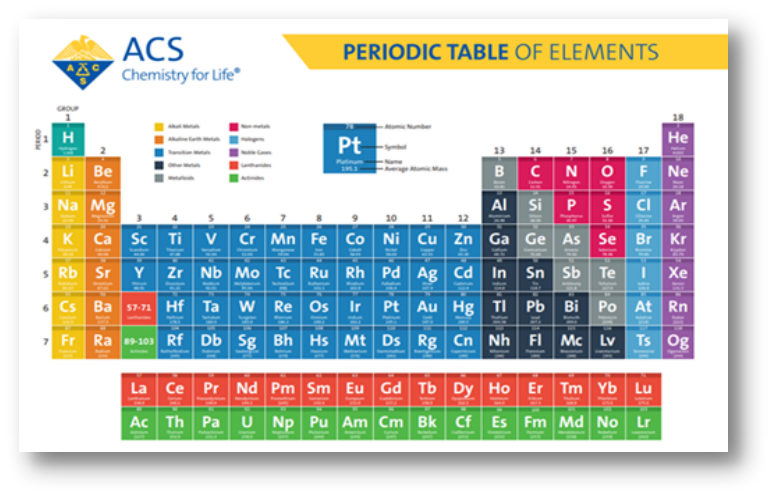
Planet Earth is a whole system. This Earth system consists of 5 interacting components (NASA, 2003): Hydrosphere (i.e. water in all forms), atmosphere (air and other gases), biosphere (all living organisms), geosphere (minerals, rocks & soils), and cryosphere (frozen water/ice). The processes within some components, and interactions among components of Planet Earth over time (million, and billions years) led to the formation of mineral deposits, such as iron ore deposits, petroleum deposits, gold deposits, coal, diamonds, and fertile soil formation, (Wicander & Monroe, 2016). Rocks are made of natural minerals and minerals consist of chemical elements. Based on similarities of properties, the chemical elements are grouped and arranged in a table known as the Periodic Table of Elements (see Figure 3 below). Within soil, rocks and minerals on Earth, similar chemical elements on the Periodic Table formed similar mineral deposits. For instance, platinum (Pt) mineral groups including gold, iron, Pt, Pt-Fe alloys, sperrylite, and other minerals are documented (Oberthur, 2014).
Geologic processes which led to the deposition and enrichment of iron ore, gold, lead, zinc, platinum and other minerals are not adequately efficient enough to single out, separate, and pack iron ore, gold, or other metals in a rock by itself. Geologists have found iron ore deposits with manganese minerals associated. Similarly, copper, lead, zinc and silver deposits are known; gold and platinum deposits are also documented (Janisch, 1986). Iron ore deposit in Cameroun is reportedly associated with monazite and other minerals containing rare Earth chemical elements (Dieudonne, 2013). Is it then conceivable that all iron ore mining companies in Liberia could have also mined and exported associated minerals and other chemicals as well? Most likely, YES (with emphasis). “Some rare metal elements such as Manganese, Niobium, Vanadium and Phosphorus are contained in iron ore”; Inoue et al (2010); Dieudonne C. et al (2013); Vierrethur & Cornell (1993). Gold mineralization in the Ivory Coast is associated with high enrichment of REEs (Djagre et al, 2025).
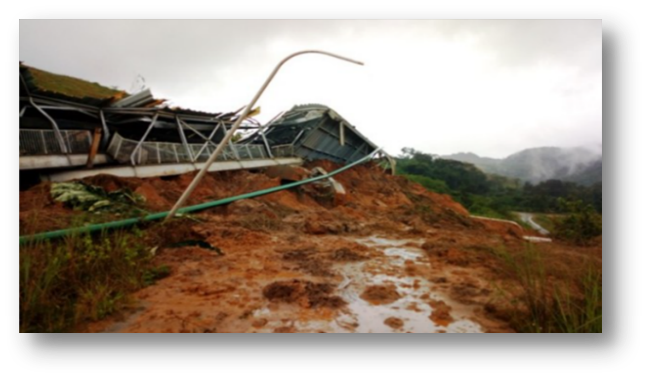
Iron ore mining in Liberia started in (random order) around 1951 with the Liberian Mining Company-LMC, followed by Bong Mining Company-BMC in 1958, National Iron Ore Company-NIOC in 1961, and Liberian-American-Swedish Mining Company-LAMCO from 1951. LAMCO closed in 1989/90. Loosed soil and rocks excavated from each mine pit are stockpiled near each mine pit. Excessive rainfalls are predicted for Liberia and other West African countries. This rainfall prediction is based on documented recent climate change computer modeling (Adeyeri et al., 2024; World Bank, 2024). When rain water infiltrates unconsolidated soil, rain water adds weight to unconsolidated soil, internal friction (a force) among soil grains can be exceeded, and then soil grains begin to float (Lutgens & Tarbuck, 2016). Dangerous mudslide/landslide will result as shown in Figure 4 below. A more deadlier mudslide occurred at Bomi Hills mine back in October 1982. All mining companies of necessity should be required to deposit surety bonds in the amount of $1,000,000 a year for 10 years, per closed mine pit. Any mining company that fails to dutifully, timely, and responsibly reclaim old mine pits according to Liberia’s specifications would forfeit a minimum of $10,000,000 to the Liberian Government. This measure is a safety deposit against contingencies and is inclusive of all cost related to restoring closed mines and reclaiming sites.
- Policy Recommendations/Options
- Liberians (aka referencing its Government) should not passively idle and wait for annual royalty and rent money for compensation of its valuable mineral endowments worth billions of dollars; while unwittingly and unknowingly transferring its substantial national mineral wealth to foreign corporations. While Liberia is waiting annually to collect penny on the dollar royalty, foreign corporations are digging, hauling, and selling Liberia’s inherited minerals weekly for substantial unmitigated sums. Foreign corporations who mine on Liberian soil operate as actual Buyers and Sellers of high value mineral supplies, having shifted from service providers of mineral extraction implements to mineral wealth suppliers and sourcing. The same mining companies are repositioning to major funders, mineral extractors project in the known MDA arrangement, and commanding controlling shares of the mineral wealth of Liberia which is actually for current and future Liberians.
In order to mitigate this difficulty in mining commerce, Liberia of necessity must assert its sovereign right to form the Natural Resources Investment Corporation (NRIC). One major objective of NRIC is to completely optimize its profits in Liberia mineral sector as part of the national and global marketplace. This is where its mineral endowments can work unhindered for its national interest. Liberia needs to urgently exercise sovereign control of its mineral endowments which is consistent with the United Nation Sustainable Development Goals-SDG #12. NRIC should have 4 main divisions: Mineral Exploration and Production Division; Energy Exploration and Production Division; Forest Products and Deforestation Management Division; Marketing and Human Resources Division. It is urgent & imperative that Liberia modifies existing laws to effectively level the playing field for this new corporation to thrive, to participate in the competitive marketplace, and to grow the mineral sector for the long term.
- All MDAs for precious metals such as gold, platinum, silver etc. should specifically require the mining company to publicly and periodically report basic weight of precious metal as troy ounce. For all total weight of gold and precious metals reported to the Liberian Government as kilogram, the government should require the gold or precious metal mining company to explain in writing how the company got the total weight of kilogram, ton, or pound. In other words, breakdown the kilogram, pound or ton unit down to a basic unit of weight measure, sufficiently clear to suit the understanding of Liberian high schoolers. The devil is in the unexplained details, meaning that the details must provide full transparency, uniformity, and clarity in order for reporting and accountability requirements to be fulfilled. All MDAs should specifically state that the basic unit of weight of precious metal reported to the Government of Liberia should be troy ounce, and NOT ounce. The difference between ounce and troy ounces is 2.75 grams.
- Sustainable Mineral Deposits Development in Liberia should replace the current practices of mining mineral deposits simply for exports, and should replace this exercise with the sound restorative initiative termed, National Optimized Mineral Extraction Policy, or NOME Policy for short. For each identified type of economic mineral deposit, policy makers should take national inventory to determine: a) the approximate total mineral endowment; b) the total opportunity and consumption needs of the current Liberia generation; and, c) honestly institute widespread conservation policy measures to account for the mineral opportunity and consumption needs of future generation of Liberians. That should help to minimize the risk of impairing, endangering, or jeopardizing the ability of future generations of Liberians to meet their mineral opportunity and consumption needs in a progressively developing economy.
- All current Liberian MDAs should be reconstituted and renegotiated so that home grown infrastructures are constructed by, controlled by, majority owned by Liberian entities, and a robust sustainable mineral industrial facilities built to process Liberian minerals on Liberian soil with the expressed objective to add market driven values before selling it to end users in the global marketplace. This national mineral market-driven strategy will: a) create high paying jobs for Liberians; b) significantly raise employment opportunity nationwide and for the longest of terms; c) generate significantly higher revenue for the local and national government; d) remove Liberia from the bottom of the global mineral supply chain as an impoverished seller; e) rescue the non-selling status of its own mineral rights across the board; f) restore its competitive position as a robust supplier of processed highly sought-after mineral and elements to interested buyers in the global marketplace; and g) recover, recoup, and steward each and all associated minerals and chemicals encountered during ore processing, whether to make iron, steel, or other marketable minerally derived products within Liberia’s boundaries.
- Liberia of necessity must develop its competency and build, operate, manage, and maintain steel mills that converts iron ore to pig iron and steel products: namely I-beams, pipes, wires, car and machine parts etc. By processing iron ore to make iron and steel products in Liberia and by Liberian majority owned entities, rare metals such as manganese, vanadium, niobium, phosphorus and mineral like monazite can be recovered and managed within a National Mineral Stockpile (NMS) to commiserate with the wealth assigned based on valuation of the global marketplace. Monazite contain rear Earth elements-REE. Niobium and other REE in monazite have applications in electronics, medical implants, electric vehicles etc. (Inoue et al, 2010; Balaram, V. 2019). These modern manufacturing supply products, owned by Liberia, are catalysts to expanding Liberia’s GDP impactfully and for the longest certain term. It would certainly place Liberia amongst major international producers and competitors for relevant highly sought-after key global components and factors of production.
- Income from mining, exploration, exporting, land, and ocean leasing must be sensibly & honestly directed to and invested in sustainable energy sources such as solar, wind, and geothermal energies to mitigate energy consumption needs and leverage income flows. Sustainable energy generated can be sold for additional profits to augment the revenue side of Liberia’s national account.
- Liberia should perform thorough geologic mapping, geophysical surveys, update all its topographic maps, and acquire new sets of aerial photographs in a nation-wide mineral management endowment strategy to serve for current and future generations. Since application of geographic information system (GIS) and mapping are continuously improving, accurate and recent geologic information are essential to exploration and discovery of new minerals. Such information is a material revenue stream driver and may be partially leased or licensed for serious profit in situations where lawfully applicable and carefully determined.
- Item 3 above should be used as guide to production and consumption patterns as stated in the U.N. Sustainable Development Goal #12.
- All mining companies in Liberia should be required and legally held accountable to reclaim, properly close all abandoned mine sites (see Figures 5-7 below), and cooperate with authorities to functionally and responsibly terminate mining operations when the time is ripe. Mining companies should close all holes created by mine excavation and construction, and further grade all soil stockpiled to prevent deadly mudslides similar to the fatal NIOC mudslide in 1982. Each mining company should post contingency surety bond in the amount of one million U.S. dollars ($1,000,000 minimum ) per year for 10 years. The surety bond as safety deposit is intended to ascertain that all abandoned mine pits shall be timely, responsibly, and properly restored when there are no more minerals to mine in accordance with the prevailing contractual arrangement. Any mining company that fails to properly close the mine according to Liberia’s specification should forfeit all of the bond money. More to the point, a flat US $10 million bond may not reliably match Liberian government risk and exposure for hazardously closed mines. Mine Security should commission and track an independently reviewed third-party closure-cost estimate and be updated as the mine footprint and risks change. This approach improves the accuracy of coverage of mine closure events. As a disclaimer, the quoted amount here again is treated as a safety deposit against prevailing contingencies.
Selected photos showing examples of abandoned mine pits in Liberia follow.
10)Accurate Reclassification of Mineral Extraction Service Providers. Mineral extraction service providers rendering mineral extraction capabilities should do just that—provide competence in mineral extraction. To mitigate the prevailing problem and existing confusion of relegating this class of vendors to functional competitors against Liberia in Liberia’s supply chain, and of mistakenly misassigning them as Investors, i.e. venture partners in owning, directing, redirecting, and largely helping themselves disproportionately to Liberia’s sovereign mineral posterity. This correction of role reassignment in the global marketplace eliminates the misdirection of Liberia’s mineral equity to extraction providers who easily transition from the extraction vendor realm to the Buyer / Seller realm. The major goal of role separation is to prevent the natural effect of severely transferring Liberia’s much needed wealth away from its majority underdeveloped, disadvantaged economy, and its Citizens. There is a need to monitor and substantiate unsuspecting efforts of mineral extraction service provider so as to prevent or substantially minimize the risk of mineral wealth flowing from Liberia to external outside sources.
- General Procedure for Closing Abandoned Mine Pits
If the Liberian Government had collected in escrow $10,000,000 of surety bond (at a minimum) from LMC by 1961, then LMC would have had good reason ($10,000,000 on hold in account by Liberian Government) to properly close all holes left behind. Suggested procedures to responsibly and properly close all former mine pits follow.
- Hire a qualified entity (consulting company) comprising of experienced & licensed professional geologist and an experienced environmental scientist from a reputable entity. Both scientists should collect statistically representative samples of stormwater in Figures 5-7 above and all similar mine pits at Bomi Hills.
- Use the same team in item a above to collect statistically representative samples of sediments/mud at the bottom of each pit.
- Perform chemical analyses of the water samples separately from all abandoned holes.
- Perform chemical analyses of all sediments/mud samples separately from each mine pit.
- Perform a bench scale treatment test for water from old mine pits. The goal of the treatment test is to substantiate that the quality of water in the old mine pits matches almost exactly the quality of water in the nearest big rivers.
- While performing the water treatment tests, apply for and obtain discharge permit from Liberia’s Environmental Protection Agency-LEPA.
- Build central surface water treatment facility to treat water from all holes at each mine.
- Pump water from each mine pit to a central water treatment facility for treatment. Responsibly treat water from all holes at each mine.
- After treating the water from huge holes at the former LMC mine, slowly discharge the water from the central treatment facility to the nearest big river. The goal of slow discharge is to prevent/minimize erosion and prevent destruction of biodiversity.
- There should be daily documented quality control tests to ascertain that the quality of discharge water matches that of the receiving river. The discharge should be very slow, and should be done during Liberia’s dry season.
- After pumping out stormwater from all holes, then use a combination of crushed rocks and soil to backfill each holes at Bomi Hill.
- Compact each hole to meet Liberia’s predetermined specifications.
- Legally regulate and enforce all the above stipulations through policy guidance and regulatory oversight of each check listed item. The goal is to ensure good faith use and stewardship of Liberia’s national mineral and mining endowments. This approach should be the mineral and mining strategies and captured in its newly reconstituted NOME Policy, the Liberia National Optimized Mineral Extraction Policy.
- How We Got to Where We Are Today and Why?
History tells us that in 1526, the first Portuguese slave ship left West Africa for Brazil. In 1562, Captain John Hawkins of England commanded the slave ship called Jesus of Lubeck that captured or “acquired” 300 African slaves from today’s Sierra Leone and sold them in Spanish West Indies. Another slave ship called the White Lion carrying 20 stolen Africans slaves arrived in Jamestown, Virginia USA in August of 1619. The Portuguese and British (aka white slave traders) established trading relationships with coastal African Chieftains and inland kingdoms. The white slave traders exchanged captured Africans slaves for irons, guns, cloths and whiskey/gin made in Europe. African Coastal Chieftains and native warriors were the middlemen for the Whiteman involved in the Trans-Atlantic Slave Trade. The slave traders took away as many slaves as they could carry and dispensed of slaves in whatever way the saw fit.
Back in 1967 to 1970, the then vice president of Zambia, Mr. Simon Mwansa Kapwepwe accurately predicted that: “If we don’t handle our independence very well, colonizers will come back in the form of investors”.
Fast forward to today and instead of the slave trade involving white slave traders and African chiefs as middlemen, we now have the mineral commodity trade, white men posting as mineral traders aka “investors”, and African rulers/leaders as middlemen or main actors: descendants from the same root. It appears that white men now posting as natural resources “investor” are taking Liberia’s inherited minerals by first deeply burying our mineral rights in a document called mineral development agreements or MDAs. Those MDAs reviewed for this policy brief had: no mineral inventory requirement, no specified unit of weight to report precious metal excavated, eight cent ($.08) per acre per year of land rent, over 500 acre of land in the case of Bea Mountain; fees paid to members sitting on committees/boards with no authority nor voice, including signature bonuses for signing MDAs, three per cent (3%) royalty annually. The MDAs had no requirement to process minerals in Liberia for value addition.
Hidden ahead of the crevices of two-lane dusty roads, mining concessions areas are populated by unemployed, very low-paid Liberian workers suffering to excavate Liberia’s high-value minerals earmarked to be quickly removed from its soil forever. Today, a segment of short-sighted third world national representatives appear to be the new African Middlemen facilitating economic and mineral extraction or mining schemes with foreign mineral commodity traders or “investors” instead of slave traders.
The institutionalized practice of obtaining inducements by few administrative individuals for the undignified purpose of harvesting Liberia’s much needed minerals and natural resources for pennies on the dollars is most similar to, if not identical to the Trans-Atlantic slave trade: exchange Human Slaves for Artifacts = Highest Value Minerals & REE exchange for Token Gain. Slaves have now been replaced by mineral and natural resources in the mining and mineral sector of the Liberian Economy, while slave traders have been replaced by “investors” in an unsustainable win-lose economic scheme.
Liberian should Collectively remove these shortcomings so as to modernize the transactional aspect of the Liberian Mineral & Mining Economy. By so doing presents a watershed opportunity for all Liberians to jointly plant the Liberian economy on firm footing in the mineral and mining sector. These actions would in turn stabilize and increase Liberia’s wealth substantially, and this will certainly be captured in its GDP growth.
- Acknowledgement
Many, many thanks to former Minister Gesler Murray for proof reading and making helpful suggestions. Similarly, Ms. Ngawa Anna White edited the draft and made major contributions.
- References
Abaka-Wood, G. B., Kathy, E., Addai-Mensah, J., Skinner, W. (2022). Recovery of Rare Earth Elements Minerals from Iron-Oxide-Silicate-Rich Tailings: Research Review. Jour. Eng 3. 259-275.
American Chemical Society (2025). Periodic Table of Chemical Elements; Available at: https://www.acs.org/education/whatischemistry/periodictable.html
Balaram, V. (2019). Rare Earth Elements: A review of application, occurrence, exploration, analysis, recycling and environmental impacts, Geoscience Frontiers, Vol 10 p. 1285 to 1303.
Brownfield, Michael, 2016. Assessment of Undiscovered Oil and Gas Resources of West African
Coastal Province, West Africa. Chapter 3 of Geologic Assessment of Undiscovered Hydrocarbon Resources of Sub-Saharan Africa, United States Geological Survey-U.S.G.S. Reston VA USA.
Dieudonne C. I., Cheo, E., Ghogomu, R. T. (2013). Textures and Rare Earth Elements Composition of Banded Iron Formations (BIF) at Njweng Prospect, Mbalam Iron Ore District, Southern Cameroon. International Jour. of Geosciences, 2013 (4). 146-165 Available at https://www.scirp.org/pdf/IJG_2013012514573612.pdf
Djagre, L., Ali, K., Kra, L. K., Kofi, B. G., (2025). Geological Controls on Gold Mineralization of the Nyangboue Prospect in the Southern Part of the Boundiali-Syama Belt, Northwest Ivory Coast. Scientific Africa, 27. 1-27. Available at: https://www.researchgate.net/publication/388784550_Geological_controls_on_gold
Central Bank of Liberia (2024-2020). Financial and Economic Bulleting, quarterly reports. Available at https://www.cbl.org.lr/sites/default/files/documents/4thquarter_2023.pdf
Gunn, A.G., Dorbor, J.K., Mankelow, Lustya, Deady, E.A., Shawa, R. A., Goodenough, K.M., (2018). A Review of Mineral Potential of Liberia; Ore Geology Review, 101; pp. 413-431
Janisch, P.R. (1986). Gold in South Africa, Jou S. African Institute of Mining and Metallurgy, 86(8). 273-316
Liberian Daily Observer, (9/14/2017). Mudslide causes damage at China Union Mine, former Bong Mines. Available at https://allafrica.com/view/group/main/main/id/00055322.html
Liberiadata.com, July 12, 2026. Eleven Signatories; available at: https://liberiadata.com/know-this
Government of Liberia, (2025). ARREST Agenda for Inclusive Development, National Development Plan 2025 to 2029. Available at https://liberiaprojects.org/liberia-aaid/AAID%20Book%20layout.pdf
Inoue, R., Ueda, S., Ariyama, T., (2010). Removal of Μη, Nb, V and Ρ from Iron Ore using Iron and Steelmaking Processes. High Temperature Materials and Processes, 29(5-6). 447 to 460
International Energy Agency (2022). The 2020 EU Critical Raw Materials List. Available at: Available at https://www.iea.org/policies/15274-the-2020-eu-critical-raw-materials-list
Brown, James, 2024. Transporting Iron Ore from Nimba to Buchanan Port, Liberia. YouTube video available at: https://www.youtube.com/watch?v=2Zk59yo4N3g
Kourides, P.T. 1/21/2025. Intergenerational Equity as a General Principle of Law, Columbia Jour. Of Transnational Law, vol. 63. Available at https://www.jtl.columbia.edu/volume-63/intergenerational
Lutgens, F.K. & Tarbuck, E.J. (2016). Essentials of Geology, 13th edit., P. 324 to 326. Pearson Publication, NY
Mavoungou, Y.B. et al, 12/2023; Banded Iron Formation in the Congo-A Review. Economic and Environmental Geology, 56(6) 745-764. Available at https://www.kseeg.org/journal/view.html?uid=2213&vmd=Full
NASA, 2003; About the Earth as a System: Background Information; Available at https://mynasadata.larc.nasa.gov/basic-page/about-earth-system
Nearinga, M.A., Yinb, S., Borrellic, P., Polyakova, V., (2017). Rainfall erosivity: An historical review. Journal Catena, 157. 357-362. Available at https://www.tucson.ars.ag.gov/unit/publications/PDFfiles/2363.pdf
Oberthur, T., Weiser, T., Melcher, F. (2014). Alluvial and Eluvial Platinum-group Minerals from the Bushveld Complex, South Africa. South Africa Jou. Of Geology, 117.2. 255-74
Togbah, C.F. (2024). An Analysis of Liberia’s Vulnerability to Climate Change in the Context of Least Developed Countries (LDCs): A Review. American Journal of Climate Change, 13. 230-250.
United Nation Climate Action (2025). What is Climate Change? Available at https://www.un.org/en/climatechange/what-is-climate-change
United Nation Development Program-UNDP (2025). Sustainable Development Goals. United Nation, Available at https://sdgs.un.org/goals
United States geological Survey-USGS (2014). The Rare-Earth Elements— Vital to Modern Technologies and Lifestyles. Available at https://pubs.usgs.gov/fs/2014/3078/pdf/fs2014-3078.pdf
U.S.G.S, (2025). About the 2025 List of Critical Minerals; Available at https://www.usgs.gov/programs/mineral-resources-program
U.S.G.S. (2025). Global Maps of Critical Mineral Production in 2023. USGS Factsheet 2025-3038
Vierrethur, C.W. and Cornell, W.L. (1993). Rare-Earth Occurrences in the Pea Ridge Tailings. United States Department of Interior-Bureau of Mines report of Investigation #9453. 1-16.
White, R. (1973). Progressive Metamorphism of Iron-Formation and Associated Rocks in Wologizi Range, Liberia. Geological Survey Bulletin #1302; United State Geological Survey.
Wicander, R. and Monroe, J. (2016); Historical Geology: Evolution of Earth & Life Through Time; Cengage Learning, Boston 434 p.
Support Independent Journalism
Your support helps FrontPage Africa continue delivering independent, credible, and impactful journalism. Every contribution strengthens our ability to investigate, inform, and hold power accountable while keeping quality journalism accessible to our readers.
Support our journalism or subscribe to receive the latest FrontPage Africa stories and updates.