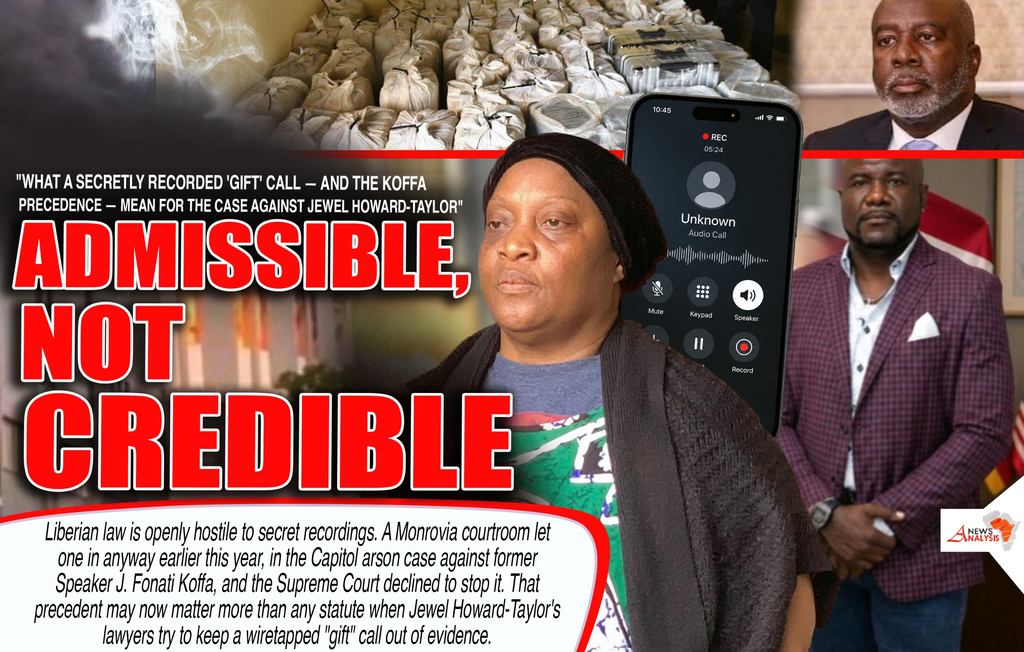
Liberian law is openly hostile to secret recordings. A Monrovia courtroom let one in anyway earlier this year, in the Capitol arson case against former Speaker J. Fonati Koffa, and the Supreme Court declined to stop it. That precedent may now matter more than any statute when Jewel Howard-Taylor’s lawyers try to keep a wiretapped “gift” call out of evidence.
By Rodney D. Sieh | [email protected]
Monrovia — Every account of how Jewel Howard-Taylor came to be arrested runs through the same piece of evidence: a phone call, recorded by a cooperating informant, in which Sheikh Bassirou Kante told the former Vice President that the “investors” she had met in Dubai had sent her a “gift.” It is the closest thing the government has to a smoking gun. It is also, under Liberian law, exactly the kind of evidence that is not supposed to reach a jury easily.
A Legal Framework Built to Keep Secret Recordings Out
Liberia’s constitutional and statutory framework treats secretly recorded conversations with open suspicion, not casual acceptance. Articles 16 and 17 of the Liberian Constitution protect citizens’ privacy and personal property, which Liberian courts have read as attaching a strong expectation of privacy to private conversations. Title 26, Article 19.1 of the Penal Code goes further, classifying unauthorized eavesdropping, the hidden installation of recording devices in private places, or the interception of non-public communications without consent as a first-degree misdemeanor. Taken together, the framework creates what defense lawyers in Liberia have long relied on: an exclusionary tendency, in which recordings obtained illegally, or in violation of a reasonable expectation of privacy, face a real risk of being thrown out before a case ever reaches trial.
The Koffa Precedent
That is the legal backdrop against which Judge Roosevelt Z. Willie made a very different call earlier this year. In the high-profile Capitol arson trial against former House Speaker J. Fonati Koffa and several co-defendants, prosecutors sought to introduce secret audio recordings allegedly extracted from a defendant’s phone. The defense objected on nearly every ground available to it: the recordings were inaudible, unauthenticated, possibly generated or altered by artificial intelligence, and unsupported by any documented chain of custody linking what was played in court to what had been recovered from the phone.
Judge Willie admitted the recordings anyway — provisionally. His reasoning drew a distinction that is likely to matter a great deal in the Taylor case: admissibility is not the same thing as credibility. Under Liberia’s evidentiary standards as he applied them, material can be admitted so long as it is “potentially relevant,” leaving it to the jury to weigh its quality and decide how much, if anything, it deserves to be believed. In the same ruling, Willie denied a defense request to have the audio transcribed into text, insisting the original recordings stand as the primary evidence — meaning jurors would have to rely entirely on what they could make out, in a case where observers described the audio quality as extremely poor and muffled. When the defense tried to halt the proceedings entirely and have the evidence suppressed at the Supreme Court, the justices instead issued a ruling that left Willie’s jurisdiction over the case, and his evidentiary rulings within it, intact. Legal observers and commentators have since accused the Court of ducking a direct constitutional question rather than resolving it — criticism that has followed the ruling into the court of public opinion even as it stands, for now, as binding precedent.
What This Means for the Recording Against Howard-Taylor
Applied to the case against Jewel Howard-Taylor, the Koffa precedent cuts in a specific, predictable direction. If “potentially relevant” is the bar for provisional admission, the Kante recording almost certainly clears it — a recorded reference to a “gift” tied to a Dubai meeting prosecutors say she took part in is relevant on its face, whatever else may be wrong with how it was obtained or preserved. That suggests Taylor’s lawyers are unlikely to succeed in keeping the recording out of the case entirely through a pretrial suppression motion, at least not on the strength of Liberia’s exclusionary tendency alone. The Supreme Court’s unwillingness to intervene in Koffa’s case, even amid public criticism, signals an appellate posture that gives trial judges wide latitude on exactly this kind of evidentiary call.
There is, however, a legal wrinkle in the Taylor case that did not exist in quite the same form in Koffa’s. Kante was not a third party secretly recording two other people’s private conversation — he was, according to this newspaper’s prior reporting, wired by investigators and a direct participant in the call with Taylor himself. Whether Liberian law treats a recording made by a cooperating, consenting participant in a conversation the same way it treats a recording secretly extracted from a third party’s phone is a genuinely open question, and one this newspaper has not seen definitively resolved in Liberian case law. Taylor’s defense may well argue the two situations are legally distinct; prosecutors will almost certainly argue the Koffa precedent applies regardless of who held the recording device.
Admissible Doesn’t Mean Believed
Assuming the recording is provisionally admitted, legal experts say, former Speaker Koffa’s trial offers a preview of where the real battle will move next: not whether jurors hear the recording, but what they are allowed to conclude from it. Expect Taylor’s lawyers to challenge the recording on precisely the grounds Koffa’s defense raised — audio quality, authentication, whether the copy played in court can be reliably tied to an unaltered original, and whether a proper chain of custody exists connecting Kante’s phone to whatever investigators ultimately presented to prosecutors. Expect, too, a fight over transcription. If Judge Willie’s approach holds as the template, a Liberian court may again require jurors to parse a poor-quality recording with their own ears rather than a clean transcript — a dynamic that can cut either way, since ambiguous audio can just as easily create reasonable doubt as it can suggest a cover-up.
None of this determines Howard-Taylor’s guilt or innocence, and FrontPageAfrica does not offer it as a prediction of the case’s outcome. What Koffa’s trial establishes is narrower but still significant: in Liberia’s current judicial climate, a secretly or covertly obtained recording is unlikely to be excluded outright simply because the Constitution and the Penal Code disfavor it in principle. The more realistic battleground, as it was for Koffa, is credibility — and that is a fight that plays out in front of a jury, not in a pretrial motion to suppress.
Support Independent Journalism
Your support helps FrontPage Africa continue delivering independent, credible, and impactful journalism. Every contribution strengthens our ability to investigate, inform, and hold power accountable while keeping quality journalism accessible to our readers.
Support our journalism or subscribe to receive the latest FrontPage Africa stories and updates.