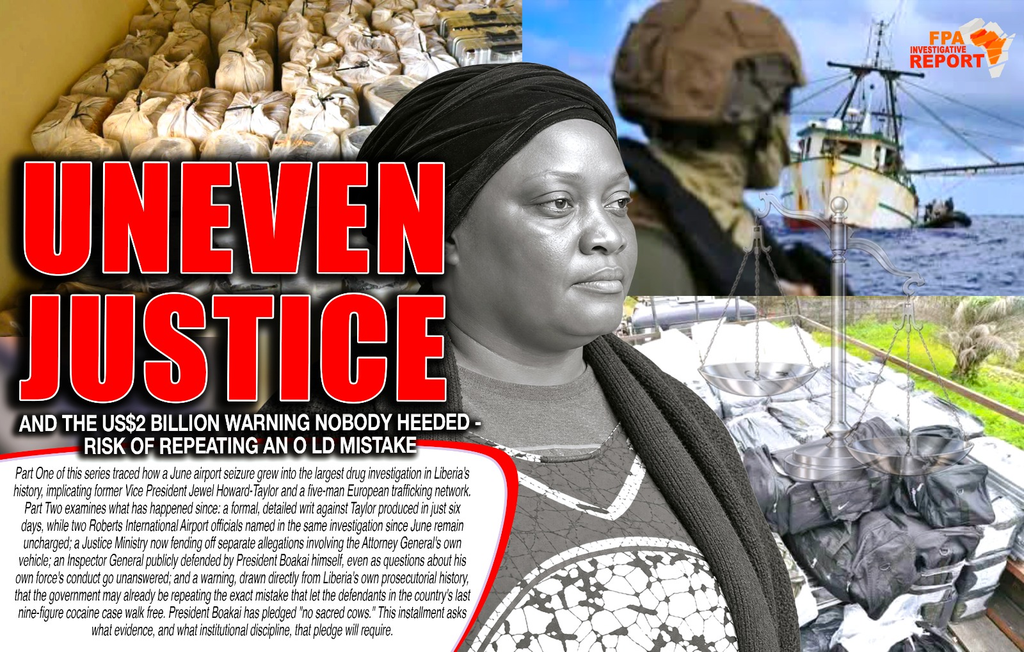
Part One of this series traced how a June airport seizure grew into the largest drug investigation in Liberia’s history, implicating former Vice President Jewel Howard-Taylor and a five-man European trafficking network. Part Two examines what has happened since: a formal, detailed writ against Taylor produced in just six days, while two Roberts International Airport officials named in the same investigation since June remain uncharged; a Justice Ministry now fending off separate allegations involving the Attorney General’s own vehicle; an Inspector General publicly defended by President Boakai himself, even as questions about his own force’s conduct go unanswered; and a warning, drawn directly from Liberia’s own prosecutorial history, that the government may already be repeating the exact mistake that let the defendants in the country’s last nine-figure cocaine case walk free. President Boakai has pledged “no sacred cows.” This installment asks what evidence, and what institutional discipline, that pledge will require.
By Rodney D. Sieh | [email protected]
MONROVIA — Part One of this series ended with a question: whether the speed and force Liberia’s government has shown against its most politically visible target in this case would extend, with equal weight, to everyone else the investigation has touched. Six weeks later, Liberia has an answer, and it is not a comforting one. The government has shown Liberians exactly what it looks like when it moves with full force. It has also shown them, by comparison, what it looks like when it doesn’t — and it is now facing a much older warning from its own legal history about what happens when a high-profile drug case is won in a press conference and lost in a courtroom.
Six Days for Her
Jewel Howard-Taylor was stopped at Roberts International Airport on August 19 as she attempted to leave the country. A formal writ of arrest followed six days later, on August 25, and it was detailed: hotel meetings in Dubai, US$45,000 in cash allegedly handed over for “shopping,” a foundation called Jewel Star Fish that prosecutors say quietly received cartel money while she held office. She faces charges under the Controlled Drugs and Substances Act of 2023 — unlicensed importation, unlicensed sale and distribution, and illicit trafficking — alongside criminal solicitation, facilitation and conspiracy charges under the Penal Law, and a money laundering charge tied specifically to the foundation. It is one of the most detailed charge sheets brought against any Liberian official in this scandal, and this newspaper has credited it as such.
Two Months and Counting for Them
Sitting a few paragraphs down in the same broader investigation are men whose names have been circulating for weeks, sometimes months, without a single charge attached. Mark Egon Kuiah, the former operations chief at Roberts International Airport, appeared on a writ of arrest back in June. He signed off on a letter vouching for a “distressed” ship Liberian troops are now chasing off Rivercess. He was fired from his job in late July. He has not been arrested and is reportedly cooperating with investigators — cooperation that only began, notably, after his name was already public. Jonathan Momolu, a security officer at the airport, is tied both to this year’s case and to a 2023 shipment of methamphetamine disguised as tea leaves that passed through an unauthorized gate while he was the senior inspector on duty. He also spent months moonlighting as a driver for the head of the Liberia Drug Enforcement Agency. He was questioned briefly. He is free. Two currently serving Liberia National Police officers, alleged to have physically escorted the drug shipment at the center of the Howard-Taylor case to the Paynesville stash house, remain unnamed by the government to this day.
The uncomfortable question writes itself: why did it take six days from arrest to a formal, detailed writ for the former Vice President, while men named in writs since June are still walking around?
The Optics Problem
Government officials would say the comparison isn’t fair — that a case against a former Vice President requires a different evidentiary bar, more coordination, more care, precisely because it will be picked apart by defense lawyers and international observers alike. There’s something to that. But Liberians have heard this argument before, and it hasn’t aged well. The country’s last nine-figure cocaine case ended with everyone accused walking free. That memory is doing a lot of work right now, and it is the subject this series turns to next — because it is not simply a memory. It is a specific, documented warning about exactly the kind of mistake Liberia’s current investigation risks making again.
The Ghost of the US$2 Billion Case
Liberia has been here before, on a scale that dwarfs even this summer’s headlines. During the administration of President Ellen Johnson Sirleaf, Liberia prosecuted a case involving cocaine reportedly valued at approximately US$2 billion, intercepted on the high seas in an operation reportedly involving the French Navy and reportedly involving Ghanaian nationals. Unlike a separate, smaller matter from the same era — roughly US$10 million, handled through cooperation with American authorities, with suspects ultimately transferred to the United States for prosecution — the US$2 billion case was tried in Liberia. It ended in acquittal.
The reason was not a legal technicality invented by a sympathetic defense. According to the history surrounding the case, the enormous quantity of cocaine was disposed of before the trial concluded, while only a small quantity was preserved and produced in court. The defense seized on a simple, powerful proposition: the small amount produced at trial did not visibly represent the enormous quantity the defendants were accused of trafficking. The defense reportedly went further still, challenging whether the substance in the envelope produced in court was cocaine at all, rather than an unidentified white powder. The jury returned a verdict of not guilty. Whatever one thinks of that verdict, the lesson is not really about the jury. It is about what happens to a prosecution when the evidence supporting a headline number cannot be produced, tested and defended in a courtroom.
Did Liberia Just Repeat the Mistake?
FrontPageAfrica previously reported that the record US$317 million cocaine seizure at the center of the current investigation has already been destroyed. That raises a direct and urgent question, one this FrontPageAfrica puts to the Ministry of Justice and the Joint Security Investigative Team plainly: before that destruction took place, was the entire seizure weighed and inventoried? Was the packaging individually identified? Were photographs and video taken to document it? Were samples drawn according to scientifically acceptable procedure, independently identifiable and securely stored? Was laboratory testing documented, by identifiable examiners available to testify? Was the destruction itself documented and witnessed by the appropriate authorities? Liberia has already lived through what happens when a government cannot answer these questions convincingly in front of a jury. If those procedures were not followed here, the country is not simply risking an unfavorable verdict. It is risking a repeat, almost point for point, of the outcome that let the defendants in the US$2 billion case walk free.
None of this is a technical objection invented to protect traffickers. Chain of custody protects the prosecution as much as the defense: it is what allows the government to prove that the substance a scientist examined is the same substance investigators recovered, and that what is eventually shown to a judge has not been substituted, contaminated or materially altered along the way. Drugs are fungible — one packet of white powder looks like any other, unlike a firearm with a serial number or a vehicle with a distinctive plate. That is precisely why documentation, not public announcement, is what ultimately proves a narcotics case.
The Court Is Not the Villain if This Goes Wrong
There is a familiar pattern in Liberia whenever a major prosecution collapses: criticism turns toward the judiciary, while considerably less attention goes to whether investigators and prosecutors produced what the law requires. That pattern should not be allowed to repeat itself here. A judge does not seize narcotics, run laboratory tests, or maintain the chain of custody. A judge receives what the parties place before the court. If an investigating agency mishandles evidence, breaks the chain of custody, or destroys physical evidence prematurely, no judge and no jury can manufacture what is missing. If the government alleges hundreds of millions of dollars in narcotics but cannot satisfactorily prove what was seized, how it was weighed and tested, who held custody of it, and what ultimately happened to it, the resulting doubt is not a failure of the courts. It is a failure of the investigation — and blaming the bench for it, as this country has done before, would be exactly the wrong lesson to draw a second time.
The same discipline applies to how this case is discussed in public before it ever reaches a courtroom. Liberians have a legitimate interest in knowing their government is fighting narcotics trafficking, but there is a real difference between informing the public and prosecuting suspects through press conferences. Categorical declarations of guilt, exaggerated claims about the strength of evidence, and conclusions announced before scientific testing is complete all raise public expectations that an eventual courtroom outcome may not be able to meet — and when that gap opens, this country has a documented habit of blaming the judiciary rather than the investigation that created it.
The President Steps In
Against this backdrop, President Boakai has thrown his personal support behind the official leading the investigation. As calls for Inspector General Gregory Coleman’s removal grew louder, the president addressed him directly, by first name: “Greg, my government remains fully supportive of your actions and leadership as you continue to spearhead the fight against illicit drugs in Liberia. You have the full backing of my government. We stand firmly behind your actions in the ongoing fight to rid Liberia of illicit drugs and protect our people.” Coleman thanked him publicly within hours. Executive Protective Service Director Sam Gaye followed with his own defense, arguing Coleman had become “public enemy number one for doing his job.”
Coleman, for his part, has offered his fullest public account yet of his own mission, thanking the president for backing the fight “not just in Liberia, but in the sub-region,” crediting the Joint Security Investigative Team collectively rather than himself, and describing a strategy that began with traffic infractions before reaching “people answering for all of the crimes that are committed.” Asked about calls from former LDEA deputy director Hassan Fadiga urging him to recuse himself, Coleman answered by first name — “Martin is a brother who has been a great advocate… If there’s anything credible, please bring it forward” — while maintaining that his own ethics are strong enough that he would step aside “gently and honorably” if he ever believed himself compromised.
None of that, however warmly delivered, resolves two specific threads still sitting inside Coleman’s own institution. He told FrontPageAfrica months ago that trafficking had been “sanctioned at very, very senior level” and has never named who. And the two Liberia National Police officers allegedly tied to escorting the Paynesville drug shipment remain unnamed, answering ultimately to Coleman himself.
A New Front: The Minister’s Vehicle
As the Coleman controversy played out, a second entanglement emerged around Justice Minister and Attorney General N. Oswald Tweh, who appeared before the Senate Committee on Defense, Security, Intelligence and Veterans Affairs amid questions about a vehicle given to him by Coleman. Social media advocate Martin Kollie has alleged the vehicle traces to drug cartel money; the Ministry has responded with a detailed paper trail — a formal written request to Coleman dated November 10, 2025, an LNP-marked Toyota Land Cruiser Prado from a government-procured fleet, and a denial that it was ever a personal or cartel-linked gift — while arguing Kollie has never supplied the evidentiary “bridge” connecting that specific vehicle to any unlawful source. This newspaper has not independently verified either side’s account. What the episode confirms, regardless of who is right, is how quickly vehicles, favors and informal transactions between Liberia’s security institutions have become a recurring flashpoint in this scandal — echoing the still-unresolved vehicle allegation that led LDEA’s Fitzgerald Biago to recuse himself earlier this year.
What Would Actually Fix This
The way forward is not another press conference. It is the unglamorous, procedural work Liberia’s own history says it has skipped before: preserving the narcotics and every related piece of physical evidence; documenting an unbroken chain of custody; obtaining credible, independently defensible scientific testing; connecting specific evidence to specific individuals rather than relying on proximity or job title; preparing prosecutors and investigators together from the earliest stage rather than handing over a finished file; and building the standardized, permanent protocols — for seizure, storage, testing and courtroom presentation of narcotics evidence — that a case of this size should never have to improvise. It also means applying the same public standard the government has just demonstrated it can meet. If six days and a fully sourced writ was possible for a former Vice President, the same speed and the same specificity are possible for two airport officials named since June, for two police officers whose names the government has simply chosen not to release, and for the unnamed source behind Coleman’s own “senior level” claim.
Liberia does not need louder announcements. It needs stronger evidence, applied evenly, and preserved carefully enough to survive the one place that has always mattered more than a press conference: a courtroom. An arrest is an allegation. An indictment is an accusation. Neither is a conviction. Whether “no sacred cows” turns out to mean anything will be decided not by how fast Liberia moved against Jewel Howard-Taylor, but by whether it can prove, to a judge, exactly what it has spent all summer telling the public it already knows.
Support Independent Journalism
Your support helps FrontPage Africa continue delivering independent, credible, and impactful journalism. Every contribution strengthens our ability to investigate, inform, and hold power accountable while keeping quality journalism accessible to our readers.
Support our journalism or subscribe to receive the latest FrontPage Africa stories and updates.