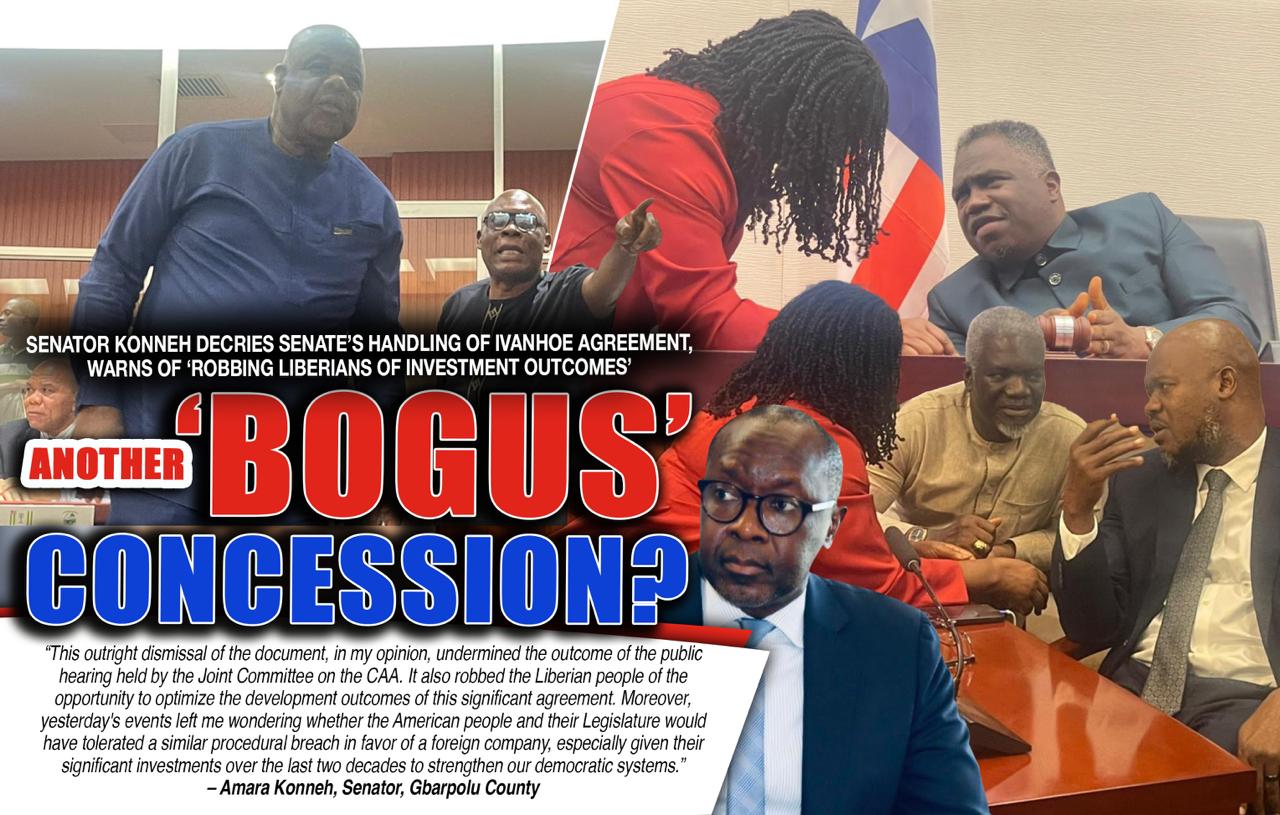
Monrovia — Gbarpolu County Senator Amara Konneh has sharply criticized the Liberian Senate’s handling and passage of the Rail Access and Concession Agreement (CAA) involving Ivanhoe Atlantic, warning that what he described as serious procedural irregularities could undermine transparency and deprive Liberians of the full development benefits of the deal.
By Obediah Johnson, [email protected]
In a strongly worded statement issued following the Senate’s concurrence with the House of Representatives, Senator Konneh—who chairs the Senate Committee on Public Accounts and Audit (PAC)—accused the Legislature of sidelining critical documentation and disregarding outcomes from public hearings conducted by the Joint Committee on Transport and Concessions.
“This outright dismissal of the document, in my opinion, undermined the outcome of the public hearing held by the Joint Committee on the CAA,” Konneh said. “It also robbed the Liberian people of the opportunity to optimize the development outcomes of this significant agreement.”
What Were the Committee’s Recommendations?
According to the Joint Committee’s report, lawmakers formally requested several critical documents from the Executive Branch to enable a comprehensive and informed legislative review of the proposed CAA.
The report disclosed that as of the public hearing held on Monday, December 15, 2025, the Committee had not received a comprehensive or official response addressing its requests.
While the Minister of Transport submitted certain documents, the Committee established that those materials were largely historical in nature, with most originating prior to September 2021. The submissions, the report noted, failed to respond to core questions raised by lawmakers regarding compliance with the Liberia–Guinea Implementation Agreement.
The Committee further disclosed that the documents did not establish any recent, formal, or documented engagement between the Governments of Liberia and Guinea following Guinea’s political transition in September 2021.
“The Minister of Transport orally asserted that recent communication occurred with his Guinean counterpart,” the report stated. “While the Committee does not impugn the sincerity of this assertion, documentary evidence was expressly requested to substantiate such claims. No such evidence was provided.”
Similarly, the Executive Director of the National Investment Commission informed the Committee that attempts to contact Guinean authorities were unsuccessful—an admission noted during the public hearing.
Conditional Approval Recommended
Following its review, the Joint Committee recommended conditional approval of the Ivanhoe–Liberia Road Access Agreement, outlining a series of amendments it said must be addressed before final legislative concurrence.
The agreement governs road, rail, and logistics access for Ivanhoe’s iron ore operations linking Guinea and Liberia. It was first passed by the House of Representatives and subsequently forwarded to the Senate for concurrence.
Among the Committee’s key recommendations was a requirement that the 25-mile heavy-haul road from the Guinea–Liberia border to Tokadeh be fully paved before the commencement of any iron ore haulage, to prevent premature damage to Liberia’s road infrastructure.
The Committee also recommended restructuring social contributions to affected communities by removing Ivanhoe from the direct implementation of community projects. Instead, it proposed that the Government of Liberia and local communities serve as the sole implementing parties to enhance accountability and local ownership.
On rail infrastructure, lawmakers proposed that the agreement explicitly obligate Ivanhoe to construct the rail line from the Guinean mine to the Tokadeh rail connection within two years of the start of commercial production, consistent with commitments outlined in the feasibility study.
Additionally, the Committee recommended that the US$37 million already paid by Ivanhoe be designated as a non-refundable signature bonus, rather than a loan or advance, upon ratification.
The panel also urged a review of the access fee currently set between US$1.55 and US$1.95 per ton, proposing an increase to a range of US$2.00 to US$3.00 per ton to better reflect infrastructure usage and national benefit.
Other safeguards included a clause recommending automatic termination of the agreement if approval for transshipment of Guinean iron ore through Liberia is not granted by Guinea within five years.
The Committee further raised constitutional concerns with Clause 16.1(d)(ii) of the agreement, recommending amendments to ensure that references to a proposed National Rail Authority or an “NRA Act” do not preempt the Legislature’s constitutional authority to establish such an entity through separate enactment.
Concerns Over Legislative Process
Despite the Committee’s recommendations, the Senate proceeded to approve the agreement. A total of 20 senators voted in favor, while Montserrado County Senator Saah Joseph, who initially chaired discussions on the deal, voted against it.
Senators Amara Konneh, Gbehzohngar Findley, Gbehbo Brown, and Wellington Geevon Smith abstained, while Senator Nya Twayen walked out of the session prior to the vote.
In a statement released over the weekend, Senator Konneh said his abstention was due to what he described as a “procedural flaw” in the Senate’s handling of the agreement.
“My decision was due to a procedural flaw, not a repudiation of American investment in Liberia,” Konneh stated.
He disclosed that although the Senate Plenary had constituted a Joint Committee chaired by Senator Joseph to review the CAA and propose amendments, the Plenary failed to act on the report submitted by the Committee.
According to Konneh, the Committee concluded its deliberations last Wednesday and was prepared to present its report for a vote on Thursday. However, the Plenary rejected the report on grounds that it “lacked sufficient signatures.”
Konneh said the dismissal undermined the public hearing process and ignored substantive findings meant to strengthen Liberia’s negotiating position.
“This process should have been driven by evidence, public input, and committee findings,” he said. “Instead, we witnessed a troubling rush to approve a concession of major national importance.”
Comparisons to International Standards
Drawing comparisons to established democracies, Senator Konneh questioned whether similar procedural breaches would be tolerated elsewhere.
“Yesterday’s events left me wondering whether the American people and their Legislature would have tolerated a similar procedural breach in favor of a foreign company,” he said, referencing international investments aimed at strengthening Liberia’s democratic institutions.
Echoes of Past Concession Controversies
Konneh’s remarks have reignited debate over Liberia’s history with concession agreements that critics say promised economic transformation but delivered limited benefits to affected communities.
Some lawmakers and civil society actors fear the Ivanhoe agreement could become another in a list of what they describe as “bogus concessions” if safeguards and legislative oversight are weakened.
Call for Transparency
While supporters argue the agreement positions Liberia as a regional logistics hub with potential for significant revenue and infrastructure investment, dissenting senators insist that procedural shortcuts could weaken the country’s bargaining power.
Senator Konneh urged stricter adherence to legislative procedures in future concession reviews.
“When we ignore our own rules, we weaken democracy and undermine the confidence of the very people we represent,” he warned.
As the agreement moves toward implementation, attention is expected to focus on enforcement, oversight, and whether the promised economic and infrastructural benefits will ultimately materialize for Liberians.
Support Independent Journalism
Your support helps FrontPage Africa continue delivering independent, credible, and impactful journalism. Every contribution strengthens our ability to investigate, inform, and hold power accountable while keeping quality journalism accessible to our readers.
Support our journalism or subscribe to receive the latest FrontPage Africa stories and updates.