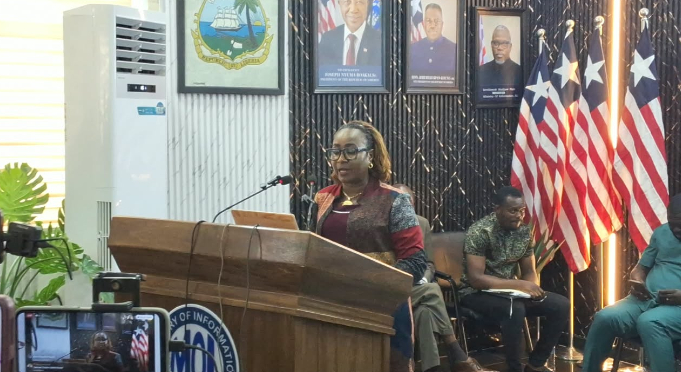
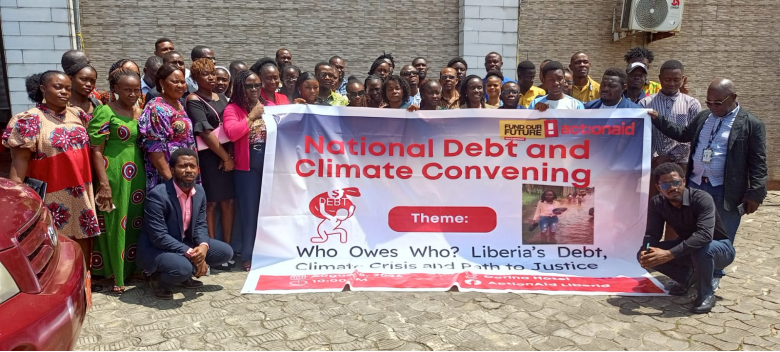
Monrovia– ActionAid Liberia has launched its National Debt and Climate Audit Report, calling for urgent global action to address the growing burden of climate-related debt on developing countries and urging wealthy nations to take responsibility for the climate crisis.
By J.H. Webster Clayeh [email protected]
The report was unveiled during a one-day event held at the Corina Hotel in Monrovia under the theme:, “Who Owes Who? Liberia’s Debt, Climate Crisis and the Path to Justice.”
The program brought together government officials, development partners, civil society organizations, and representatives of the private sector.
Delivering the keynote remarks, ActionAid Liberia Country Director, Elizabeth Gbah-Johnson, said the launch was more than the presentation of a report, describing it as a call to confront the global inequalities that continue to shape the realities of countries like Liberia.
She stressed that Liberia should not be forced to shoulder the financial burden of a climate crisis to which it contributed very little.
According to Madam Gbah-Johnson, the initiative seeks to amplify the voices of communities on the frontlines of climate change while strengthening collective efforts to demand justice, equality and accountability.
She said the theme:, “Who Owes Who? Liberia’s Debt, Climate Crisis and the Path to Justice,” is “not simply a slogan but a political, economic and moral question.”
Madam Gbah-Johnson argued that industrialized nations, whose economic development has largely driven global greenhouse gas emissions, continue to owe a climate debt to vulnerable countries.
Referring to ActionAid’s global analysis, she noted that while wealthier countries have failed to fulfill their climate finance commitments, countries like Liberia are increasingly compelled to borrow money to adapt to climate change, recover from disasters and strengthen resilience.
According to her, the report reveals that Liberia’s national debt has risen significantly, with debt servicing consuming a substantial share of domestic revenue.
This, she said, leaves fewer resources available for healthcare, education, agriculture, water and sanitation, climate adaptation and social protection.
“This is what ActionAid describes as the debt crisis. It creates a vicious cycle where new borrowing increases fiscal pressure, leaving countries even more vulnerable to future climate shocks,” she said.
Madam Gbah-Johnson further emphasized that the burden falls disproportionately on women and girls, who often bear the greatest consequences of weak public services and climate-related disasters.
“For ActionAid, this is fundamentally about climate justice, debt justice, economic justice and gender justice. Countries and communities on the frontlines of climate change should not be forced to pay for a crisis they did not create,” she emphasized.
She called for climate financing to be provided through accessible grants rather than unsustainable loans and urged governments and development partners to place women, young people and affected communities at the center of climate decision-making.
Also speaking at the launch, the Executive Director and Chief Executive Officer of Liberia’s Environmental Protection Agency (EPA), Dr. Emmanuel King Urey Yarkpawolo, said the report’s theme challenges policymakers to look beyond financial obligations recorded in government accounts and instead consider historical responsibility, environmental damage, inequality and what is owed to future generations.
“Climate change is not only an environmental problem. It is a development, public health, food-security, human-rights and debt problem. Liberia contributed very little to this crisis, yet coastal erosion, flooding and changing rainfall threaten communities, infrastructure, agriculture and livelihoods,” Dr. Yarkpawolo said.
The EPA Executive Director warned that climate change continues to deepen poverty in vulnerable countries by increasing the need for borrowing after disasters.
“Every climate disaster forces a poor country to spend scarce resources on recovery while reducing production, household income and government revenue. Climate change therefore increases poverty; poverty weakens our ability to adapt; inadequate adaptation produces greater losses; and those losses create pressure to borrow.”
Dr. Yarkpawolo noted that debt servicing diverts critical resources away from education, healthcare, coastal protection, clean energy and climate-resilient agriculture.
“In this way, climate change is making poor countries poorer,” the EPA boss added.
Support Independent Journalism
Your support helps FrontPage Africa continue delivering independent, credible, and impactful journalism. Every contribution strengthens our ability to investigate, inform, and hold power accountable while keeping quality journalism accessible to our readers.
Support our journalism or subscribe to receive the latest FrontPage Africa stories and updates.