
MONROVIA – In commemoration of its 50th anniversary this month, the management of the Liberia Electricity Corporation (LEC), in collaboration with the Ellen Johnson Sirleaf (EJS) Presidential Center for Women and Development, held a day-long dialogue for women’s empowerment in Science, technology, engineering, and Mathematics (STEM) education.
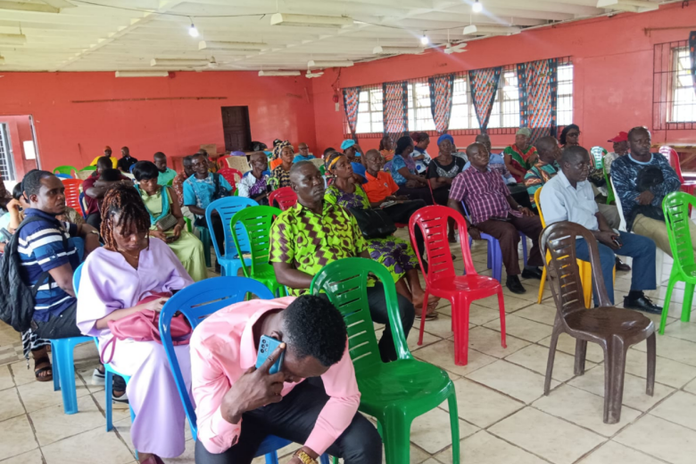
The dialogue, which took place at the EJS Presidential Center in Sinkor, brought together students from the Alexander B. Cummings Model Science and Technology School and others, including employees from LEC and the EJS Center.
In her welcome remarks, Amini Kajunju, Chief Operating Officer of the EJS Center, told the participants that the purpose of the event was to learn more about the opportunities and challenges of the STEM landscape for women in Liberia.
She said, “Every year on February 11th, the EJS Center celebrates the International Day of Women and Girls in Science. EJS Center Amujae Leaders like Farida Bedwei, who developed a cloud software platform that is used by over 100 companies, are working across the continent on STEM issues.”
According to Kajunju, in Liberia, the center provided grants to three local organizations for the Liberia support program, including US$30,000 to Girls in Tech for computer technology training in Microsoft Office and Quick Books for 110 young women. She stressed that the EJS Center supports women in STEM and that “we are very proud to be co-hosting today’s program.”
William Anderson, LEC Manager for Gender and HRIS, who provided the overview, disclosed to the students and others that, in Liberia, the number of females in technical fields or occupations is significantly lower than the number of men in technical occupations. Anderson also wondered whether women do attend public or private schools across the counties; there are already a limited number of technical universities in Liberia, which affects the number of women in STEM.
He averred that the lower representation of women in STEM at the national level affects the corporation as a major stakeholder. “This means, Anderson emphasized, that the corporation is already in deficit to absorb competent women in STEM because Liberia does not provide the anticipated output in terms of the significant number of females in STEM.”
He, however, said that the corporation has designed several gender interventions and strategies to attract and absorb women in STEM as it sets a gender parity target at two major levels: in the technical composition of its workforce at 40:60 and in its leadership at 30:70, which Anderson said are geared towards achieving the anticipated target by 2030.
For her part, Jestina Fofona, Executive Director, reiterated that globally, gender gaps in the labor market of the future lie within STEM occupations, important jobs that are well remunerated and expected to grow in significance and scope in the future. She said LinkedIn data on members’ job profiles shows that women remain significantly underrepresented in the STEM workforce.
Fofana is also the Human Resources Director at LEC. “Women make up almost half of total employment across non-STEM occupations, at 49.3%, but just 29.2% of all STEM workers,” she said. Fofana observed that in Liberia, it is unfortunate that the number of women in technical roles is significantly lower than that of men, and it is also sad that Liberia’s cultural practices still affect the process of changing the narratives. She further calls for national government’s intervention to address the issue of women in STEM in Liberia and achieve the desired results, like the strategy the LEC has embarked on. Meanwhile, the dialogue was also attended by Vernice Guthrie, Peace Corps Liberia Country Director; Sara Buchanan, Executive Director of Orange Digital Center; and Winnie Siakor Dilah, President of the Society of Women Engineers of Liberia.
Support Independent Journalism
Your support helps FrontPage Africa continue delivering independent, credible, and impactful journalism. Every contribution strengthens our ability to investigate, inform, and hold power accountable while keeping quality journalism accessible to our readers.
Support our journalism or subscribe to receive the latest FrontPage Africa stories and updates.