MONROVIA – Three decades ago, Liberia needed West Africa’s soldiers to help end its civil war. Today, it has a chance to help shape the region’s economic future.
By Rodney D. Sieh
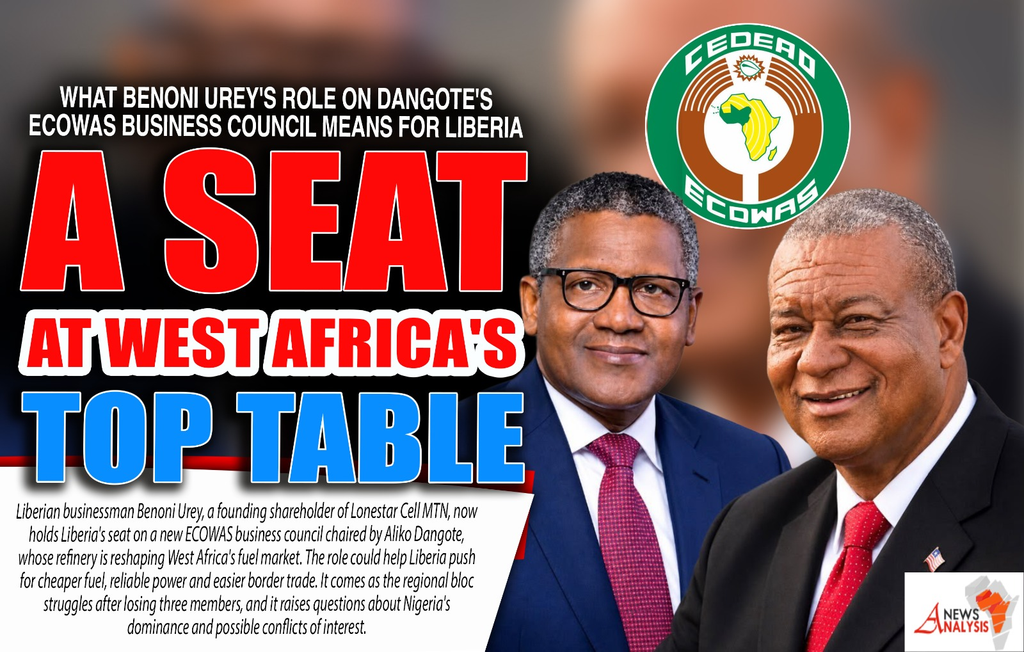
Benoni W. Urey, a Liberian businessman best known as a founding shareholder of the mobile network Lonestar Cell MTN, has been named Liberia’s representative on the ECOWAS Business Council. The council is a new advisory body chaired by Nigerian industrialist Aliko Dangote, Africa’s richest man, and is meant to give the private sector a direct line to the presidents of West Africa.
The appointment comes at a delicate moment. The regional bloc has lost three members, its trade ambitions have stalled, and its energy map is being redrawn by one giant Nigerian oil refinery.
Whether Liberia’s new seat delivers anything for ordinary people — cheaper fuel, easier border crossings, steadier electricity, a bigger market for Liberian goods — will depend on how the council works, whose interests it serves, and how hard Liberia’s representative fights for a small country in a room full of giants.
A Bloc Under Strain
The Economic Community of West African States, or ECOWAS, was founded in Lagos, Nigeria, in 1975. Liberia was one of its founding members.
For many Liberians, though, ECOWAS means peacekeeping more than trade. Its military force, ECOMOG, entered Liberia’s civil war in 1990, and ECOWAS mediators helped broker the 2003 peace agreement in Accra, Ghana, that ended 14 years of conflict.
Fifty years after its founding, the bloc’s economic promise remains largely unfulfilled.
It has also shrunk. In January 2025, the military-led governments of Mali, Burkina Faso and Niger formally walked out and formed their own Alliance of Sahel States. That left ECOWAS with 12 members and cost it roughly a fifth of the levy revenue that funds its institutions. In October 2026 the two blocs agreed to set up working groups to manage their relationship, but there is no sign of a reunion.
Trade among members remains thin. Less than 15 percent of the region’s trade happens between ECOWAS countries, held back by tariffs, red tape, roadside checkpoints and poor roads. A long-promised single currency, the Eco, has been postponed again and again; leaders now say it will launch in 2027, starting with the countries that meet its economic targets.
The bloc also has new leadership. General Birame Diop of Senegal now heads the ECOWAS Commission, succeeding Dr. Omar Alieu Touray of The Gambia.
For Liberia, a country of about five million people, the stakes are practical. It trades heavily with neighbouring Sierra Leone, Guinea and Côte d’Ivoire, imports almost all of its fuel, and depends on regional power lines and road links that ECOWAS helps plan and fund.
Long Promised, Just Starting
The ECOWAS Business Council is not quite as new as it appears. ECOWAS ministers created it on paper in 2021, and its launch slipped from December 2024 to September 2025. Dangote was finally named its first chairman by the bloc’s foreign ministers in Abuja in December 2025, and West African heads of state later endorsed him.
The council’s job is to advise ECOWAS leaders on trade, investment and industrial policy, and to help clear the barriers that stop people, goods, services and money from moving freely across the region’s borders.
Each member state gets one representative, and Nigeria, the region’s largest economy, gets two more. Regional business associations also have a voice. Dangote’s team says his two-year term will focus on energy corridors to ease the power shortages that choke business, as well as ports and logistics, with funding to be sought from lenders such as the African Export-Import Bank and the Africa Finance Corporation.
The council is still finding its feet. By mid-2026 only a handful of national representatives had been confirmed, and its first meeting was planned for late October or early November, with further approvals due at a ministerial meeting in December.
The risk is familiar. Business councils across Africa have often become talking shops. This one will be judged on results — fewer roadblocks, faster customs clearance, power projects that actually get built — and on whether its members speak for market traders and young companies, not just the region’s biggest conglomerates.
Dangote at the Helm
Choosing Aliko Dangote sends a clear signal about how ECOWAS sees its future: industrial, energy-driven and led by large regional investors.
No single business has done more to change West Africa’s fuel market in recent years. Dangote’s refinery outside Lagos, built at a reported cost of about US$20 billion, reached its full design capacity of 650,000 barrels a day in February 2026 and is aiming for 700,000. It now supplies most of Nigeria’s fuel, and according to the U.S. Energy Information Administration, Nigeria’s fuel exports to other African countries rose to nearly 120,000 barrels a day in the second quarter of 2026. Analysts estimate the refinery has cut West Africa’s imports of refined fuel from outside the region by close to a quarter. When the conflict involving Iran disrupted supplies from the Gulf and Europe this year, Dangote stepped in with more gasoline exports across the continent.
The company markets its cleaner, European-standard fuel as an end to the days when West Africa served as a dumping ground for low-quality imports.
For Liberia, which imports nearly all its fuel and where pump prices have often run higher than in neighbouring countries, a major refinery a few days’ sail away could mean shorter supply chains, more reliable deliveries in a crisis, and cleaner fuel.
But there are real concerns.
The first is concentration. A region that trades its dependence on Europe and the Gulf for dependence on one private refinery gains proximity but may lose competition. And the council advising presidents on energy and trade policy will be chaired by that refinery’s owner.
The second is conflict of interest. Dangote’s empire spans cement, sugar, fertilizer and petroleum — all sectors shaped by tariffs, import rules and industrial policy. Dangote has long argued that Africa should produce what it consumes and has championed protection for local manufacturers. Regional protection can help West African industry grow, but small, import-dependent economies like Liberia can end up paying more for everyday goods.
The third is Nigeria’s weight. With three seats and the chairmanship, Nigerian business interests will carry outsized influence in the council’s decisions.
None of this means the council cannot serve the whole region. Dangote has publicly urged governments to protect private investment, back local investors and keep their policies consistent — messages that resonate with business owners in Monrovia. The real test is whether the council produces rules that open markets or rules that protect those already on top.
The Record Urey Brings
Urey’s career spans several of the sectors the council has made its priorities.His biggest business success is in telecommunications. Through his company PLC Investments, he was a founding shareholder of Lonestar Communications Corporation, which launched in 2001 in partnership with South Africa’s MTN Group. Lonestar grew into one of Liberia’s two main mobile networks and a major provider of mobile money. That experience matters: ECOWAS wants payment systems that work across borders, and cross-border mobile money may be the most direct way regional integration reaches traders and families who send money to relatives in neighbouring countries.
He also knows shipping. From 1996 to 2003, Urey headed Liberia’s Bureau of Maritime Affairs, which oversees the country’s international ship registry. Liberia, despite its size, flags one of the largest merchant fleets in the world, making the registry one of the country’s few globally significant economic assets. With ports and logistics high on Dangote’s agenda, that background could prove useful.
On energy, Urey once served as a deputy director general at the state-owned Liberia Electricity Corporation. Power is the council’s headline priority, and Liberia remains one of the least electrified countries in the region. Urey could press for faster completion of the regional power lines linking Liberia with Côte d’Ivoire, Sierra Leone and Guinea.
He also runs commercial farms in Konola and Careysburg, outside Monrovia, that supply the local market — relevant in a country that still imports much of its staple food, rice.
And he knows politics. Urey served as mayor of Careysburg and founded the All Liberian Party, running for president in 2017. That gives him a feel for how policy plays out on the ground, but it also raises a question: how will a political party leader keep party interests separate from a regional business role?
What Liberia Should Ask For
A well-connected representative could push hard on the issues that matter most to a small economy. Among them: ending harassment and illegal fees at busy border crossings such as Bo Waterside, on the Sierra Leone border, and Ganta, on the Guinea border; securing regional fuel supply on fair terms; speeding up power links; making mobile payments work across borders; and opening regional financing to Liberian small businesses.
Urey has said he wants Liberia’s entrepreneurs and young companies to have a clear voice in regional policy. That promise is the yardstick by which his tenure should be measured.
What to Watch
Three questions will shape how this appointment is judged.
Business interests. The council will advise on telecoms, digital finance, agriculture and trade — sectors in which Urey has commercial stakes. Lonestar’s competition with rival Orange Liberia is one example. The council should publish a clear conflict-of-interest policy for all its members.
Selection. The press statement announcing the appointment says Urey was chosen after consultations across the region and that membership is by invitation. It is not clear whether Liberia’s government, its Chamber of Commerce or its business associations had a say.
Accountability. Liberian businesses will need a way to bring their concerns to their representative, and a way to hear back from him.
The Bottom Line
Liberia has gained a voice in a body that, if it works, could influence how fuel, power, money and goods move across West Africa. Dangote’s chairmanship gives the council financial muscle and direct access to presidents. It also concentrates influence in the hands of the region’s most dominant industrialist.
For a small country with limited bargaining power, the value of Urey’s seat will be measured in concrete results: lower costs at the border, reliable fuel and electricity, and real opportunities for Liberian entrepreneurs. Anything less, and the appointment will be just another title.
Support Independent Journalism
Your support helps FrontPage Africa continue delivering independent, credible, and impactful journalism. Every contribution strengthens our ability to investigate, inform, and hold power accountable while keeping quality journalism accessible to our readers.
Support our journalism or subscribe to receive the latest FrontPage Africa stories and updates.