Only Half of Representatives Submit Formal Reports Despite 91.7% Returning to Constituencies
MONROVIA — Despite 91.7 percent of Liberia’s lawmakers returning to their respective districts during the second constituency break, only half submitted formal reports to their constituents, while more than one-third operated without functional constituency offices, raising fresh concerns about legislative accountability and public engagement.
By Francis G. Boayue
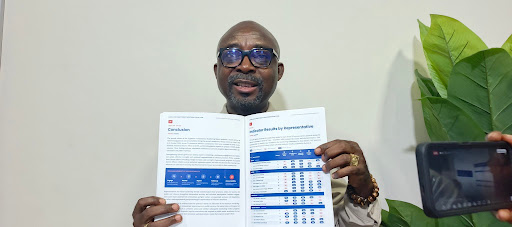
The findings are contained in a new report released by Naymote Partners for Democratic Development, titled “Assessing Representatives’ Engagement, Accountability, and Responsibilities During Liberia’s Second Constituency Break.”
The 2026 Legislative Constituency Monitoring Report assesses the performance of members of the House of Representatives between July 17 and October 9, 2026, covering 72 electoral districts across Liberia’s 15 counties. District #10 in Montserrado County was excluded because of a court case involving Representative Yekeh Kolubah.
Presenting the findings, Naymote Executive Director Eddie D. Jarwolo disclosed that 66 of the 72 representatives, representing 91.7 percent, returned to their districts during the monitoring period.
However, the report found that only 56 lawmakers, or 77.8 percent, organized town hall meetings, while 51, representing 70.8 percent, engaged the media or participated in radio programs.
More concerning, only 50 percent of the lawmakers submitted formal reports detailing their constituency activities, while 62.4 percent maintained functional constituency offices.
The findings raise questions about how effectively elected representatives communicate their legislative activities, account for their performance, and remain accessible to the citizens who elected them.
Jarwolo emphasized that the monitoring exercise was not intended to discredit lawmakers but to encourage them to improve their engagement with constituents.
“This is not to bring the lawmaker down. This is just to help the lawmaker succeed,” he said.
He explained that Naymote evaluated lawmakers using five major indicators: district visits, town hall meetings, radio engagement, formal reporting, and the functionality of constituency offices.
“Did they visit their district? Did they organize town hall meetings? Do you have radio programs? Do you present reports to anybody? Those are the things we were looking at,” Jarwolo stated.
He expressed particular concern about the lack of formal reporting, arguing that constituents often have little or no access to documented information about what their elected representatives accomplish.
“One of the things we are looking at is reporting. You cannot go to any district and say, ‘I want to see your lawmaker’s report for 2025.’ You can’t find it,” he said.
Jarwolo also questioned the substance of some activities lawmakers undertake during constituency visits, stressing that representation should go beyond donations and occasional assistance to individuals.
“Most of the activities were donating rice, running clearances, and just different things,” he observed.
He argued that lawmakers should provide constituents with regular updates on bills they have sponsored or supported, committee assignments, oversight activities, advocacy efforts, and projects funded through the national budget.
LAWMAKERS’ PERFORMANCE VARIES
The report highlighted significant differences in the performance of individual lawmakers across the five indicators.
Representative Thomas A. Goshua of Grand Bassa County District #5 recorded positive results across all five monitored areas. He maintained a functional constituency office, visited his district, organized town hall meetings, engaged the media through a radio program, and submitted a formal report.
Representatives Rugie Yartu Barry of Montserrado County District #1 and Prescillia A. Cooper of Montserrado County District #5 also recorded positive results across all five indicators.
Representative Sekou Karneh of Montserrado County District #2 performed positively in most areas but lacked a radio program, according to the presentation.
In Margibi County, Representative Ivar K. Jones of District #2 maintained a functional constituency office, visited his district, engaged the media, and submitted a report. However, he did not organize a town hall meeting.
On the other hand, Representatives Bintu Masaley of Grand Cape Mount County District #1 and Roland O. Cooper of Margibi County District #1 were reported to have failed all five indicators.
According to the presentation, neither lawmaker maintained a functional constituency office, visited their districts, organized town hall meetings, engaged the media through radio programs, nor submitted formal reports during the monitoring period.
Representative Ellen A. Attoh-Wreh of Margibi County District #3 maintained a functional constituency office, visited her district, and organized a town hall meeting. However, the presentation did not provide complete information about her radio engagement and formal reporting performance.
MONITORING METHODOLOGY
Naymote said it deployed 72 monitors, one in each electoral district, supported by interns and members of its office team.
The monitoring exercise involved telephone calls to lawmakers, field visits, physical inspections of constituency offices, and engagements with community members.
The organization used Google Forms, Open Data Kit (ODK), telephone verification, and physical inspections to collect and verify information, reporting 98.6 percent coverage during the exercise.
Jarwolo disclosed that the monitoring initiative had already encouraged some lawmakers who were previously inactive to become more engaged with their constituents.
“I can tell you some of the lawmakers who disagreed, who were not active in the report, became more active. They felt that when there is a report showing that you are not going to the district, it makes things a little bad. So they are moving to the district,” he said.
He added: “Our work is just to check whether they are going to the district.”
The findings come amid growing public expectations for greater transparency and accountability from elected officials. House Speaker Richard Koon has also publicly urged lawmakers to return to their respective districts and engage with their constituents.
NAYMOTE PROPOSES ACCOUNTABILITY MEASURES
To address the gaps identified, Naymote recommended that representatives publish their constituency visit schedules in advance, indicating the dates and duration of visits, locations for town hall meetings, and radio stations through which citizens can engage them.
The organization also called for a standardized reporting template requiring lawmakers to document their legislative activities, including bills considered, committee work, oversight engagements, advocacy initiatives, budget allocations, and projects implemented in their districts.
Additionally, Naymote recommended that representatives maintain functional constituency offices and employ staff capable of tracking government projects and budget allocations, engaging relevant ministries, and following up on development commitments.
Jarwolo maintained that improved recordkeeping and regular reporting would enable citizens to better assess whether their elected representatives were fulfilling their responsibilities.
Naymote disclosed that it would distribute the report across the counties and conduct a follow-up survey involving between 50 and 60 citizens in each electoral district to assess public perceptions of their representatives’ performance.
The organization also said it would withhold the identities of its district monitors because of concerns about possible pressure or retaliation.
According to Naymote, the monitors were drawn from different professional backgrounds, including journalism, civil society, and teaching.
Support Independent Journalism
Your support helps FrontPage Africa continue delivering independent, credible, and impactful journalism. Every contribution strengthens our ability to investigate, inform, and hold power accountable while keeping quality journalism accessible to our readers.
Support our journalism or subscribe to receive the latest FrontPage Africa stories and updates.