Monrovia – A top legal officer at the Liberian Senate could soon take home US$2,920 a month. That is roughly 20 times what the law guarantees an unskilled Liberian worker, and the raise alone, US$1,216 a month, is more than eight months of minimum wage.
By Rodney D. Sieh
The figure is contained in a proposal from the Senate Committee on Rules, Order and Administration (ROA), seen by FrontPageAfrica. It asks Senate leadership to set aside US$792,552 in the Fiscal Year 2027 budget to raise salaries for 224 Senate employees and hire four new maintenance staff.
The proposal lands as the Executive prepares to send the FY2027 budget to the Legislature by the October 31 deadline, and as ordinary Liberians struggle to put rice on the table.
What the Senate Committee Wants
Committee chairman J. Gbleh-bo Brown of Maryland County forwarded the proposal to President Pro Tempore Nyonblee Karnga-Lawrence on October 12, five days after the committee signed it. Six of seven committee members signed; Senator Augustine Chie’s signature line is blank.
Most of the money, US$554,712, would go to the 174 personal staff working in 29 senators’ offices. Another US$199,320 covers 50 civil servants in Central Administration, and US$38,520 would hire four new maintenance workers.
The Senate Pay Raise Proposal at a Glance.
The committee says the plan will “promote harmony” and align Senate pay with comparable jobs in the Executive Branch, in line with the National Remuneration Standardization Act of 2019. It also asks that remaining staff be reviewed in the FY2028 budget, signalling more requests to come.
Life Outside the Capitol
For most Liberians, the numbers in the Senate proposal belong to another world. The legal minimum wage for an unskilled labourer is US$5.50 a day, and US$3.50 for a domestic worker, rates unchanged since 2015. Labour Minister Cooper Kruah has had to warn security firms paying guards as little as US$75 a month, about half the legal floor.
The hardship is measured, not imagined:
* Roughly half of Liberians live below the national poverty line, and analysts project it could reach 51 percent this year.
* About 52 percent live in multidimensional poverty, according to the World Food Programme.
* Nearly five in ten households spend more than 65 percent of their income on food alone, the government’s own food security survey found.
* About one in three Liberians is undernourished, and 30 percent of young children are stunted.
* Liberia grows less than a third of the rice it eats, leaving families exposed to every swing in import prices.
Public workers who keep schools and clinics running are not spared. Lawmakers this year summoned education and health officials over teachers whose US-dollar pay had gone unpaid since October 2025. Nurses are now demanding a US$500 monthly minimum, less than a fifth of the Legal Counsel’s proposed salary.
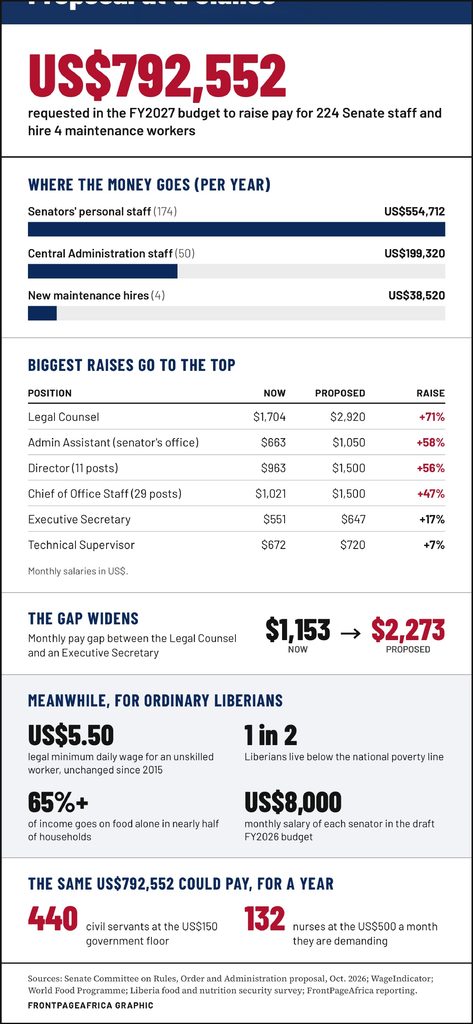
Put another way, the US$792,552 the committee wants could pay 440 civil servants at the US$150 government floor for a full year, or 132 nurses at the salary they are asking for.
Biggest Raises Go to the Top
The committee’s own document quotes the 2019 Act’s goal of narrowing “the inequality gap in government.” Its numbers do the opposite: the higher the job, the bigger the raise.
The Legal Counsel’s pay would jump 71 percent, from US$1,704 to US$2,920 a month. Directors would get 56 percent and Chiefs of Office Staff 47 percent. At the bottom, Executive Secretaries would get 17 percent, and Technical Supervisors just 7 percent.
Today the Legal Counsel earns about US$1,150 a month more than an Executive Secretary. Under the proposal, that gap nearly doubles to about US$2,270. The secretary’s raise is US$96; the lawyer’s is US$1,216.
The single largest line is the 29 Chiefs of Staff in senators’ offices, whose raises alone cost US$166,692 a year. Personal staff, hired by and loyal to individual senators, take 70 percent of the total package.
A Budget That Only Grows
The proposal asks for new money. It does not say what the Senate would cut to pay for it.
The Senate’s budget rose from about US$14.6 million to a proposed US$16.4 million for FY2026, according to figures cited by the staff association. The Legislature as a whole was allocated US$51.7 million in the draft FY2026 budget, up from US$41.3 million in 2024. That is nearly four times the US$13.7 million set aside for agriculture, in a country that cannot feed itself.
Senators themselves earn US$8,000 a month each, the figure carried in the draft FY2026 budget. A bill to cut that to US$5,000, first introduced by Senator Abraham Darius Dillon in 2020, has stalled for years and, when it resurfaced, met open murmurs of resistance. Senators’ combined salaries exceed US$3 million a year.
A Senate that will not trim its own pay is now asking taxpayers to fund raises of up to 71 percent for its staff, while asking nothing of itself.
The Staffers Have a Case
Senate employees are not the villains of this story. The Liberian Senate Staffers Association says salaries have not moved “even a dime” since 2015, while the Senate’s budget has grown every year. Last December, staff protested and threatened to sue the Senate for ignoring the 2019 Act it passed.
Their complaint mirrors that of teachers, nurses and civil servants across government: eleven years of rising prices on a frozen wage. President Joseph Boakai said in September, after domestic revenue crossed US$1 billion for the first time, that civil servants should see the reversal of salary harmonization cuts.
The question is not whether Senate workers deserve better. It is whether the Senate should move its own staff to the front of the line, at these rates, before the teacher in Gbarpolu or the nurse in River Gee.
Questions the Proposal Does Not Answer
A close reading of the document raises issues the full Senate should settle before voting:
1. Where are the benchmarks? The plan says it aligns Senate pay with “similar positions” in government, but names no Executive salary it is matching. Why is a Senate Legal Counsel worth US$2,920?
2. Which branch? The cover letter cites the Executive Branch only; the proposal itself cites the Executive and Judiciary.
3. What did fuel cost? The committee says it has already standardized fuel and gas benefits for directors, secretaries, drivers and others, but discloses no amounts.
4. Who filled the Maintenance Department? The committee calls it a “dumping ground” with many staff and few skills. It proposes four new hires, but not what happens to those already there, or who put them there.
5. Do the numbers add up? The proposal’s table shows a US$152 raise for the Procurement Analyst; the arithmetic, and the committee’s own spreadsheet, show US$138. The objectives even promise to improve staff “inefficiency.”
6. Why not reallocate? The Senate’s budget has grown by about US$1.8 million in a single year. The proposal does not explain why raises cannot come from within it.
7.
Bread Before Butter
The Senate is right that pay across government should follow a fair, published scale. That is exactly what the 2019 Act demands. But fairness that starts at the top of the Capitol and works down rarely reaches the market woman in Red Light or the volunteer teacher still waiting for a payroll slot.
If the Senate wants to lead on standardization, it could start where the Act points: lift the lowest-paid first, publish the Executive benchmarks, fund raises from its own growing budget, and finally vote on the bill to cut senators’ salaries. A raise that narrows the gap would win public support. One that widens it, in a year when families are skipping meals, will be read for what it is.
The FY2027 budget will show whether Liberia’s lawmakers have heard the bread-and-butter cries of the people they represent.
Support Independent Journalism
Your support helps FrontPage Africa continue delivering independent, credible, and impactful journalism. Every contribution strengthens our ability to investigate, inform, and hold power accountable while keeping quality journalism accessible to our readers.
Support our journalism or subscribe to receive the latest FrontPage Africa stories and updates.