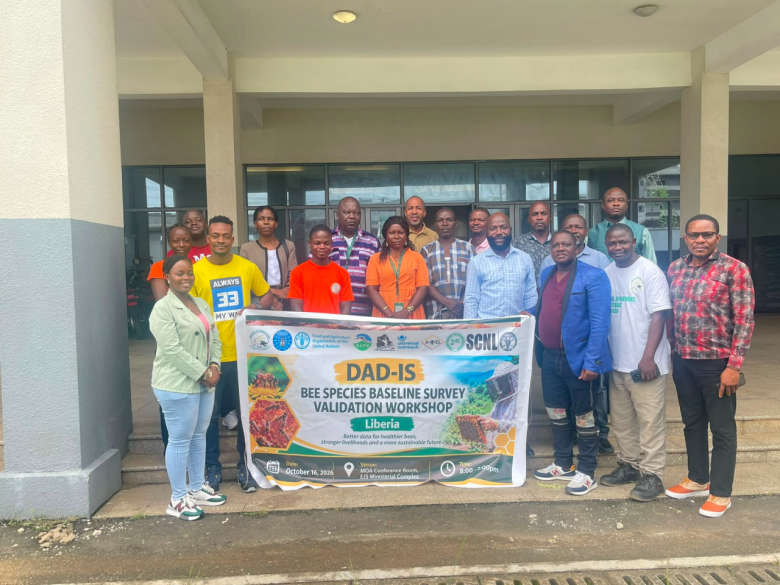
MONROVIA — The Ministry of Agriculture(MOA), in collaboration with the Society for the Conservation of Nature Liberia (SCNL) and other partners, has convened a national workshop to validate findings from Liberia’s first national honeybee survey, aimed at establishing baseline data to guide the development of the country’s beekeeping industry.
By Francis G. Boayue
The validation workshop held over the weekend brought together stakeholders in agriculture, beekeeping and conservation to review the survey findings, identify challenges facing honey producers, and recommend measures to strengthen production, improve market access, and promote sustainable beekeeping practices.
The survey covers Liberia’s 15 counties and seeks to establish baseline information on the number and distribution of beekeepers, honey production trends, harvesting methods, and the marketing of honey products.
Austin G. Yeanay, Director of Extension at the Ministry of Agriculture, welcomed participants and expressed optimism that the findings would provide useful information to advance the sector.
Yeanay acknowledged that the survey process had faced delays but said the information gathered from the field would provide a basis for discussions and further action. He encouraged participants to carefully review the findings and contribute to deliberations that would help move the beekeeping sector forward.
Cecil S. Wilson, Country Director of Universal Outreach, said the survey presented an opportunity to understand the current state of beekeeping in Liberia, particularly in areas where organizations have supported the activity for several years.
Wilson, who said he had spent 14 years working in Liberia, noted that the initiative would help stakeholders assess developments in the sector and identify barriers to its growth.
He urged participants to pay close attention to the findings and provide meaningful contributions to ensure the final report accurately reflects the realities of beekeeping across the country.
Michael E. Taire, Program Manager of SCNL, described the survey as significant, noting that Liberia had not previously conducted a national assessment of honey production.
According to Taire, the findings will establish a baseline against which future changes in the number of beekeepers, production levels, and market participation can be measured.
He explained that the survey examines the number of farmers engaged in honeybee production, their geographic distribution, harvesting practices and the plant species that attract bees.
The assessment also considers how beekeepers process, package and market their products, including whether they sell locally or supply supermarkets and other larger markets.
Taire said the information would help stakeholders determine whether honey production is increasing or declining and identify opportunities to improve the competitiveness of Liberian honey.
He added that the findings could inform strategies to expand market access and explore opportunities for exporting Liberian honey to other countries.
The initiative is supported by the Food and Agriculture Organization of the United Nations (FAO) through the Apimondia program, with the Ministry of Agriculture taking the lead in collaboration with SCNL and other organizations involved in beekeeping development.
Other partners identified during the workshop included the Wild Chimpanzee Foundation, Samaritan’s Purse, Universal Outreach, and the Association of Beekeepers of Liberia. The names and roles of participating organizations will need confirmation before publication.
Beyond agricultural production, Taire said beekeeping also contributes to environmental conservation because honeybees depend on flowering plants, including those found in forests and agricultural areas.
He encouraged communities, particularly those living near forest areas, to embrace beekeeping while protecting forests and planting trees that provide suitable habitats and food sources for bees.
According to him, maintaining healthy forest ecosystems can support honey production while advancing broader conservation efforts. The validated report is expected to provide the Ministry of Agriculture and its partners with information to guide interventions, address challenges confronting beekeepers, and strengthen the development of Liberia’s honey production industry.
Support Independent Journalism
Your support helps FrontPage Africa continue delivering independent, credible, and impactful journalism. Every contribution strengthens our ability to investigate, inform, and hold power accountable while keeping quality journalism accessible to our readers.
Support our journalism or subscribe to receive the latest FrontPage Africa stories and updates.