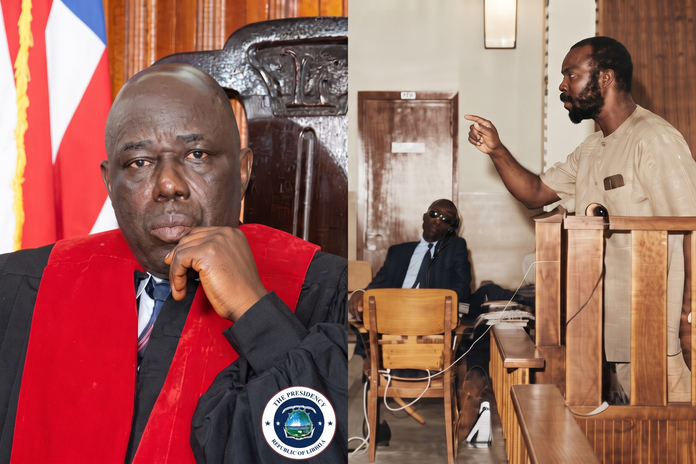
Liberia’s Supreme Court is approaching a moment that could shape the boundaries of legislative power for generations. On October 22, five justices are scheduled to hear arguments in the case of Representative Yekeh Kolubah, whose controversial expulsion from the House of Representatives has transformed a disciplinary confrontation into a far-reaching test of constitutional government.
By Dr. Clarence R. Pearson, Sr., contributing writer
The dispute is no longer simply about whether one outspoken lawmaker deserved punishment. It concerns whether the Legislature, empowered to regulate its own proceedings, may exercise that authority without meaningful judicial scrutiny, particularly when allegations arise that its actions disregarded an order of the Supreme Court.
A Notice of Assignment dated October 14 identifies Kolubah as appellant and the House of Representatives, Speaker Richard Nagbe Koon, Deputy Speaker Thomas Fallah, and legislative officials as appellees. Chief Justice Yamie Quiqui Gbeisay and four associate justices are listed for the October Term hearing.
The document establishes the hearing date, not the merits of either party’s arguments. That distinction is essential.
Scheduling oral arguments does not establish that the House acted unlawfully, that Kolubah’s expulsion was constitutionally justified, or that either side will prevail.
Yet the constitutional stakes are substantial.
Article 38 of Liberia’s 1986 Constitution authorizes each legislative chamber to establish its rules, enforce order, and expel a member for cause with a two-thirds vote of its entire membership. This provision recognizes a necessary institutional power. Legislatures cannot function effectively when misconduct obstructs deliberation, threatens colleagues, or undermines parliamentary order.
But Article 38 does not exist in constitutional isolation.
Article 15 protects freedom of expression, while Article 17 safeguards peaceful assembly, association, petitioning, and citizens’ ability to instruct their representatives. Article 20(a) protects due process, and Article 2 establishes constitutional supremacy while assigning the Supreme Court final authority over constitutional questions.
These provisions create a demanding legal question: Where does legitimate legislative discipline end, and unconstitutional punishment begin?
Kolubah’s expulsion, reportedly supported by 49 representatives in April, followed accusations of misconduct and statements considered threatening or damaging to national security. His defenders characterize the action as political retaliation against a confrontational opposition voice. His critics argue that elected office cannot become a sanctuary for intimidation or persistent disregard of legislative rules.
Neither argument should be dismissed automatically.
Freedom of expression does not necessarily immunize legislators from disciplinary consequences for genuinely unlawful threats or serious misconduct. Conversely, legislative majorities cannot convert political irritation, offensive criticism, or dissent into constitutional grounds for expulsion merely by attaching the language of national security.
The distinction must depend on identifiable conduct, established rules, reliable evidence, and a procedurally fair determination.
The proceedings themselves deserve close examination. Reports indicate that Kolubah’s lawyers requested additional time and access to evidence, while a legislative committee restricted their participation. Those circumstances raise questions about whether the accused received a meaningful opportunity to answer the allegations before the ultimate sanction was imposed.
More consequential is the reported confrontation over judicial authority.
On April 16, Associate Justice Yussif Kaba directed the House to suspend further proceedings pending judicial consideration. The House nevertheless proceeded with the expulsion on April 17. Subsequent reporting identified a dispute over the delivery and service of the court’s directive.
That complication matters. A court examining alleged defiance must distinguish deliberate disobedience from a genuine procedural dispute concerning notice, service, or the legal effect of an order.
Nevertheless, constitutional government cannot survive if institutions recognize judicial authority only when its decisions are politically convenient.
The Supreme Court must also avoid the opposite danger: substituting judicial preferences for legitimate legislative judgment. Its responsibility is not to determine whether Kolubah is politically agreeable, but whether the House acted within constitutional boundaries.
The hearing therefore presents several interconnected questions. Was the disciplinary process fundamentally fair? Did the alleged conduct constitute sufficient cause for expulsion? Was the judicial stay legally operative when the House acted? And what remedy would appropriately address any constitutional violation?
The consequences extend beyond Kolubah. Expulsion removes an elected representative and potentially deprives thousands of constituents of their chosen voice in government. Such authority must be exercised with exceptional care.
Liberia’s constitutional architecture rests on a straightforward proposition: no branch possesses unlimited power.
The Supreme Court’s approaching hearing offers an opportunity to reaffirm that principle without diminishing legitimate legislative independence.
Whatever the eventual judgment, its credibility will depend on transparent reasoning, fidelity to constitutional text, and equal application of the law.
The ultimate question is not whether Yekeh Kolubah should be admired, condemned, or politically defeated. It is whether Liberia’s institutions can demonstrate that constitutional authority remains stronger than institutional rivalry.
A republic proves its commitment to the rule of law not when its branches agree, but when they disagree and still submit to the Constitution.
Support Independent Journalism
Your support helps FrontPage Africa continue delivering independent, credible, and impactful journalism. Every contribution strengthens our ability to investigate, inform, and hold power accountable while keeping quality journalism accessible to our readers.
Support our journalism or subscribe to receive the latest FrontPage Africa stories and updates.