Liberia’s political crisis, President Tolbert’s African ambitions, American strategic interests, and the declassified documents that raise new questions about April 12, 1980.
By Derek M. Moore, contributing writer
Twenty-two days before President William R. Tolbert Jr. was assassinated, Gerald Funk, a member of President Jimmy Carter’s National Security Council staff at the White House in Washington, prepared a confidential memorandum dated March 21, 1980, for Zbigniew Brzezinski, Carter’s National Security Adviser. The memorandum warned that Liberia’s political situation was deteriorating and examined the growing pressures confronting Tolbert’s government.
What makes this document particularly revealing is that Washington’s concerns extended beyond Liberia’s political stability. Funk identified valuable American strategic interests, including the Omega navigation station, Voice of America facilities, regional communications infrastructure, and access to Roberts International Airport and the Port of Monrovia. The memorandum acknowledged that the United States received considerable benefits from these arrangements while Liberian officials increasingly complained that Washington was taking their country for granted.
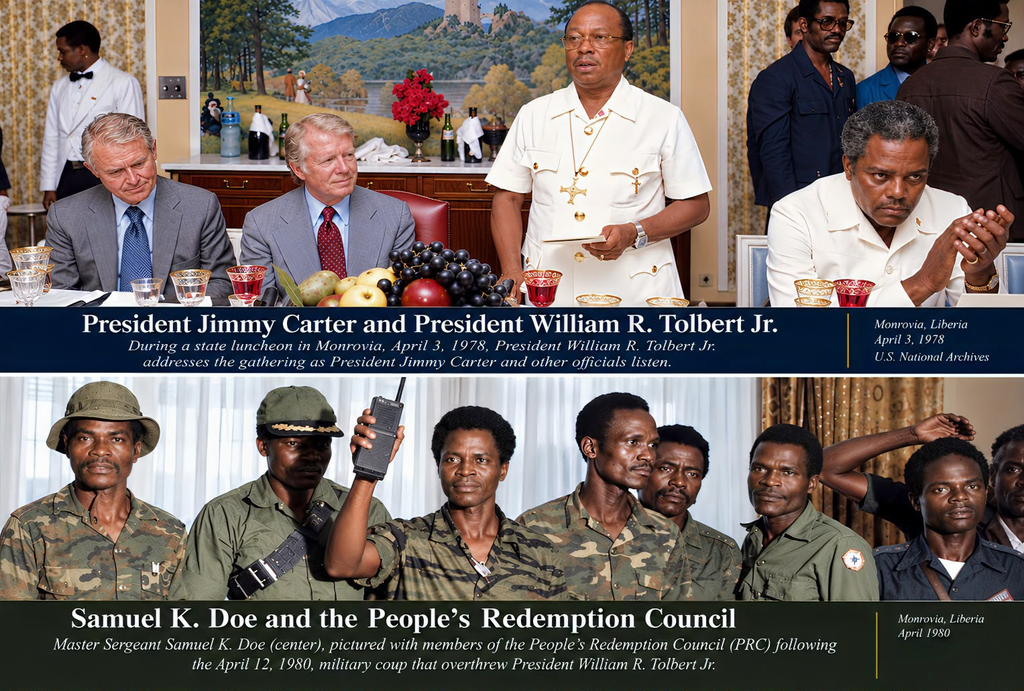
Then came April 12, 1980. Tolbert was killed, soldiers led by Master Sergeant Samuel Kanyon Doe seized power, and Liberia entered a new political era. Within weeks, American officials were discussing how to influence the new government, including through covert activities.
Nearly half a century later, these declassified records raise questions worth examining. What did Washington actually know before the coup, and how far was it prepared to go afterward?
In researching this history, I examined a controversial 2010 account by Ijoma Robert Flemister, a later response by Liberian scholar Dr. Emmanuel Dolo, findings from Liberia’s Truth and Reconciliation Commission, and American government documents covering the final months of Tolbert’s presidency and the early days of Doe’s administration.
What emerges is a complicated history involving Liberia’s internal political failures, Tolbert’s ambitions for Africa, American strategic interests, and allegations that still require independent verification.
The Warnings Liberia Failed to Resolve
To understand April 12, we must first examine the political environment that existed before soldiers entered the Executive Mansion. For generations, political power had been concentrated within the True Whig Party establishment. Although Tolbert introduced reforms intended to broaden participation and promote national integration, many indigenous Liberians continued to experience significant political and economic disadvantages. His efforts also encountered resistance from conservative elements within his own political establishment.
Meanwhile, rising living costs, unemployment, inequality, and demands for accountability were placing increasing pressure on the government. Liberia’s dependence on iron ore and rubber exports also exposed the economy to fluctuations in international markets. The April 14, 1979, Rice Riots brought these frustrations into the open. What began as opposition to a proposed rice-price increase developed into widespread violence, exposing grievances that extended far beyond the cost of the country’s staple food.
The Brownell Commission, established to investigate the disturbances, identified serious economic and political problems. As discussed in Dr. Dolo’s examination and Liberia’s Truth and Reconciliation Commission report, its recommendations included amnesty for those arrested and attention to demands for accountability from senior officials.
Tolbert did not entirely ignore these warnings. On June 22, 1979, he announced an amnesty for people imprisoned following the riots. His administration also established a Code of Conduct Committee, reshuffled the cabinet, and pursued reforms within the True Whig Party. Yet these measures failed to restore lasting public confidence or resolve the deeper struggle over political participation.
The confrontation intensified in the months that followed. Controversy surrounding Monrovia’s proposed mayoral elections, including Dr. Amos Sawyer’s challenge and disputes over voter qualifications, raised further questions about the openness of the political system. On January 8, 1980, the People’s Progressive Party was legally registered, marking an important development in the struggle for multiparty politics. But tensions escalated when the PPP called for the resignation of the president and vice president. The government subsequently banned the party and arrested opposition figures.
By April, Liberia was confronting not simply economic dissatisfaction but a broader crisis of political legitimacy. The country had experienced months of unrest, reform attempts, and confrontation, while confidence in the government’s ability to manage the crisis continued to deteriorate.
Tolbert’s African Vision and Washington’s Interests
While confronting these difficulties at home, Tolbert was pursuing an ambitious international agenda. As chairman of the Organization of African Unity, he was involved in discussions concerning African economic independence, Angola, Namibia, Zimbabwe, and the struggle against minority rule in Southern Africa.
On October 2, 1979, Tolbert met President Jimmy Carter at the White House. The declassified memorandum of their conversation confirms that he advocated greater African economic independence, arguing that political sovereignty remained incomplete while African nations continued to depend economically on foreign powers.
Yet the same meeting reveals a more complicated relationship. Tolbert requested additional American development, agricultural, and military assistance while urging Washington to adopt more constructive positions on African affairs. He also sought help improving military housing, recognizing the poor conditions affecting Liberia’s armed forces.
Tolbert wanted Africa to exercise greater control over its future without abandoning Liberia’s longstanding relationship with the United States. Maintaining that balance was particularly difficult during the Cold War, when Africa’s political and economic direction carried considerable international significance. Liberia also provided Washington with important strategic facilities, including the Omega navigation station, Voice of America installations, communications infrastructure, and access to Roberts International Airport and the Port of Monrovia.
In October 1979, President Carter approved a proposal for a special Presidential Commission on U.S.–Liberian Relations to examine difficulties and recommend ways to strengthen cooperation. Its planned visit was later canceled following the change in government. This does not rule out undisclosed American activities, but it demonstrates that Washington was also pursuing formal diplomatic measures to improve relations with Tolbert’s administration.
The Allegations That Challenge the Familiar Story
In April 2010, Ijoma Robert Flemister published a letter alleging that Tolbert’s overthrow was connected to his support for greater African control over natural resources and his refusal to accommodate certain American strategic interests. Flemister claimed that President Carter offered Liberia $100 million in exchange for military basing rights in Grand Gedeh County and expanded American intelligence authority. According to his account, Tolbert refused, and the United States subsequently orchestrated his removal. He went further, alleging that Americans participated in the events surrounding Tolbert’s assassination.
Flemister raised another allegation that deserves examination. He claimed that President Tolbert was scheduled to travel to Southern Rhodesia, now Zimbabwe, on April 14, 1980, just two days after the coup, as the country prepared for independence on April 18. According to Flemister, Tolbert’s involvement in African liberation diplomacy made his removal desirable to Western interests.
Tolbert’s involvement in Southern African affairs is well documented, particularly through his leadership of the Organization of African Unity and his discussions with President Carter. However, I have not found independent confirmation of the alleged April 14 travel itinerary or evidence establishing that his assassination was intended to prevent his participation in Zimbabwe’s independence celebrations.
These are serious accusations, particularly because Flemister claimed firsthand knowledge of confidential diplomatic discussions. However, the declassified records examined do not corroborate the proposed military-base agreement or establish American responsibility for the coup.
His account also contains chronological inconsistencies. He refers to the Uruguay Round of international trade negotiations, which began in 1986, and connects events surrounding the 1980 coup to President Reagan, who did not assume office until January 1981. References to George Shultz’s position during the early post-coup period also require scrutiny because Shultz did not become Secretary of State until July 1982. These errors do not automatically invalidate every recollection, but they weaken the reliability of the account and make independent verification essential.
Dr. Emmanuel Dolo’s 2017 response offers a different interpretation, emphasizing the domestic political and economic conditions that undermined Tolbert’s government. His discussion of the Brownell Commission, political exclusion, inequality, and resistance to reform provides important context that Flemister’s account largely dismisses. Both perspectives deserve examination, but neither should be accepted without testing its claims against contemporary evidence.
Twenty-Two Days Before the Coup
On March 21, 1980, National Security Council official Gerald Funk prepared a confidential memorandum for Zbigniew Brzezinski, President Carter’s National Security Adviser. Funk described Liberia’s political situation as serious and worsening. He identified economic pressures, rising expectations among urban workers and non-Americo-Liberians, and resistance to reform within the established political order.
The memorandum also acknowledged that the United States received substantial strategic benefits from its relationship with Liberia at relatively modest cost. American officials recognized Liberian frustration that Washington was taking the country for granted, even as they sought to preserve access to facilities considered valuable during the Cold War. Washington was clearly concerned about Liberia’s instability and its own strategic interests, but the memorandum does not establish that American officials knew a specific coup was being planned.
In May 1979, Foreign Minister Cecil Dennis expressed concerns to American officials about possible Soviet encouragement of the Rice Riots. However, he acknowledged that the Liberian government could not document a specific connection. Whether directed at the Soviet Union or the United States, allegations involving foreign powers require evidence before becoming accepted history.
What the Declassified Documents Reveal
On April 12, 1980, soldiers led by Samuel Doe seized power and President Tolbert was killed at the Executive Mansion. The new military leadership denounced corruption and the failures of the old political order, promising a different future for Liberia. A contemporary United Press International dispatch relayed through the American Embassy reported Doe’s efforts to establish contact with both American and Soviet diplomatic representatives.
Twelve days later, on April 24, senior American officials met to discuss Liberia’s rapidly deteriorating situation. The meeting records reveal that intelligence officials were still considering competing explanations of the coup’s origins, including whether it had developed spontaneously or resulted from longer-term planning. They also discussed the breakdown of command within Liberia’s armed forces, the safety of American citizens, and possible military evacuation contingencies. These discussions demonstrate Washington’s concern about an unstable new government, not proof that American officials had directed the coup.
By May 7, American officials were discussing assistance to Doe’s administration while weighing concerns about human rights, instability, and the political direction of the military leadership. On May 23, senior officials considered covert assistance, including political and administrative advice, intelligence and security support, and covert propaganda.
One particularly revealing proposal involved an adviser who would formally work for the Liberian government while reporting to the American Ambassador. Some State Department officials objected, concerned that such an arrangement could associate Washington too closely with Doe’s administration.
The subsequent presidential finding, signed by Jimmy Carter, authorized covert activities concerning Liberia. The accompanying operational description referred to assisting the new government and preserving its moderate, pro-Western orientation.
This is the central documentary finding: American authorization of covert activities after the coup is established. American orchestration of the coup itself has not been demonstrated by these records.
The presidential finding does not establish that every proposed activity was implemented. Nevertheless, it demonstrates that Washington was prepared to influence Liberia’s political direction through measures that were not necessarily visible to the Liberian public.
Liberia’s Truth and Reconciliation Commission later offered a more critical assessment of American influence, concluding that Washington’s policies had undermined Tolbert and favored political change as his government moved toward greater nonalignment. That conclusion deserves attention alongside the declassified records, but does not independently establish that American operatives planned or executed the April 12 coup.
The Questions History Still Owes Liberia
The soldiers who seized power promised a new political order, but the problems that helped undermine the old government did not disappear. Liberia continued to confront economic hardship, political divisions, and struggles over power, while repression and instability deepened in the years that followed.
The country would eventually experience years of civil conflict, leaving consequences that continue to affect Liberians today. This does not mean that every subsequent tragedy can be attributed directly to April 12, but it reminds us that overthrowing a government is not the same as building institutions capable of delivering justice, accountability, and opportunity.
For some Liberians, April 12 represented the end of a political system they believed had excluded them for generations. For others, it marked the beginning of a national tragedy. Many who initially welcomed the military takeover would later question whether the promised changes had justified the suffering that followed. Each of these experiences deserves to be heard because Liberians did not all experience April 12 in the same way, nor did they share the same expectations of what would come afterward.
The evidence confirms that Liberia was experiencing a serious domestic crisis, that Tolbert was pursuing African economic independence while maintaining a complicated relationship with Washington, and that American officials considered Liberia strategically important. It also establishes that the Carter administration authorized covert activities concerning the new government after the coup. What remains unproven is Flemister’s central allegation that the United States organized and executed Tolbert’s overthrow.
We should continue asking who planned the coup, what foreign intelligence services knew beforehand, what happened inside the Executive Mansion during Tolbert’s final hours, and whether additional records could clarify the circumstances surrounding his death. But we must also ask why Liberia’s political leadership failed to resolve the problems that its own investigators and reformers had identified.
For those of us who lived through that period, April 12 is more than a historical date. It represents a turning point whose consequences have touched generations of Liberians. For younger Liberians, understanding those events requires more than political slogans, family recollections, or competing accusations.
We do our history no service by ignoring the failures of Tolbert’s government. Neither do we serve it by dismissing legitimate questions about foreign influence without examining the evidence.
What concerns me most is how easily we inherit explanations of major events without examining the evidence ourselves. The documents now available allow us to ask better questions, challenge longstanding assumptions, and distinguish what can be established from what remains uncertain. We may never recover every detail of what happened inside the Executive Mansion that morning, but we should not stop searching for answers simply because the events occurred decades ago.
Liberia cannot change what happened on April 12, 1980. But we can change how carefully we examine it, how honestly we discuss it, and what we teach the generations who came afterward.
I Would Like to Hear From You
Do you believe the April 12, 1980, coup was primarily the result of Liberia’s internal political problems, or do you believe foreign interests played a greater role than has been acknowledged?
If you have firsthand knowledge, credible documents, or historical accounts that could help clarify these events, I welcome your contribution. Our history deserves careful examination, and the next generation deserves answers grounded in evidence.
For Readers Who Wish to Examine the Evidence
The following two declassified American government records are central to this investigation. Both are published in the U.S. Department of State’s official historical collection.
Document 1 — March 21, 1980
Memorandum from Gerald Funk to Zbigniew Brzezinski concerning Liberia’s worsening political situation and American strategic interests, 22 days before the coup.
https://history.state.gov/historicaldocuments/frus1977-80v17p2/d52
Document 2 — Presidential Finding, 1980 (Undated)
President Jimmy Carter’s authorization of covert activities concerning Liberia following the April 12 coup.
https://history.state.gov/historicaldocuments/frus1977-80v17p2/d61
These are authenticated government transcriptions.
#BackInTime #DidYouKnow #LiberianHistory #WilliamRTolbert #April121980 #RiceRiots #Liberia #AfricanHistory #DerekMoore
Support Independent Journalism
Your support helps FrontPage Africa continue delivering independent, credible, and impactful journalism. Every contribution strengthens our ability to investigate, inform, and hold power accountable while keeping quality journalism accessible to our readers.
Support our journalism or subscribe to receive the latest FrontPage Africa stories and updates.