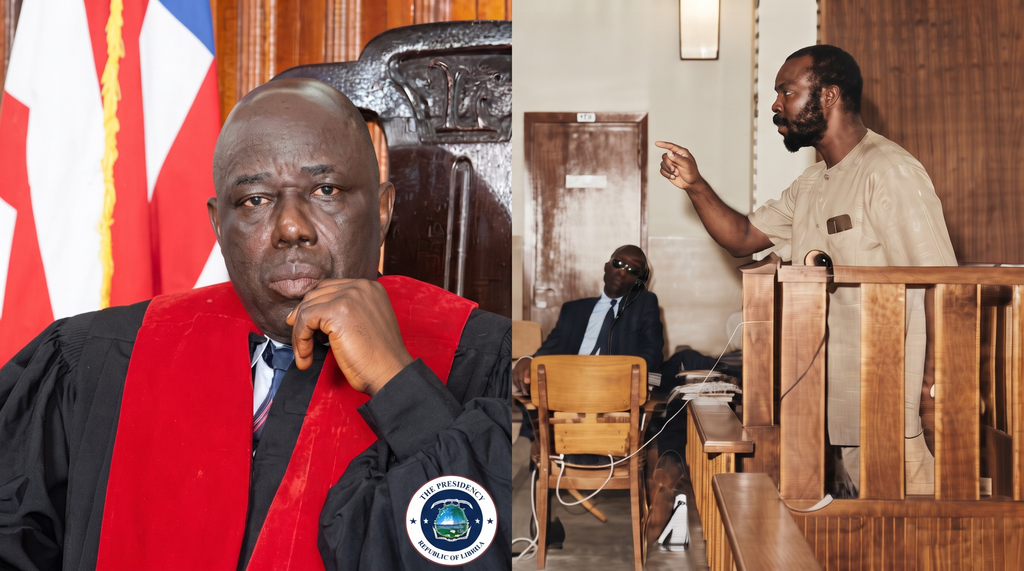
On Monday, October 12, standing before President Joseph Boakai and the nation’s senior officials at the opening of the Supreme Court’s October Term, Chief Justice Yamie Quiqui Gbeisay Sr. asked the Legislature to consider abolishing Liberia’s trial jury system. His case fit in one sentence: “A corrupt jury is worse than no jury at all.”
By George Fahnbulleh, Contributing Writer
It is a memorable line. It is also the wrong conclusion.
What unsettles me is a pattern I have watched for most of my life. Our officials are devoted constitutionalists right up to the moment the Constitution asks something hard of them. Then, instead of finding a solution inside the framework they swore to uphold, they propose removing whatever has become inconvenient to administer. That is not legal wisdom. It is institutional failure presented as reform.
What the Chief Justice Proposed
To be fair to the Chief Justice, he did not speak in abstractions. He pointed to reported jury tampering in Nimba, Grand Gedeh, Bomi, and Margibi counties, in cases ranging from rape to drug trafficking. In one Bomi County case, tampering surfaced weeks after an acquittal, and a judicial investigation concluded it had occurred. He also cited suspected interference at Criminal Court “C.”
Those are serious allegations, and nobody defending the jury should wave them away. Bribing or threatening a juror strikes at the heart of a fair trial. The Liberia National Bar Association condemned tampering while making clear that joining any review is not an endorsement of abolition. Senator Abraham Darius Dillon went further, pointing out that the right cannot be removed by ordinary legislation.
But this is not the first time the Chief Justice has set his sights on the jury. At his confirmation hearing in July 2025, his argument was about caseloads: the population and court dockets had grown, he said, and jury trials could not keep up. Now the justification is corruption. When the destination stays fixed while the reasons change, the public is entitled to ask which one is actually driving the proposal.
Why This Is Personal
My father was convicted by a jury during the presidency of William V. S. Tubman.
We knew how that trial would end. Every case the government brought in those years seemed to end the same way. The courtroom offered the form of due process—the robes, the oath, the citizens in the jury box—while the outcome felt settled before the first witness was called.
When we went looking for a lawyer, one of the country’s most respected law firms told us plainly: “We do not represent people charged with crimes against the government.”
I have carried that sentence for decades. It told a family that the nature of the accusation alone placed them beyond the help of the legal profession.
So I hold no romantic illusions about juries. A jury sat in my father’s case, and it did not save him.
But that experience leads me to the opposite of the Chief Justice’s conclusion. The jury did not fail my father on its own. It failed because the institutions around it—the prosecution, the bar, the courts, the presidency—were bent toward a predetermined result. Removing the citizens from that courtroom would not have made the outcome any less certain. It would only have made it more efficient.
The Constitution Is Not a Convenience
Liberia’s Constitution does not treat jury trial as an administrative option. Article 20(a) requires that justice be done without sale, denial, or delay, and guarantees the right to trial by jury in cases outside courts not of record, courts-martial, and impeachment. Article 21(h) guarantees anyone charged with a capital or infamous crime a speedy, public, and impartial jury trial, unless that person, with appropriate understanding, expressly waives it.
Notice where the choice sits. The Constitution allows the accused to give up a jury. It does not allow the state to take it away.
The Chief Justice understands this. In 2017, presiding over Criminal Court “C” in the Sable Mining bribery case, then-Judge Gbeisay reluctantly granted the defendants’ request to proceed without a jury, noting that jury trial was their right under Article 21(h). He was right then. The right belongs to the accused.
Nor can the Legislature abolish it by statute. Article 2 makes the Constitution supreme and voids any law inconsistent with it. Removing these guarantees would require an amendment under Article 91: a proposal backed by two-thirds of both houses, followed by a national referendum held no sooner than a year later.
The Chief Justice is free to advocate for that. But the existence of an amendment process does not make every amendment wise. The head of the branch charged with interpreting and defending the Constitution should be the last official, not the first, to propose shrinking the rights it guarantees.
Removing the Jury Does Not Remove the Corruption
Here is the flaw at the center of the proposal. If jurors can be bribed, intimidated, or pressured, what makes us confident a judge cannot?
Judges bring training and experience, and both matter. Neither is a vaccine against money or fear. A briber who today must reach several jurors would, under this plan, need to reach just one person. Concentrating the verdict in fewer hands does not shrink the target for corruption. It makes the target easier to find and more valuable to hit.
Consider, too, who would guard the new system: the same judiciary that, by the Chief Justice’s own account, has watched tampering spread across several counties. If the courts cannot protect a jury from a bribe, the public deserves to hear how those same courts will protect a judge from one.
The honest comparison is not between a corrupt jury and an ideal judge. It is between a jury system with its flaws and a bench system with its own. The advocates of abolition have described only one side of that comparison.
The President’s Charges, the President’s Judge
This is the part I find hardest to accept.
Under the Constitution, the President nominates judges and appoints them with the consent of the Senate. Judges then hold office during good behavior, and I do not claim that every appointed judge answers to the Executive Mansion. Many have shown real independence.
But picture a citizen charged in a politically sensitive case. The government brings the charges. A judge appointed by the President hears them. Under the Chief Justice’s proposal, that judge alone would decide guilt. What independent check would remain between that citizen and the power of the state?
That question is not academic in Liberia today. The same week the Chief Justice floated abolition, the Liberia Council of Churches warned that justice must not become an instrument of political revenge, as former ministers were convicted in a high-profile case. Whatever one thinks of any particular verdict, a country prosecuting its former officials should be strengthening the safeguards around those trials, not removing them.
For a family like mine, the question answers itself. We learned what it means to face the state when every lever of the process points in the same direction. The answer to that danger is more independent judgment in the courtroom, not less.
What Real Reform Would Look Like
If tampering is as widespread as the Chief Justice says, Liberians are owed a plan, not a surrender. Serious reform would start here:
Prosecute the tamperers. Every bribe has a giver and often a go-between. Identify them, charge them, and publish the outcomes. Tampering will continue as long as corrupting a jury costs less than answering for it.
Clean up jury selection. Make the compiling and drawing of jury lists transparent and auditable, so no one can handpick a compliant panel.
Protect jurors. Sequester or shield jurors in high-risk cases, restrict outside contact, and give them a safe way to report an approach.
Pay jurors fairly and on time. A juror who has gone unpaid for weeks and cannot afford the ride home is a juror someone else can rent.
Hold the whole system accountable. Jurors do not bribe themselves. Lawyers, court staff, and anyone else who brokers influence must face the same scrutiny.
Measure the results. Report how many tampering complaints are filed, investigated, and prosecuted, and whether the reforms are working.
Some of these steps need funding, and some need new legislation. All of them fit within the Constitution. None of them requires asking citizens to give up a right because the state failed to protect it.
The Test of a Constitutionalist
It is easy to praise the Constitution at ceremonies. The real test comes when upholding it demands discipline, money, and confrontation with powerful people. That is exactly when a Chief Justice is supposed to lead.
Liberians should not be forced to choose between a jury that can be bought and a judge they are simply asked to trust. That is a false choice. We should demand impartial juries, independent judges, an ethical bar, and court administrators who answer for what happens on their watch.
Mr. Chief Justice, investigate the corruption. Prosecute those responsible. Propose the safeguards and fight for the resources. But do not ask ordinary citizens to pay for the system’s failures with their constitutional rights.
I know what it feels like for a family to sit in a courtroom and believe the verdict was written before the trial began. Liberia’s task is to make that fear less justified, not to leave the next family with even fewer protections when they face the power of the state.
Support Independent Journalism
Your support helps FrontPage Africa continue delivering independent, credible, and impactful journalism. Every contribution strengthens our ability to investigate, inform, and hold power accountable while keeping quality journalism accessible to our readers.
Support our journalism or subscribe to receive the latest FrontPage Africa stories and updates.