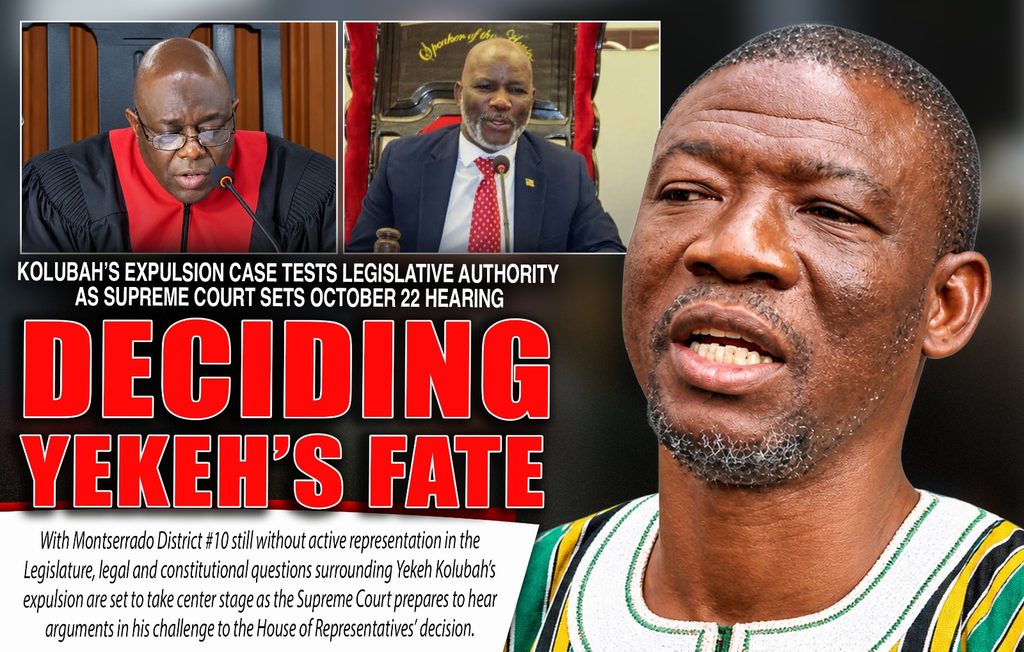
MONROVIA – What started as a political controversy over remarks by Montserrado County District 10 Representative Yekeh Y. Kolubah has grown into one of the most consequential confrontations between Legislature and judiciary in recent years. On Thursday, October 22, 2026, at 11:00 a.m., the Supreme Court will hear his appeal against an expulsion that 49 lawmakers approved on April 17.
By Selma Lomax, [email protected]
The Court’s October 14 notice, signed by Clerk Cllr. Sam Mamulu, schedules arguments. It does not announce a decision, and it does not promise a judgment on the day. Nearly six months after the vote, the case is returning to the full bench, and its outcome may turn less on politics than on a question of procedure.
A border comment becomes a disciplinary case
The dispute traces back to statements attributed to Kolubah during a sensitive period in the country’s territorial disagreement with Guinea. According to communications later presented to the House, he suggested that contested territory belonged to Guinea. Some lawmakers and security officials reacted with alarm.
Inspector General of Police Gregory Coleman wrote to the House warning that such statements, made by an elected official without an established legal, diplomatic or treaty basis, could unsettle border communities. He also reported that Guinean authorities and affiliated actors had begun referencing the remarks, which he feared could lend weight to claims unfavorable to Liberia. In his view, lawmakers carry a heightened responsibility when speaking about sovereignty, and reckless statements could raise concerns about breaches of the peace.
That argument immediately raised a competing constitutional question. Can an elected legislator be expelled for a controversial opinion on a national issue? Or can such statements, depending on their nature and consequences, amount to misconduct serious enough to justify the harshest sanction a chamber can impose?
The matter reached the House through two communications: one from the Montserrado District 3 Representative, Sumo Mulbah, seeking expulsion for alleged misconduct and violation of his oath, and the other from Coleman. Montserrado District 4 Representative and lawyer Michael Thomas then moved that the Committee on Rules, Order and Administration investigate and report to Plenary during the special session. Speaker Richard Nagbe Koon urged Kolubah to cooperate with the process.
The vote
On April 17, the House voted to expel Kolubah. Article 38 of the Constitution lets each chamber set its rules, maintain discipline and expel a member with the concurrence of two-thirds. Forty-nine votes clear that threshold in a 73-member chamber, so the numbers have not been the weak point of the House’s position.
The more contested question is whether the process leading to the vote met constitutional and procedural standards. Expulsion differs sharply from a reprimand or suspension. It removes an elected official from the institution and strips a constituency of its chosen representative, which is why the safeguards surrounding it matter as much as the count.
The hearing Kolubah left
The House’s lawyers say he was given the opportunity to answer the allegations but walked away from the hearing convened for that purpose. Having left voluntarily, they argue, he cannot credibly claim he was denied due process.
Kolubah’s challenge disputes the legality of the process. Accounts of the proceedings have also raised questions about whether his lawyers had a real chance to participate, obtain evidence and prepare a defense. Those allegations would require examination of the disciplinary record before anyone could draw firm conclusions.
The disagreement illustrates a distinction between holding a hearing and providing a meaningful opportunity to be heard. Article 20(a), which protects due process, generally requires adequate notice, understanding of the allegations, access to relevant evidence and a fair chance to respond. Yet an institution is not necessarily obliged to halt its proceedings whenever an accused member declines to take part. The legal weight of Kolubah’s departure depends on the circumstances around it.
The order and the vote
While the disciplinary process was underway, Kolubah’s lawyers sought help from the Supreme Court. According to accounts of the dispute, Associate Justice Yussif D. Kaba issued a directive on April 16 concerning the continuation of the House’s proceedings. The House voted to expel him the next day.
That sequence became the foundation of Kolubah’s case. His lawyers argue the Legislature acted in disregard of judicial authority. The House replies that it was never properly served with the relevant documents and cannot be accused of violating an order it did not legally receive.
The dispute thus moved from legislative discipline into a question about the authority of the courts. Article 2 establishes the supremacy of the Constitution, and no branch of government has unlimited power. But showing that an institution defied an order requires proof of the order’s legal effect and of notice delivered in the manner the law prescribes. Acting after a directive was reportedly issued does not, by itself, establish deliberate defiance.
The Bill of Information and the House’s defense
Kolubah’s lawyers filed a Bill of Information alleging violations of judicial directives and due-process protections. On April 29, the House’s lawyers asked for its dismissal. They argued that the House has constitutional authority to discipline and expel members, that Kolubah received due process but abandoned the hearing, that the judicial documents were not properly served, and that he failed to exhaust internal legislative remedies before going to court.
The service argument proved the most powerful. A government institution, the lawyers said, cannot be held responsible for an order never communicated to it through recognized procedures.
May’s ruling
In May 2026, Justice Kaba dismissed the Bill of Information for improper service. According to accounts of the ruling, the House had not been properly served with the writ and stay order. The Sergeant-at-Arms was identified as the official authorized to receive documents for the Legislature, and the papers had not reached that office through the required channel.
The decision was a significant setback for Kolubah, but its limits matter. It did not hold that the expulsion was constitutional, and it did not find that the allegations justified removal. It addressed the narrower question of whether the procedural conditions for enforcing the directive against the House had been met.
That means a procedural ruling can settle one legal challenge without resolving the underlying constitutional dispute. If the Supreme Court upholds the dismissal, it will not necessarily have examined or endorsed the disciplinary proceedings. Likewise, a win for Kolubah on service would not automatically prove the expulsion unconstitutional.
What legal practitioners expect
FrontPage Africa asked legal practitioners how the appeal might fare. Two lawyers, neither of whom authorized publication of their names, pointed to service as potentially decisive.
One said court documents must be served on officials legally authorized to receive them, and that delivery to anyone else may not establish that an institution got proper notice. He expressed doubts about Kolubah’s prospects. The other explained that service guarantees a party legally sufficient notice, ordinarily through a sheriff or marshal delivering papers to the right recipient. He called the earlier finding a serious weakness in Kolubah’s position.
Both framed their views as personal predictions, not knowledge of how the justices will rule. The justices must decide independently whether the earlier finding was correct and what follows from it.
The constitutional view
Political and social commentator Dr. Clarence R. Pearson Sr. has looked past service to the wider stakes. He sees the case as a test of whether the Court can avoid two dangers: letting legislative independence become immunity from constitutional scrutiny, and letting judicial oversight erode the Legislature’s legitimate authority over its own affairs.
Pearson notes that Article 38 must be read alongside Article 15 on freedom of expression, Article 17 on assembly, association and petition, Article 20(a) on due process and Article 2 on constitutional supremacy. A power to expel, he argues, does not make every use of it lawful. He cautions against treating dissent or controversial criticism as grounds for expulsion without examining the actual conduct, evidence and applicable rules, while acknowledging that free expression does not shield unlawful threats or serious misconduct.
He also insists the case should not become a referendum on Kolubah’s popularity or combative style. The analysis must rest on constitutional provisions.
District 10
The people of Montserrado County Electoral District 10 have been living with uncertainty since April. Article 37 provides for filling legislative vacancies through by-elections, but applying it is difficult while the legality of the removal is under challenge. If the expulsion stands, the vacancy questions return. If it is invalidated, the consequences differ.
One lawyer told FrontPage Africa that the by-election timetable should not be confused with the Supreme Court’s own scheduling, noting that cases can wait extended periods before assignment and that no general rule requires the Court to hear matters within the vacancy period. That is a legal point, but it does not remove the public-interest concern about prolonged uncertainty over an elected seat.
What the justices might do
The Court could uphold the dismissal, leaving the Bill of Information closed and the expulsion unexamined. It could instead find that the earlier ruling needs reconsideration and order further proceedings. It could also address the operation of the April 16 directive and the circumstances of the vote.
A favorable procedural ruling would not necessarily mean immediate reinstatement, since the Court might grant limited relief or direct a remedy aimed at a specific defect. An unfavorable ruling would not endorse every allegation against him. Predictions that Kolubah will automatically return or permanently lose his seat are premature.
A precedence that outlives the dispute
Whatever the result, the case is likely to be cited. A ruling on the limits of expulsion could shape future disciplinary proceedings and clarify when judicial review is available. A ruling stressing service could affect disputes involving ministries, agencies and other public bodies that become parties to litigation.
It is also a chance to reaffirm that constitutional protections apply regardless of political identity. An outspoken opposition lawmaker and a member aligned with House leadership are entitled to the same safeguards, and the House’s authority to discipline should not depend on the accused member’s popularity.
When the justices convene on October 22, the question will reach beyond whether Kolubah should have been expelled. It will be whether the process complied with the Constitution and whether the institutions wielding public
power stayed within the law. For a country that depends on the separation of powers, the answer may matter far more than the fate of a single seat.
Support Independent Journalism
Your support helps FrontPage Africa continue delivering independent, credible, and impactful journalism. Every contribution strengthens our ability to investigate, inform, and hold power accountable while keeping quality journalism accessible to our readers.
Support our journalism or subscribe to receive the latest FrontPage Africa stories and updates.