The late Guinean President Ahmed Sékou Touré: “We prefer poverty in freedom to wealth in slavery.”
“A starving child does not ask from which country comes his bread.” Former President of Guinea Ahmed Sékou Touré.
By: Austin S Fallah – True Son of the Planet Earth Soil: [email protected]
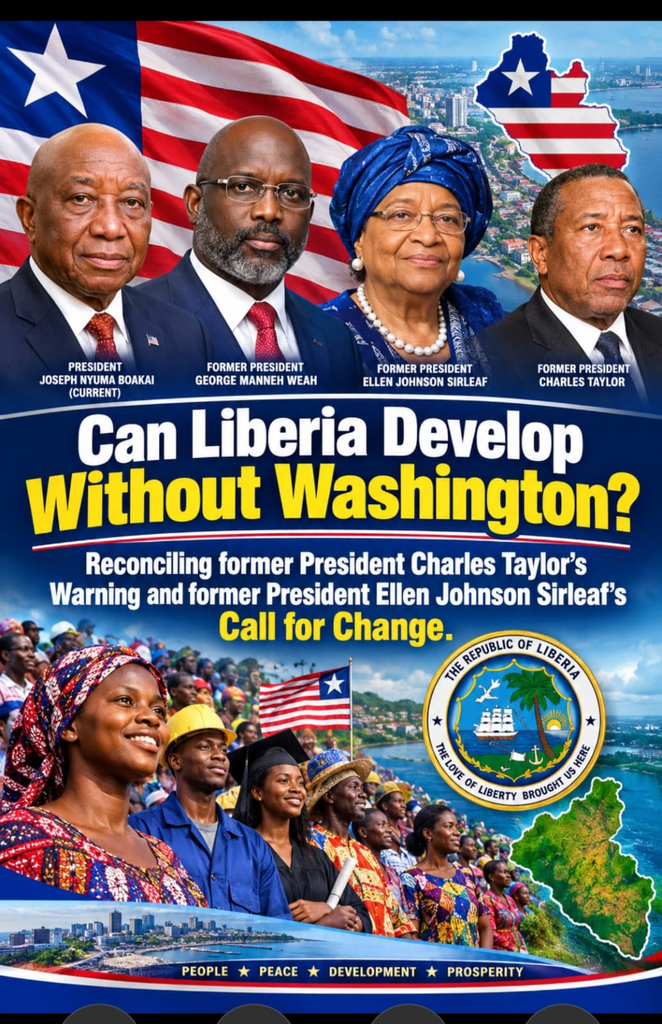
Former President Charles Taylor, in an interview in Nigeria during his exile in that country, said, ” A Liberian, unless you have it right with the United States, until the United States understands you, until you understand them, I think there will always be problems, and Liberia will not develop. He also said, “There is no neutrality in Journalism in the big countries when it comes to their national security.” During the interview, he made it clear that “No President of Liberia can make it successfully until they are in line with Washington.” Can Liberia or its president develop without Washington? Source: https://youtu.be/w2xNc8Z3BGQ?is=nF13hRtX1i6bGwtt
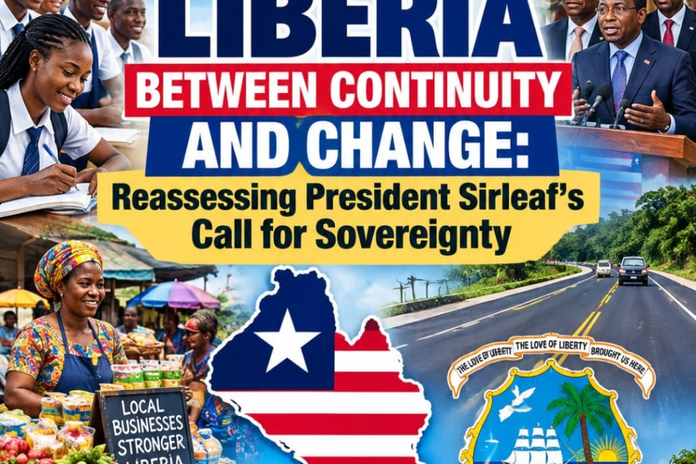
Former President Sirleaf: Liberia has been doing the same thing over and over, same structures, same type of policies, same type of attitudes, and mindset. It is time for change; Africa is changing, the world is changing, and Liberia can not be left behind. Source: Facebook, Voice of Liberia.https://www.facebook.com/share/v/18DEF7UL35/
Liberia’s historical relationship with Washington need not be understood as a choice between dependency and isolation.
The statements of former President Charles Taylor, former President Ellen Johnson Sirleaf, former President George Manneh Weah and President Joseph Nyuma Boakai suggest a third model: sovereign partnership, one in which Liberia actively engages the United States and other international partners for capital, technology, diplomacy and security while retaining domestic ownership of its institutions, resources, employment agenda and development priorities.
President Joseph Nyuma Boakai: “This country can only be built by Liberians with the help of others.”Global News Network Liberia.
President Boakai: “Growth must come with development, and growth must be equitable.”
President Boakai: “This country can only be built by Liberians with the help of others.”
President Boakai: “We believe we can make the relationship work to our benefit.”
President Boakai:In his January 22, 2024 inaugural address, Boakai made an unusually direct observation: “We believe we deserve more.” Global News Network Liberia. But he immediately balanced that argument with domestic responsibility:
President Boakai:“We cannot ask the United States to do for us what we can do for ourselves.”
Former President George Manneh Weah: “We hope our international development partners will assist us in this transformation.”
For President Weah: “Without peace, there can be no progress or development.”
Former President Weah: The 2021 State of the Nation message described Liberia’s foreign policy as engagement with partners: “Liberia remains positively engaged with its partners and friends at the bilateral and multilateral levels.”
Former President Ellen Johnson Sirleaf:Addressing the U.S. Congress in 2006, former President Sirleaf made an important qualification to the reconciliation project: “But while we seek national unity and reconciliation, we must not sacrifice justice.”
Former President Sirleaf:In an interview with Nigeria’s NTA,former President Sirleaf explained her diplomatic approach:“Together working we can strengthen and deepen the relationship between our two countries and our two peoples.”
The question of whether Liberia can develop without the help and input of Washington, DC, is not merely a foreign-policy question.
It is a question of power, history, sovereignty, national leadership, and Liberians’ responsibility to their own country.
Liberia’s connection to the United States is unusually deep. Liberia, given its name in the 19th century by settlers from the United States and sponsored in part by the American Colonization Society, has long had political, cultural, economic, and social ties with America.
English is Liberia’s official language; the United States influenced the country’s political institutions, and America has remained one of Liberia’s most important international partners.
Because of this history, many Liberians believe that Washington has significant influence over who governs Liberia, which policies succeed, and whether the country receives international support.
Former President Charles Taylor expressed this belief clearly during an interview in Nigeria while he was living in exile.
He stated that a Liberian leader must “have it right with the United States,” arguing that until Liberia and the United States understand each other, Liberia will continue to face problems and will not develop.
He went further by saying that no president of Liberia can succeed unless that president is “in line with Washington.”
On the other hand, former President Ellen Johnson Sirleaf argued that Liberia has been repeating the same mistakes: the same structures, policies, attitudes, and mindsets.
She insisted that Liberia must change because Africa is changing, the world is changing, and Liberia cannot afford to be left behind.
At first glance, these statements appear to conflict.
Former President Taylor’s view suggests that Liberia’s future depends on Washington, while former President Sirleaf’s statement emphasizes internal reform and national transformation.
However, the two views can be reconciled. Liberia needs constructive relations with the United States and other international partners, but Washington cannot build Liberia without Liberian leadership, accountability, productivity, and national unity.
Liberia’s development will not come simply from pleasing Washington, nor will it come from rejecting America or pretending that international power does not matter.
The country can develop only when Liberians take responsibility for reforming their institutions while wisely engaging the United States as a partner rather than treating it as a master, a savior, or an enemy.
Former President Charles Taylor’s statement should be understood in the context of Liberia’s political realities.
The United States has played an important role in Liberia for generations.
During the Cold War, Liberia was one of America’s strongest allies in Africa.
Its strategic location on the Atlantic coast, its open-door policy toward American investment, and its historic cultural connection to the United States made it especially valuable to Washington.
Liberia hosted important American communications and security facilities, including the Voice of America relay station and other strategic installations.
American companies also had enormous economic interests in the country, especially in the rubber industry through Firestone.
As a result, Liberian leaders have often believed that maintaining good relations with Washington is essential to political survival and economic stability.
Liberia’s relationship with the United States affects foreign aid, debt relief, international legitimacy, investment confidence, and security assistance, directly or indirectly.
A government that is isolated from Washington may find it harder to attract support from international financial institutions, donor nations, and private investors.
This does not mean the United States controls every decision in Liberia.
Yet it does mean that Washington’s opinion carries weight, particularly in a small, aid-dependent country recovering from war, poverty, weak institutions, and limited infrastructure.
Former President Taylor’s claim, therefore, contains a measure of truth.
A Liberian president who openly antagonizes the United States, violates democratic principles, encourages corruption, undermines peace, or becomes isolated internationally may face serious consequences.
Such consequences may include sanctions, a loss of foreign assistance, travel restrictions, damaged diplomatic relations, and declining investor confidence.
In the modern world, no country develops completely alone.
Even powerful nations rely on trade, diplomacy, technology, foreign investment, and strategic partnerships.
Liberia, with its small economy and substantial development needs, can not ignore the influence of the United States.
However, former President Taylor’s statement becomes problematic if interpreted to mean that Liberia has no agency or that its leaders must simply obey Washington to succeed.
That view reduces Liberia to a dependent state whose destiny is decided elsewhere.
It also excuses Liberian leaders from responsibility for their own failures.
If every economic problem, political crisis, or governance failure is blamed on Washington, then Liberians may overlook the internal causes of underdevelopment: corruption, misuse of public funds, weak public institutions, political favoritism, poor roads, inadequate schools, lack of reliable electricity, land disputes, unemployment, and the exclusion of ordinary citizens from meaningful economic opportunity.
This is where former President Ellen Johnson Sirleaf’s statement becomes especially important.
Former President Sirleaf identified a deeper problem: Liberia has often repeated the same patterns while expecting different results.
That also sounds like one of Hon. Alexander B Cummins the political leader of the Alternative National Congress political part, political, social, and economic important talking points.
The country has changed presidents, political parties, and international partners, but many old habits have remained.
These include centralized political power in Monrovia; a system in which public jobs are often treated as loyalty rewards; poor management of natural resources; weak law enforcement; and a tendency to put short-term political advantage above long-term national planning.
Foreign aid can help repair roads, train health workers, or support schools, but it cannot permanently solve these problems if the underlying attitudes remain unchanged.
Former President Sirleaf’s message is therefore a call for Liberians to look inward.
Development begins with national character, responsible institutions, and a shared commitment to the public good.
Liberia can not become prosperous if public officials treat public money as private property.
It can not attract sustainable investment if contracts are unclear, courts are weak, and businesses must rely on political connections to operate.
It can not educate its young people if teachers are unpaid, schools are neglected, and education policies change with every administration.
It can not create a strong health system if hospitals depend entirely on foreign donors and lack trained local personnel, medical supplies, and accountable management.
The devastating Ebola crisis of 2014 demonstrated both Liberia’s vulnerability and the importance of international partnership.
The United States played a major role in supporting Liberia’s response, including deploying personnel, building treatment units, providing logistical assistance, and helping mobilize international attention.
Without outside assistance, Liberia would have struggled even more severely.
Yet the crisis also revealed the consequences of weak domestic systems.
Liberia’s health infrastructure had been damaged by years of conflict, neglect, and insufficient investment.
Foreign support helped save lives, but the long-term lesson was that Liberia must build a health system capable of protecting its people before the next emergency arrives.
The same principle applies to every sector.
International assistance is most effective when it strengthens local capacity rather than replacing it.
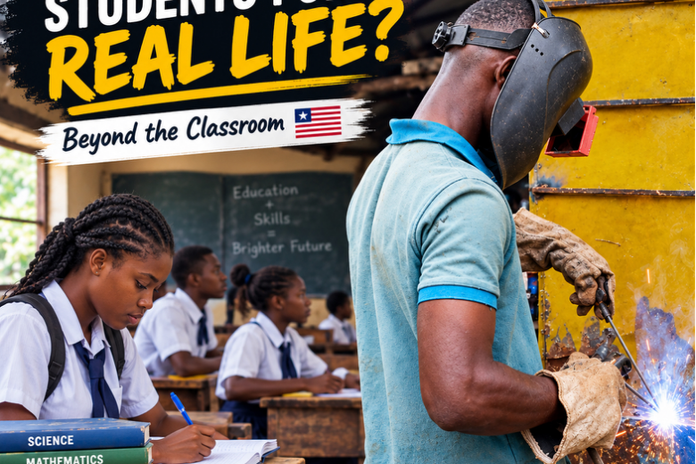
If Washington provides aid for education, Liberia must ensure that schools are managed honestly, teachers are trained, and students learn skills that prepare them for employment.
If foreign investors enter the mining, agriculture, forestry, or energy sectors, Liberia must negotiate fair agreements, protect communities, enforce environmental standards, and ensure that national resources benefit the broader population rather than a small political or business elite.
If the United States supports democracy and elections, Liberian political leaders must accept election results, reject violence, respect the courts, and place the country above personal ambition.
In this sense, Liberia does not need to choose between Washington and self-reliance.
It needs a mature relationship with Washington.
A mature relationship is not based on dependency, fear, or blind loyalty.
It is based on mutual interests, mutual respect, and honesty.
Liberia should welcome American support in areas such as health, education, infrastructure, agriculture, anti-corruption efforts, security-sector reform, entrepreneurship, and technology.
At the same time, Liberia should not shape every national decision merely to satisfy foreign expectations.
A government’s first responsibility is to the Liberian people.
Washington can offer advice, assistance, and partnership, but Liberia must determine its own priorities through democratic institutions and public participation.
For example, Liberia’s economic development should not depend on extracting raw materials and exporting them without building local industries.
The country has rich natural resources, including iron ore, gold, diamonds, timber, rubber, fertile land, and a long coastline.
Yet natural wealth alone does not guarantee development.
Many resource-rich countries remain poor because they mismanage wealth or allow a few individuals to capture it
Liberia must invest resource revenues in roads, electricity, clean water, schools, hospitals, and agricultural development.
It must support farmers, especially rural women and young people, so that food production can reduce dependence on imports.
It must invest in vocational education, information technology, and small businesses so that young Liberians can find jobs outside of politics and the civil service.
Washington can assist with these goals, but it cannot create the political will to achieve them.
Only Liberians can do that. The most important question is not whether America will help Liberia.
The more important question is whether Liberians are prepared to build a system worthy of help.
Donors are more willing to invest in countries where funds are used transparently, laws are respected, and projects are completed.
Investors are more willing to create jobs where the government is stable and contracts are honored.
Citizens are more willing to pay taxes and obey laws when they believe leaders are serving the nation rather than themselves.
Development grows from trust, and trust grows from accountability.
Former President Taylor’s comments about journalism and national security also deserve careful consideration.
His assertion that there is no neutrality in journalism in major countries when national security is involved reflects a common concern that powerful countries use media and information to protect their interests.
It is true that media institutions, governments, and international organizations may all have biases.
Liberia should be aware of this reality and should not accept every foreign narrative without question.
However, the answer is not to attack press freedom or to dismiss criticism as foreign interference.
Liberia needs stronger, more independent journalism, not weaker journalism.
A free press can expose corruption, investigate abuse, give citizens information, and hold leaders accountable.
The country’s national security is not protected by silence; it is protected by transparent institutions, public trust, and leaders who govern responsibly.
Ultimately, the statements of former President Taylor and former President Sirleaf can be reconciled by recognizing that both external and internal factors matter.
Former President Taylor was correct that Liberia cannot ignore Washington’s influence.
The United States remains an important diplomatic, economic, humanitarian, and security partner.
A president who completely disregards that reality may make Liberia’s challenges more difficult.
But former President Sirleaf was more correct in identifying the central obstacle to lasting development: Liberia must break the cycle of repeating failed policies, outdated structures, and destructive attitudes.
Liberia can develop with Washington, but it can not develop because of Washington alone.
It can also develop without being controlled by Washington, provided that it builds strong institutions and broad partnerships with Africa, the United States, Europe, Asia, regional organizations, private investors, and the Liberian diaspora.
The country’s future should not rest in one foreign capital.
It should rest in the hands of Liberians who are willing to demand better leadership, reject corruption, educate their children, protect their resources, respect the rule of law, and work together across ethnic, political, and social divisions.
The final answer, then, is that Liberia’s development depends first on Liberians.
Washington can be a valuable ally, but it can not substitute for national responsibility.
A Liberian president does not need to be “in line” with Washington in the sense of surrendering the nation’s independence.
Rather, that president must be wise enough to maintain productive international relationships while remaining accountable to the Liberian people.
Liberia will move forward when it combines former President Sirleaf’s call for internal transformation with a realistic understanding of the global influence described by former President Taylor.
True development will come not from dependence on Washington, nor from hostility toward Washington, but from a confident Liberia that leads itself and partners wisely with the world.
Support Independent Journalism
Your support helps FrontPage Africa continue delivering independent, credible, and impactful journalism. Every contribution strengthens our ability to investigate, inform, and hold power accountable while keeping quality journalism accessible to our readers.
Support our journalism or subscribe to receive the latest FrontPage Africa stories and updates.