Prof. Wilson K. Tarpeh: “Judah did not come from outside the crowd; he came from the table. Be careful with the people you sit with at the table.”
By: Austin S Fallah – A True Son of the Planet Earth Soil: [email protected]
“Mothers and family members are not to be used as political abusive play toys. Stop mentioning mothers and family members in political disagreements.”-Austin S Fallah.
“Democracy requires criticism, but democratic criticism should address policies, decisions, conduct, and public accountability rather than descend into personal degradation.”(Personally Crafted/Paraphrased from President Boakai , former President Weah, and former President Sirleaf, public statements).- Austin S Fallah.
President Joseph Nyuma Boakai:“Criticism is not a threat to democracy; it is the essence.”
President Boakai:“We will not shy away from your questions; instead, we will listen. We will not stifle dissenting voices; we will engage with them.”
President Boakai.“We must work together or fail separately.”
Former President George Manneh Weah: “We must learn how to celebrate our diversity without drawing lines of division in our new Liberia.”
Former President Weah: “We must respect each other and act as neighbours, regardless of religious, social and economic differences.”
Former President Weah: “How can someone go on Facebook insulting my mother, insulting my children, insulting me, and you agree? And you agree. How?”
Former President Weah: “We must not allow political loyalties to prevent us from collaborating in the national interest.”
Former President Weah: “Learn how to celebrate our diversity without drawing lines of division in our new Liberia.”
Former President Ellen Johnson Sirleaf: “Patriotism does not mean blind loyalty to power.”
Former President Sirleaf: “They believe in a democracy of policies, not personality; merit, not money; action, not words.”
Former President Sirleaf: “Allegations, hate speech, and inciting language have been defining what should be a proud moment in our history.”
Hon. Musa Hassan Bility: Publicly stated that insults are harmful to political discourse, February 2026: “We must distinguish between the right to oppose and the right to demean. Between criticism and cruelty. Between dissent and degradation.”
Hon.Musa Hassan Bility: On a “culture of noise and insult” — April 2025: In a statement explaining his departure from Nimba during the senatorial campaign, Hon. Bility said: “I could never have competed with those who only show up beating drums, tapping horns, and trading insults in the streets. That has never been my style, and it never will be.”
Hon.Bility also described what he was refusing to participate in as:
“a culture of noise and insult.” – FrontPageAfrica.com on April 21, 2025, which attributed them directly to Hon. Bility.
Hon. Bility: “ideas, policies, records, character and the sovereign power of the ballot box, not through insults, intimidation or attempts to monopolize the opposition.” The Analyst reported this on September 29, 2026.
Hon.Simeon Freeman — “Insult begets insult and violence begets violence.”
Hon. Freeman: “Insulting a sitting public official and encouraging our followers to do the same is not healthy for our democracy.”
He also emphasized the responsibility of political communicators: “Our children are listening to the radio and TV. They are on Facebook, Instagram and Snapchat. We must take responsibility for what we say.”
Hon. Alexander Torbor Kun: “Liberian politics is full of undermining and political witch hunts, and that is not the essence of political democracy. Liberians can do better.”
FrontPage Africa interviewed ordinary Liberians about political rhetoric and public dissatisfaction. Gadeh Moses Hopeyellomi, identified as a resident of Via Town, stated: “Going on social media and using all sorts of bad language on our leader is not the right way.”
Hon. Edward Wesee: “Social media and technology are for positive engagement and solving problems, and they are not for insults and setting traps for others.”
Political disagreement is normal in every democratic society.
In fact, disagreement can signal intellectual life, civic freedom, and public engagement.
Citizens do not always see national problems in the same way because they come from different communities, generations, educational backgrounds, economic circumstances, and political experiences.
Some may support one political party because they believe it offers a better path for development. In contrast, others may support another party because they believe it protects their interests or represents their values. Such differences should not be feared.
However, political disagreement becomes dangerous when it is transformed into a battlefield of insults, humiliation, abusive language, and attacks on family members.
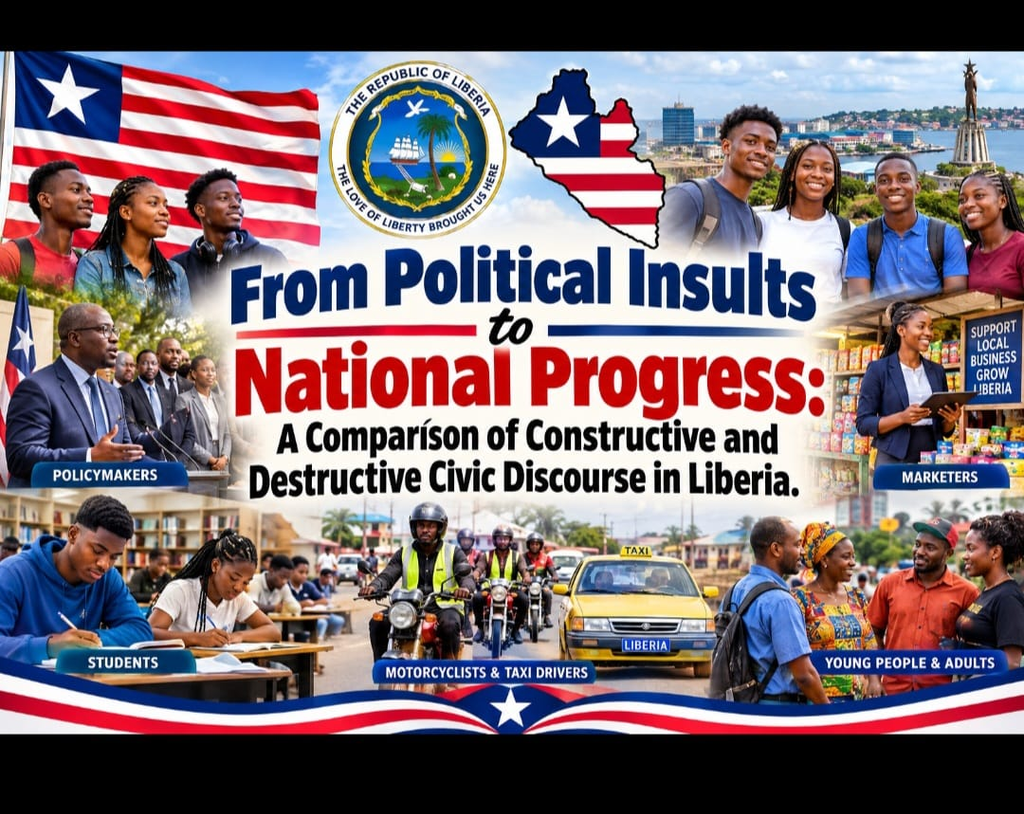
In Liberia, young people and adults must understand the difference between disagreeing with an idea and destroying another person’s dignity.
The contrast between constructive political discourse and destructive political discourse is especially important in the age of social media.
Constructive discourse focuses on policies, leadership records, national priorities, and solutions.
Destructive discourse focuses on personal attacks, vulgar language, tribal hostility, false accusations, and insults directed at parents, particularly mothers.
One approach strengthens democracy and national unity; the other weakens both. One prepares Liberia for development and international respect; the other presents the country as divided, angry, and unwilling to mature politically.
If Liberia is serious about changing course and catching up with other nations in the 21st century, its people must replace a culture of online abuse with one of responsible civic engagement.
The first major difference between constructive and destructive political speech is the purpose behind the communication.
Constructive political discussion is intended to persuade, inform, and improve society.
A person may criticize a president, senator, representative, minister, community leader, or political party, but the criticism should be connected to facts and public concerns.
For example, a citizen can ask why roads remain unfinished, why schools lack materials, why health facilities need improvement, or why young people struggle to find jobs.
These are serious national questions. They invite discussion about government performance and encourage leaders to explain their decisions.
When citizens raise such concerns respectfully, they contribute to accountability.
Destructive political speech, by contrast, often has no purpose beyond embarrassing or provoking another person.
It may begin with a disagreement over elections, party loyalty, or a government decision, but it quickly moves away from the issue.
Instead of discussing a policy, people insult one another’s intelligence, appearance, family background, or parents.
In many cases, a person’s mother becomes the target of vulgar language.
This kind of behavior is deeply troubling because mothers are widely respected in Liberian society.
They represent sacrifice, care, discipline, and family dignity.
Even when people disagree strongly, dragging someone’s mother into political arguments does not prove intelligence or loyalty.
It only reveals a lack of self-control and respect.
The harmful practice of insulting female parents also creates a painful contradiction.
Many of the same people who publicly insult someone else’s mother may claim to respect women, value family, or support national unity.
Yet respect is not demonstrated only during ceremonies, religious services, or public speeches.
It shows up in daily behavior, including online.
A person who uses offensive language against another person’s mother is not simply attacking an individual; that person is attacking the values of dignity and mutual respect that hold communities together.
Liberians should remember that political parties will change, leaders will come and go, and election seasons will pass. Still, careless language can damage families and communities for years.
Another important comparison concerns social media.
Social media can be a powerful instrument for education, communication, business, advocacy, and civic participation.
It allows Liberians at home and abroad to exchange information quickly.
Students can access educational resources. Entrepreneurs can advertise their products and services.
Journalists can share breaking news. Community organizations can mobilize support for development projects. Citizens can raise awareness about corruption, poor public services, gender-based violence, disability rights, environmental concerns, and youth unemployment.
Political leaders can also use social media to explain policies and listen to public concerns.
In this positive sense, social media can help strengthen the relationship between citizens and government.
However, social media can also become a platform for careless and harmful behavior.
Instead of being used for learning and national development, it is sometimes used to spread rumors, insults, fabricated stories, and videos designed to disgrace others.
Comment sections often become places where people compete to produce the most offensive statement rather than the most thoughtful argument.
This is not freedom of expression at its best. Freedom of expression carries responsibility.
A society cannot benefit from speech that intentionally humiliates people, promotes hostility, or turns every political discussion into a personal fight.
The difference is clear: responsible social media use contributes to national development, while irresponsible use drains national energy.
A young person who spends hours insulting political opponents online may feel temporarily powerful. Still, that activity does not create employment, improve education, repair roads, attract investment, or strengthen public institutions.
On the other hand, a young person who uses the same platform to discuss entrepreneurship, technology, agriculture, education, public health, and good governance can positively influence others.
The internet offers Liberian youth access to the world.
It would be unfortunate to use such an opportunity mainly for behavior that brings embarrassment rather than progress.
Liberia’s international image is also shaped by how its citizens communicate online.
In today’s world, social media is not as private as people sometimes imagine.
A comment written in Monrovia, Gbarnga, Buchanan, Voinjama, Kakata, Harper, Robertsport, Bong Mines, Harbel, Gbatala, Arthington, Kolahun, Kpadamai, Foya, Sulomah, River Gee, Sinoe, Paynesville, Logan Town, 12th Street, UL Campus. People in the United States, Europe, Asia, other African countries, and across thee diaspora can reach Waterside, Todee, Tapitah, Dambalah, Gbapolu, Big-va-le-yeh, or any Liberian community within minutes.
Potential investors, development partners, universities, employers, and international organizations often observe how citizens speak about their country and one another.
This does not mean Liberians should hide their problems or refuse to criticize leaders.
Every nation has challenges, and honest criticism is necessary for improvement.
But there is a difference between exposing a problem and displaying a culture of uncontrolled abuse.
Countries that make progress are not countries where everyone agrees.
They are countries where people learn to manage disagreement through institutions, evidence, debate, and compromise.
In mature political environments, citizens can strongly oppose a leader without calling that leader’s supporters worthless.
They can criticize a policy without insulting the families of those who hold different opinions.
They can demand accountability without spreading false information. Liberia can learn from this principle.
The nation does not need silence; it needs better speech. It does not need blind support for leaders; it needs informed citizens. It does not need political hatred; it needs political maturity.
A useful comparison can also be made between temporary political loyalty and permanent national identity.
Political parties are important in democratic systems because they organize ideas and offer citizens choices.
Yet party membership should never be stronger than national responsibility.
A Liberian remains a Liberian before, during, and after elections.
Supporting a candidate should not require hating on another citizen.
Celebrating a political victory should not require humiliating those who lost.
Likewise, disappointment after an election should not result in threats, insults, or attempts to make the country ungovernable.
National development requires citizens to think beyond the next campaign season.
This is particularly important for young people.
Liberia has a youthful population, and young Liberians have tremendous influence over the country’s future.
They are active on Facebook, WhatsApp, TikTok, Instagram, X, YouTube, and other digital platforms.
Their words can shape public opinion, influence their peers, and either calm or intensify political tension.
Young people should therefore see themselves not merely as party defenders but as future leaders, professionals, parents, teachers, lawmakers, entrepreneurs, and community builders.
A young person who learns to debate respectfully today is developing the leadership habits needed for tomorrow.
By contrast, a young person who becomes known only for insulting others online may damage his or her own reputation, educational opportunities, and professional future.
Adults also have a major responsibility.
It would be unfair to place the burden only on young people when many adults contribute to the culture of abuse.
Some older citizens, political actors, and public figures use inflammatory language that encourages their followers to behave badly.
When respected individuals insult opponents or mock their families, they send the message that abusive speech is acceptable.
Adults should instead model discipline. Parents, teachers, religious leaders, traditional leaders, journalists, and political leaders all have a role to play in teaching that disagreement does not justify disrespect.
The values taught in homes, schools, churches, mosques, workplaces, and public forums must be reflected online as well.
The need for responsible conduct becomes even more serious when considering Liberia’s long-term national recovery and development.
Mr. Herman Cohen, who served as the United States Assistant Secretary of State for African Affairs in 1990, warned Liberians that if violence reached Monrovia, the country would face serious trouble for years.
Without revisiting the history behind that statement, its central lesson remains relevant: national instability and institutional damage can have consequences that last far beyond the moment of crisis.
Liberia therefore cannot afford to normalize language that creates hatred, encourages division, or makes violence appear acceptable.
Words do not always lead to conflict, but reckless words can prepare the emotional environment in which conflict becomes easier to imagine and harder to prevent.
The better path is to build a political culture based on what may be called “firm respect.” Firm respect means citizens should not be afraid to criticize.
They should ask difficult questions, investigate public spending, challenge poor leadership, reject corruption, and demand better services.
But they should do so without stripping others of their humanity.
A citizen can say, “I disagree with this government policy because it has not created enough opportunities for young people,” rather than using insults.
Another citizen can say, “I support this leader because of the development projects I have seen, but I believe more must be done,” instead of attacking anyone who holds a different view.
This kind of language is not weakness. It is discipline.
Liberia can also encourage better public discourse through education and digital literacy.
Schools and universities should teach students how to evaluate information, recognize misinformation, debate ideas, and communicate responsibly.
Respectful civil society organizations can organize forums where young people from different political backgrounds discuss national issues without hostility.
Media institutions can promote programs that focus on policy rather than political drama.
Political parties can train their supporters to avoid hate speech and misinformation.
Social media users can report abusive content instead of sharing it for entertainment.
These actions may appear small, but together they can help change national habits.
Ultimately, Liberia’s future will not be determined only by elections, political parties, or government officials.
It will also be shaped by the everyday behavior of ordinary citizens.
Every comment, post, video, voice note, and public statement contributes either to a culture of dignity or a culture of disrespect.
Liberians must decide which culture they want to pass on to the next generation.
The nation cannot move forward if citizens use every political difference as an excuse to insult one another and denigrate parents, especially mothers, in public spaces.
Liberia deserves political debate that is intelligent, courageous, and respectful.
Its young people deserve role models who show that one can disagree without becoming abusive.
Its mothers deserve honor rather than being used as targets in political quarrels.
Its social media platforms should become spaces for knowledge, innovation, accountability, and national progress, not places for empty behavior that produces no benefit for the country.
Political disagreement will always exist, but abuse does not have to exist with it.
By choosing ideas over insults, facts over rumors, and national unity over political hatred, Liberians can present a stronger image to the world and help build the stable, dignified, and progressive nation they desire.
Support Independent Journalism
Your support helps FrontPage Africa continue delivering independent, credible, and impactful journalism. Every contribution strengthens our ability to investigate, inform, and hold power accountable while keeping quality journalism accessible to our readers.
Support our journalism or subscribe to receive the latest FrontPage Africa stories and updates.