A social media advocate says the Justice Minister’s official vehicle traces back to drug cartel money. The Ministry says it traces back to a formal request, a government fleet, and a supplier called Dutch Health BV — and that nobody has shown the evidence connecting the two.
By Rodney D. Sieh | [email protected]
MONROVIA — There is a particular kind of controversy that does not begin with a scandal at all, but with a vehicle — a white SUV parked outside a ministry, a license plate somebody photographed, a question that starts on social media and ends, a few days later, in front of a Senate committee.
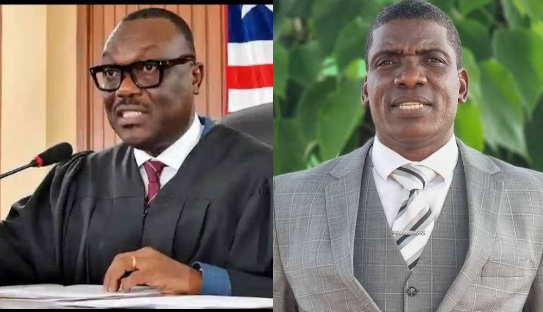
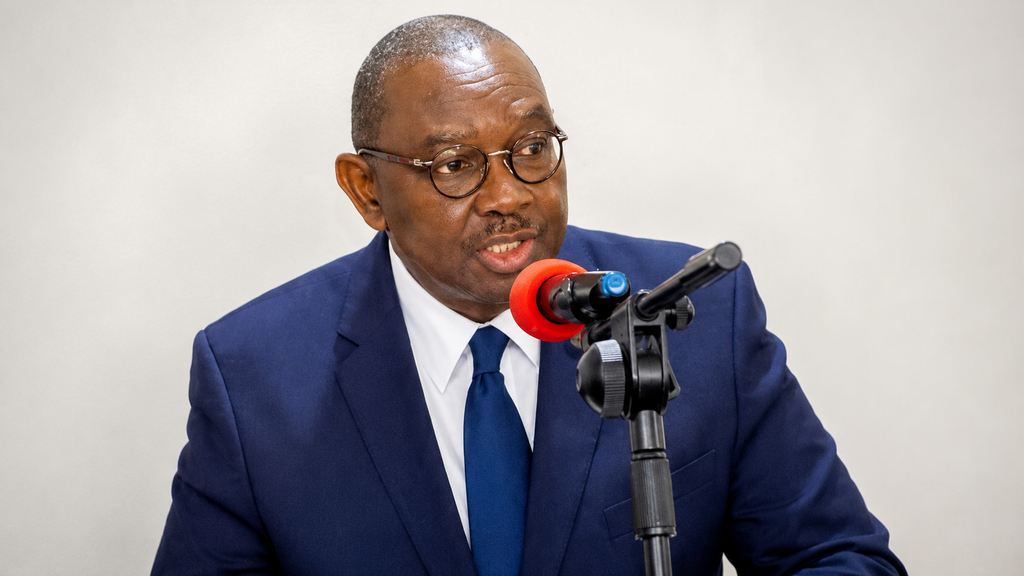
That is roughly the shape of the week Attorney General N. Oswald Tweh has had. He “voluntarily” appeared before the Senate Committee on Defense, Security, Intelligence and Veterans Affairs Tuesday amid daunting questions surrounding a vehicle given to him by Gregory Coleman, Inspector General of the Liberia National Police. What was said behind those closed doors has not been made public. Senator Momo Cyrus, the Chairman of the Senate Committee on Defense and Intelligence, declined to speak to reporters about the meeting, saying what was discussed in the meeting was not meant to be made public.
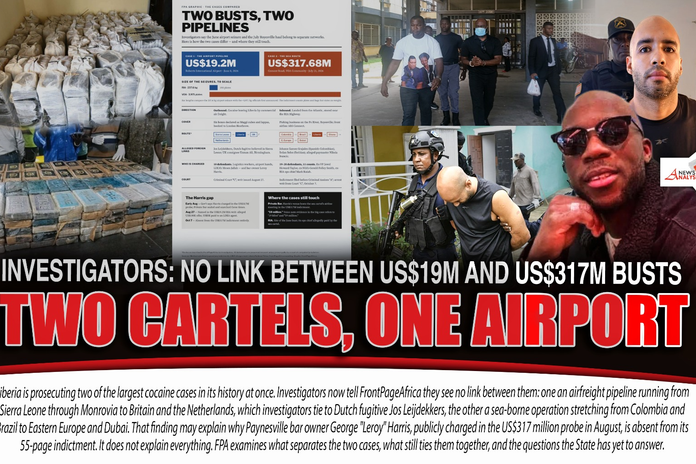
What has been made public, in increasingly forceful terms, is the Ministry’s own attempt to get ahead of a rumor it says has already outrun the facts: that the Minister was riding around Monrovia in a vehicle traceable to the same drug cartel network under investigation in both the US$19 million and the US$317 million cases.
The Ministry’s response stems from a single, persistent voice — social media advocate Martin Kollie, whose posts on the vehicle have circulated widely enough that the Ministry felt compelled to answer them point by point rather than let them sit. The Ministry’s framing of the dispute is itself telling: it describes Kollie’s criticism as crossing a dangerous but real line between exposing a criminal network and manufacturing suspicion around public institutions — the kind of language a government reaches for when it believes it is fighting not just an allegation, but a narrative that has already started to take on a life of its own.
The Ministry’s Position: Missing the “Evidentiary Bridge”
Strip away the back-and-forth, and the Ministry’s argument comes down to one image, repeated in different forms throughout its response: a bridge that was never built. According to the Ministry, the weakness in Kollie’s allegation is not that it has been denied. It is that, on the face of the materials he has presented, the conclusion drawn against the Ministry and the Minister arrives without the factual link connecting either of them to drug proceeds, a drug trafficker, or an unlawful transaction. Kollie has repeatedly asserted, in a series of public posts, that the Minister is “compromised,” that he must “step aside,” and that his official vehicle is somehow connected to cartel activity. The Ministry’s position is that an accusation of this gravity cannot rest on placing several suspicious-sounding facts beside one another and inviting the public to draw its own conclusion about what they add up to.
As the Ministry frames it, the relevant question is not whether the Minister uses a Toyota Land Cruiser, whether Coleman was involved in assigning it, or whether separate allegations exist concerning other vehicles connected to the police force. The question the Ministry says matters is narrower: what credible evidence connects this specific vehicle, or the Minister himself, to drug proceeds, a trafficker, or an unlawful transaction? Kollie’s write-up and photographs, the Ministry argues, do not show that connection. His narrative moves from allegations about three “cash-gifted cars” associated with Coleman to a separate assertion that the Minister requested and received an official vehicle — two claims the Ministry says are not automatically the same thing. A vehicle allegedly tied to one transaction, in the Ministry’s telling, cannot without evidence be transformed into proof that every vehicle assigned through the Liberia National Police shares the same origin.
The Ministry’s Account of the Vehicle
Where Kollie alleges a cartel connection, the Ministry answers with paperwork — dates, a letter, a license plate, a supplier’s name, the specific texture of a bureaucracy trying to prove it has nothing to hide. It says the Ministry formally wrote Inspector General Coleman on November 10, 2025, requesting a suitable vehicle, the kind of routine administrative letter that exists in a filing cabinet somewhere and, in ordinary times, would never be read by anyone outside the two institutions involved. The LNP, in response, assigned a white Toyota Land Cruiser Prado carrying LNP identification GSA-LNP-03-14. The Ministry states the vehicle came from a government-procured fleet acquired from a supplier identified as Dutch Health BV, and that it remains government property, used for official duties rather than personally owned. Whatever further verification the public may reasonably want, the Ministry argues, that account at least identifies a traceable chain addressing the specific vehicle in dispute — a formal request, a marked vehicle, a stated procurement source, and a government ownership record, laid end to end for anyone willing to check it.
“Assignment Is Not Confession”
A central plank of the Ministry’s rebuttal is a distinction it says Kollie has collapsed: the difference between the LNP assigning a government vehicle for official use, and the Inspector General personally gifting the Minister a vehicle. Kollie has described the episode as a “confession” — that Tweh acknowledged Coleman gave him a car. The Ministry says that characterization misstates its own position. Its actual account, the Ministry says, is that an official vehicle was assigned by the LNP following a formal request, while expressly denying that the vehicle was a personal gift, a cartel gift, or a vehicle purchased with drug proceeds for the Minister’s benefit. Acknowledging that an institution assigned a vehicle, the Ministry argues, is not the same as admitting the vehicle was privately gifted by an individual or a criminal organization — and treating those as identical, in the Ministry’s view, changes the factual and legal character of what happened.
The Ministry also pushed back on the idea that its own swift response was itself suspicious. The speed of a rebuttal, it argues, does not establish the falsity of the rebuttal — a prompt clarification is, if anything, an ordinary response when a public allegation directly concerns the integrity of the Attorney General and the Ministry of Justice. A statement does not become dishonest because it was issued quickly, the Ministry says, and an allegation does not become true because it was made first.
“Evidence Is Coming” Versus Evidence in Hand
The Ministry’s sharpest criticism of Kollie’s campaign concerns timing and certainty. Kollie has described his own reporting as evidence-based, using phrases like “100% fact” and “hard facts” while demanding immediate resignations — even as he has also indicated that additional documentation, photographs, audio and video would follow later. The Ministry argues those two postures are in tension: if presently available evidence is already sufficient to publicly pronounce the Minister compromised and demand his resignation, it asks, why is connective evidence still being promised for later? And if the crucial evidence has not yet been produced, the Ministry argues the responsible course is to verify and present it before converting suspicion into a public verdict. Under Liberian legal principle, the Ministry notes, the burden of proof does not shift simply because an accusation is dramatic — the person making a positive allegation must establish its factual basis, and a public official is not required to disprove a claim merely because an accuser has promised more evidence may eventually appear.
A Second Objection: Guilt by Association
The Ministry also objects to what it describes as an attempt to treat unresolved questions about Coleman as automatic proof against Tweh. Even assuming, for argument’s sake, that questions exist regarding other vehicles or other transactions involving other people, the Ministry argues that does not establish that the Minister participated in, knew of, benefited from, or was connected to those alleged transactions. Because the Ministry has identified the Minister’s vehicle as a specific government vehicle from a stated fleet, it argues the allegation against him requires more than institutional proximity or hierarchy — it requires a demonstrated link showing the particular vehicle was unlawfully acquired, that the Minister knew of an unlawful source, that he solicited an improper benefit, or that he entered into an arrangement with alleged cartel actors. The Ministry says none of those links have been shown.
Nor, the Ministry argues, is it improper on its face for the Justice Ministry to request a vehicle from the LNP. The Ministry says it lacked a budgetary allotment at the relevant time for a new ministerial vehicle, and that ordinary administrative communication between the Ministry and the police force it supervises is not, by itself, evidence of wrongdoing — supervision, it argues, does not eliminate the need for institutional coordination.
The Ministry’s Broader Charge: A “Fishing Expedition”
The Ministry characterized Kollie’s overall pattern as casting an unusually wide net — vehicles, police officers, past dismissals, institutional relationships, alleged conversations, housing projects, historical allegations and the wider drug crisis — and then presenting the accumulation of suspicion as though volume itself amounted to proof against the Minister. The number of allegations, the Ministry argues, does not cure the absence of proof connecting a specific person to a specific unlawful act; ten unproven insinuations, in its framing, do not become one proven fact simply because they are repeated together. The Ministry draws a distinction between saying “this matter should be investigated” and declaring “this official is compromised” or demanding resignation as though guilt were already established — the first, it says, is a call for inquiry; the second is a public verdict issued without the evidentiary chain to support it.
The Ministry went further, framing Kollie’s campaign as a potential distraction from the underlying investigation rather than a contribution to it. Because the fight against drug trafficking depends on investigators following financial trails, communications and verifiable relationships, the Ministry argued that a national conversation pulled toward defending or debating unproven allegations can divert attention from the evidentiary work needed to identify and prosecute traffickers. The Ministry stopped short of accusing Kollie of intentionally helping the network under investigation, but argued that irresponsible, unsubstantiated allegations can have that practical effect regardless of intent — and suggested, in unusually pointed language for an official government response, that the matter could rise to the level of criminal interference with an active investigation, a characterization Kollie has not publicly responded to and which this newspaper has not independently assessed.
What the Ministry Is Asking For
The Ministry’s closing position is that the burden now rests on Kollie to move from accusation to substantiation. If the underlying claim is that the vehicle came from drug money, the Ministry argues the evidence must connect the money, the purchase, the vehicle and the Minister specifically — not merely gesture at proximity between the Ministry and a broader scandal. If Kollie disputes the Ministry’s stated procurement trail, the Ministry says the proper response is documentary evidence identifying the specific discrepancy, not repetition of the original claim. “We call on the Ministry of Justice to remain focused on the lawful dismantling of criminal drug networks,” the Ministry said of its own mandate, adding that those who make grave public allegations should be held to the same evidentiary standard they demand of public officials.
What This Doesn’t Resolve
This is not the first time a vehicle has become a flashpoint inside Liberia’s drug investigation. LDEA Officer-in-Charge Fitzgerald Biago recused himself earlier this year over a separate, unresolved allegation involving vehicles accepted from a figure tied to the case. That precedent is part of why a vehicle allegation involving the country’s chief law enforcement officer has drawn this much attention so quickly — Liberians have already watched one senior official’s position become entangled with exactly this kind of claim once this year. The Ministry’s rebuttal is detailed and specific about the Minister’s own vehicle. It does not, however, address the broader question raised by Kollie’s original allegations concerning Coleman and the three “cash-gifted cars” — a claim the Ministry treats as a separate matter rather than one it is defending. Tuesday’s closed-door Senate session, called specifically because of the vehicle questions, remains undisclosed. Until its substance becomes public, or until either side produces the documentary evidence each is demanding of the other, this remains what the Ministry itself says it should not become: a contest of accusations rather than a settled account of the facts.
Support Independent Journalism
Your support helps FrontPage Africa continue delivering independent, credible, and impactful journalism. Every contribution strengthens our ability to investigate, inform, and hold power accountable while keeping quality journalism accessible to our readers.
Support our journalism or subscribe to receive the latest FrontPage Africa stories and updates.