MONROVIA –The Ministry of Finance and Development Planning(MFDP) Minister Augustine Kpehe Ngafuan says Liberia’s improving economic indicators will only matter if they result in more jobs, better services and higher living standards for ordinary citizens.
By Emmanuel Weedee-Conway
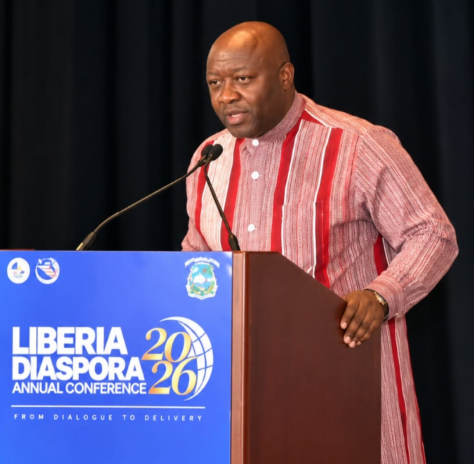
Speaking recently at the National Steering Committee Meeting on the ARREST Agenda for Inclusive Development (AAID) at Monrovia City Hall, Minister Ngafuan presented key economic data showing continued growth despite a tough global and fiscal environment.
Economy Showing Strong Gains
Minister Ngafuan reported that real GDP growth rose from 4.0 percent in 2024 to 5.1 percent in 2025. It is projected to hit 5.5 percent in 2026.
GDP per capita also increased from US$849.30 in 2024 to US$861 in 2025 and is expected to reach US$961 this year. That, he stated, puts Liberia closer to the AAID target of US$1,050 per capita by 2029.
On debt, the Minister asserted Liberia’s debt-to-GDP ratio declined from 56.1 percent in 2024 to 54 percent in 2025, nothing, it is projected to fall further to 49.6 percent in 2026.
He reported that domestic revenue collection has also surged, rising from US$699 million in 2024 to US$848 million in 2025.
By June 2026, the Minister indicated that the government had already collected US$761.1 million, putting the country on track to meet its US$1.3 billion domestic revenue target for the year.
Stability Is Only One Part
Despite the positive numbers, Minister Ngafuan cautioned that economic growth alone is not enough.
“Macroeconomic stability is only one part of the development equation,” he told the Committee.
” The real measure of progress is whether economic gains translate into better public services, more jobs, greater investment opportunities and improved living conditions.”
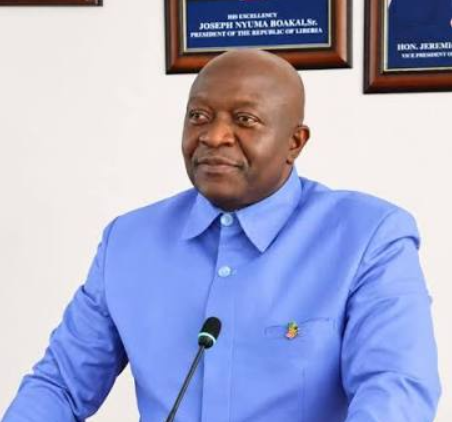
He echoed President Joseph Nyuma Boakai’s call for faster implementation and greater accountability across government.
The Challenge Ahead
The meeting reviewed the AAID 2025 implementation report and draft reports for the first and second quarters of 2026.
While progress has been made in aligning priorities and mobilizing resources, both President Boakai and Minister Ngafuan acknowledged uneven performance across institutions.
President Boakai also warned against appointments based on personal or political ties, saying advancement must be based on performance.
The AAID, launched on January 15, 2025, focuses on job creation, education, healthcare, telecommunications, water security, and infrastructure.
Minister Ngafuan closed by reaffirming the Finance Ministry’s commitment to working with all partners to ensure that Liberia’s economic growth delivers tangible results for the Liberian people.
The President, who also spoke at the meeting, warned against delays, poor performance, and institutional bottlenecks which he maintained “will no longer be tolerated.”
Accountability and Results-Based Spending
President Boakai told ministries and agencies to implement full sector interventions without further delay and to ensure that every public dollar is managed with integrity.
He also directed timely and accurate reporting in formats agreed upon by the Ministry of Finance and Development Planning.
Minister Ngafuan supported that directive, stressing that the Ministry of Finance will enforce stricter monitoring to ensure resources are directed to programs with the greatest impact.
The President also raised concerns about the management of public corporations, warning officials against treating state assets as personal property.
The Liberian leader pointed out that poor management could force government to rescue failing entities.
Financing Beyond Aid
UN Resident Coordinator Christine N. Umutoni, Deputy Chair of the AAID National Steering Committee, joined the call for a new financing approach.
She urged Liberia to move beyond dependence on traditional aid and mobilize domestic resources, private investment, climate finance, and innovative financing.
“The question can no longer be only, who will fund the development programs,” Ms. Umutoni asserted.
“It must increasingly be: ‘How do we structure these development programs so different sources of capital can finance them.’”
She urged government to focus on a limited number of major investments in human capital, economic transformation, food systems, digital development and climate resilience, rather than spreading resources thin.
Support Independent Journalism
Your support helps FrontPage Africa continue delivering independent, credible, and impactful journalism. Every contribution strengthens our ability to investigate, inform, and hold power accountable while keeping quality journalism accessible to our readers.
Support our journalism or subscribe to receive the latest FrontPage Africa stories and updates.