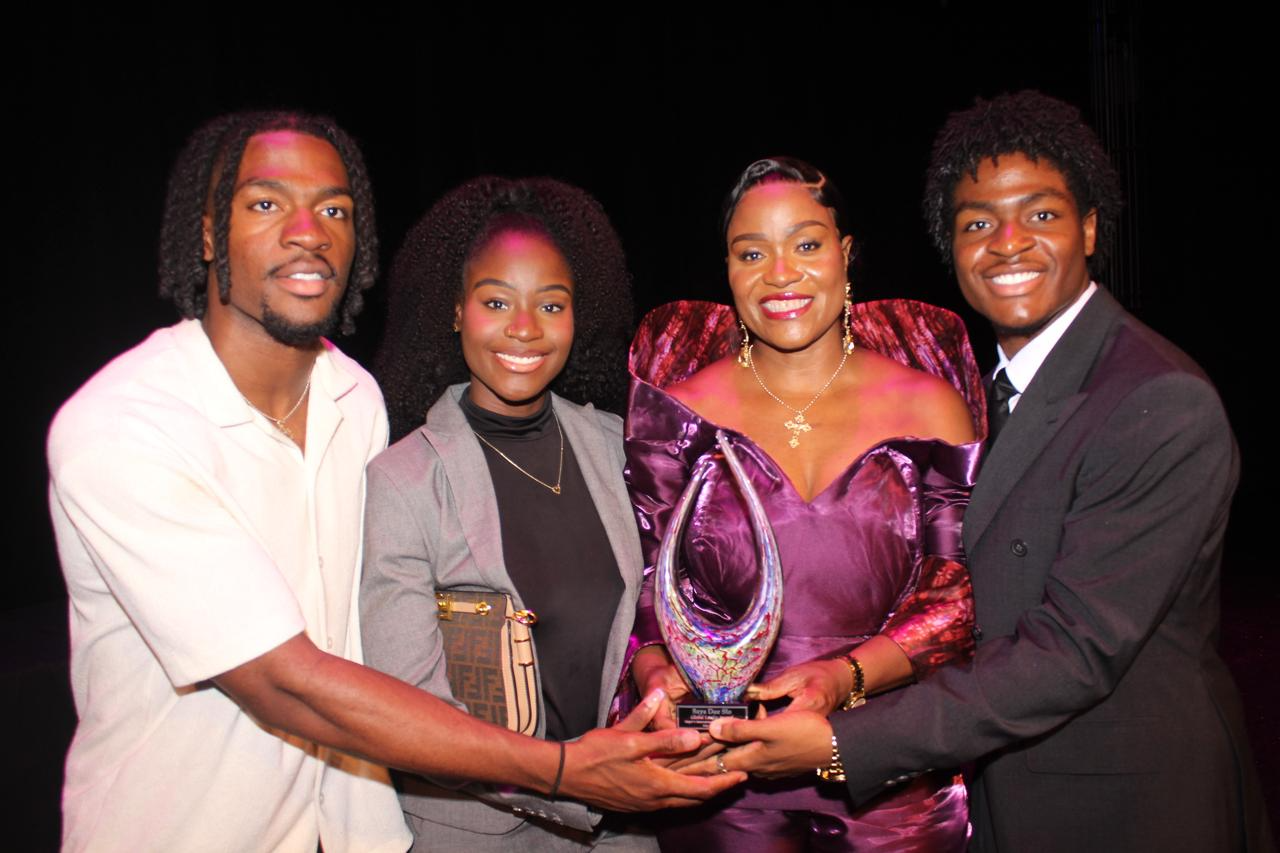
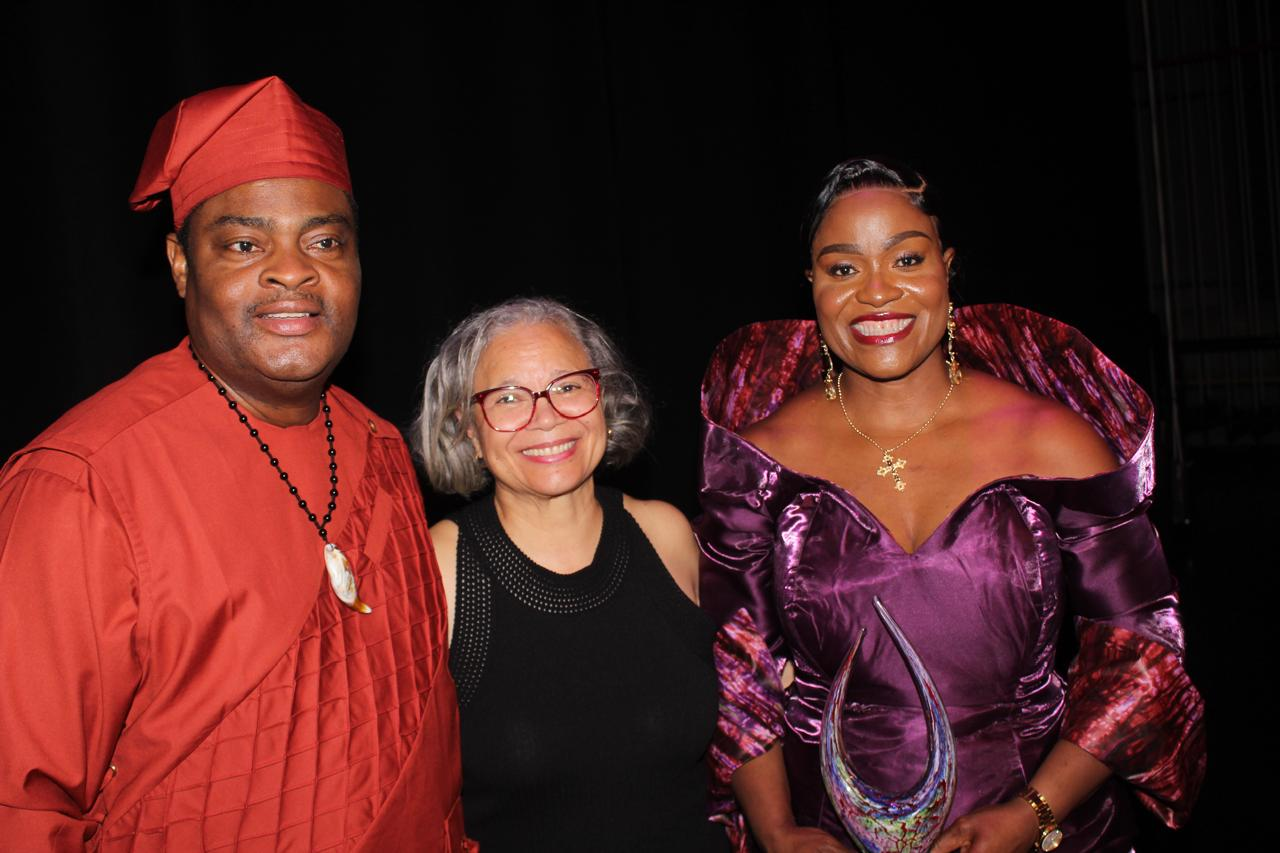
The citation for the individual and institutional award presentation to Mr. Lancedell Mathews, the Executive Director of the New Africa Research & Development Agency (NARDA), was read by Dr. D. Evelyn S. Kandakai. The award was presented on behalf of the NUHA Committee by the 62nd National Unification Day Keynote Speaker, Ambassador Blamo Nelson, eminent citizen and former Liberian Ambassador to Japan.
Mr. Mathews was honored as a peerless “peace architect” whose distinguished civil society leadership has spanned nearly four decades. His career is a masterclass in utilizing community-based development, social justice, and social accountability to build national unity from the bottom up. As the former Chair of the Civil Society Advisory Committee and the long-standing Liberia Coordinator for the Civil Peace Service (CPS) Mano River Network, Mr. Mathews has consistently fought to amplify the voices of marginalized, rural populations, ensuring they are heard at both national and international policy tables.
His scholarly and practical approaches to local ownership over international dependency have altered how development is conceptualized in post-war West Africa.
His life’s work serves as a primary pillar of the nation’s stability, inspiring the next generation of democratic actors to reject division and embrace collective accountability.
A key feature of this year’s dialogue was the deliberate utilization of the newly established Most Outstanding Civil Society Organization (MOCSO) framework to evaluate the historical trajectory of NARDA under Mr. Mathews’ stewardship.
The NUHA Committee subjected NARDA to a rigorous matrix of selection criteria designed to serve as a mirror of excellence for the entire sector, including:
- Institutional Integrity & Internal Governance: Maintaining strict ethical conduct, financial transparency, and non-partisan clarity in all national and community engagements.
- Community Validation & Social Integration: Demonstrable, empirical proof of settling historic conflicts, bridging deep social divides, and countering election-related violence and tribal hate speech at the grassroots level.
- Verifiable, Long-Term Impact: Moving completely away from superficial, activity-based reporting towards sustainable interventions that actively reinforce the rule of law, civic education, and democratic stability.
For decades, NARDA has met and exceeded these benchmarks, operating as a stellar consortium vehicle that brought fractured grassroots groups together under unified developmental goals. NARDA proved to the state and the international community that local civil society possesses the intellectual capital, the operational capacity, and the cultural literacy required to manage complex national development priorities. NARDA remains the definitive archetype of civil society excellence in modern Liberian history.
In remarks, both honorees expressed profound gratitude to BFF, NUHA Committee, and the CSO-PdG consortium for the exceptional honor, with commitment to rededicate their lives in service to Liberia and humanity.
They challenged all Liberians to inherit and sustain the peace and nonviolent legacies of Mother Mary N. Brownell to inspire future generations.
However, the consortium has utilized this celebration of NARDA’s excellence to sound an extrasensory, alarming note regarding the severe structural paralysis currently facing the wider civil society sector.
The presentation of the NUHA awards served as the ideal backdrop to amplify a critical, collective call to the National Legislature regarding an existential threat: the acute CSO sustainability crisis in Liberia.
For more than twenty years, the operational survival, monitoring capacity, and advocacy programs of Liberia’s civil society were subsidized by international liquidity. The massive footprint of the United Nations Mission in Liberia (UNMIL), complemented by heavy funding portfolios from the United States Agency for International Development (USAID), the European Union, the Swedish Embassy (Sida), and a vast array of International Non-Governmental Organizations (INGOs), maintained the civic ecosystem.
With the drawdown and ultimate departure of UNMIL, and the ongoing structural funding reductions from USAID, Sida, and global INGOs, that external financial architecture has completely evaporated. This has left an unprecedented, dangerous vacuum. Today, out of the 2,500+ registered CSOs in Liberia, a vast majority are facing imminent institutional collapse, forcing a forced retreat from rural human rights monitoring, anti-corruption whistleblowing, and community-level dispute resolution.
The Better Future Foundation and its partners argue with absolute clarity that a democracy cannot survive if its civil society is treated as an optional, externally funded luxury. CSOs are the fundamental transmission belt between high-level constitutional policy and grassroots reality. When a state allows its independent civic organs to starve into extinction, it effectively silences its early-warning systems against conflict and removes the primary checks and balances against state corruption and bad governance.
Therefore, the consortium is issuing an unyielding demand to the National Legislature for an immediate legislative budgetary appropriation specifically dedicated to supporting Liberian Civil Society Organizations for peace, democracy, and sustainable development.
To guarantee absolute transparency and prevent this fund from becoming an instrument of political patronage, the consortium proposes that eligibility be strictly tied to independent, rigorous vetting, through the Government of Liberia “open call for proposals for CSOs to bid.”
To turn this advocacy into a permanent solution, the NUHA Committee has declared that it will annually vet, recognize, and award the Most Outstanding CSO in Liberia.
This annual selection process will serve as an independent, peer-reviewed mechanism to showcase compliant, high-impact organizations that merit public investment, thereby providing the state with an unassailable roadmap for national civic financing.
The era of total reliance on foreign donors must end; the state must assume national ownership of its democratic infrastructure.
The intellectual core of the 62nd National Unification Day Dialogue lies in its refusal to treat national reconciliation as a rhetorical or sentimental exercise.
Instead, through the leadership of Rev. Augustine S. Arkoi and the advisor network of the NUHA Committee, the consortium has perfectly interlinked this celebration with an empirical, data-driven offensive: the official launch of a Nationwide Snap Survey on Reconciliation, capturing 15,000 respondents across all 15 counties of Liberia over a compressed six-week period.
This survey is not a mere academic exercise; it is the vital operational fuel for a sophisticated, multi-phase “Dialogue-to-Justice” framework explicitly engineered to break the paralyzing transitional justice impasse currently stalling Liberia’s moral and political recovery.
Breaking the Impasse of the War and Economic Crimes Court
For years, the discourse surrounding the operationalization of the Office of War and Economic Crimes Court in Liberia (OWECC-L) has been gridlocked by political posturing and elite fearmongering. Right-wing and factional political actors frequently weaponize the narrative of justice, falsely claiming that pursuing accountability will rupture the fragile peace, fracture ethnic lines, and reignite historical conflicts. Conversely, peace has often been erroneously defined as “peace through amnesia”—a superficial stability that leaves the root causes of structural trauma and economic plunder completely unaddressed.
The 15,000-respondent Snap Survey systematically dismantles this elite deadlock by substituting political rhetoric with empirical, grassroots citizen data. By testing public sentiment on the immediate correlation between recent electoral tensions, county-level post-election reconciliation needs, and the popular demand for formal accountability, the survey will provide an unassailable, scientific dataset.
This localized data will be directly fed into the policy machinery of the OWECC-L and the leadership of the National Legislature. For the OWECC-L, this data functions as an indispensable strategic roadmap—identifying geographic regions of high social tension, mapping community readiness for transitional justice mechanisms, and transforming “justice” from a divisive, top-down Monrovian political debate into an inclusive, community-validated national priority.
It provides progressive policymakers with the precise empirical coverage required to navigate political pushback from entrenched interests, ensuring that the legal frameworks of the court are anchored securely in the authentic, sovereign will of the Liberian populace.
To ensure that the survey findings are not filed away into bureaucratic obscurity—a fate that befell previous major national commissions—the BFF-led consortium has committed to an aggressive operational loop. Throughout the remainder of 2026 and leading directly into National Unification Day 2027, the consortium will host mandatory quarterly stakeholder postmortem sessions.
These iterative dialogues will bring the Speaker and members of the National Legislature, the Executive Directorate of the OWECC-L, leaders of the diplomatic corps, traditional elders, grassroot women networks and youth heads back to the table.
By continuously re-injecting the survey’s evolving empirical findings into the public square, “The Dialogue Loop” will dynamically shape public opinion, inform ongoing legislative debates on budgetary appropriations, and maintain unyielding civic pressure on the state to execute meaningful constitutional, legal, and structural reforms. Peace, development, and justice are thus fused into a singular, self-reinforcing public policy cycle.
CONCLUSION: A CALL TO MATURITY AND SOVEREIGN RESPONSIBILITY
As the echoes of the 62nd National Unification Day celebrations fade from the auditorium of the University of Liberia, the message contained within this comprehensive press statement remains clear. Liberia has proven that its civil society possesses the intellectual sophistication, the historic memory, and the collaborative willpower to guide the state through its most complex transitional bottlenecks. By honoring Sister Barbara Brillant and Mr. Lancedell Mathews under the immortal banner of Mother Mary N. Brownell, the nation has re-established its benchmark for civic virtue.
Yet, the tools created by this dialogue—the 15,000-respondent survey, the “Dialogue-to-Justice” framework, and the “Dialogue Loop”—cannot run on vision alone. The departure of international pillars like UNMIL, USAID, the Swedish Embassy, and INGOs must be met with the immediate dawn of total national sovereignty and financial responsibility.
The consortium calls upon the President of Liberia, the Speaker, and the honorable members of the National Legislature to act with matching courage: permanently appropriate funding for the independent civil society sector, embrace the empirical truth of the upcoming nationwide survey, and move boldly from mere celebratory dialogue to lasting, institutional justice.
The National Unification Day Dialogue underscored that genuine reconciliation and national unity in Liberia require a commitment to accountability, justice, and the strengthening of democratic institutions. University of Liberia President Dr. Layli Maparyan and Sinoe County Representative Thomas Romeo Quiah both emphasized that while elections are essential pillars of democracy, their true value lies in how effectively they foster public trust, inclusive governance, and national cohesion rather than just political victory. Adding to this institutional framework, Defense Minister Geraldine Janet George reaffirmed the
Armed Forces of Liberia’s commitment to remaining a professional, non-political entity dedicated to serving all citizens equally, while UN Representative Christian Mukosa reminded attendees that true reconciliation must be lived actively as a daily practice rooted in the absolute respect for human rights and free expression.
Crucially, the dialogue highlighted that addressing the painful scars of past civil conflict is a mandatory prerequisite for Liberia’s future progress. Prof. Jallah A. Barbu Executive Director of the Office of War and Economic Crimes Court cautioned that lingering impunity, corruption, and inequality remain major roadblocks to development, defining true unification as an intentional effort to ensure every Liberian feels safe, included, and represented regardless of their background.
This urgent need for data-driven, transitional justice aligns directly with the Better Future Foundation’s newly announced nationwide survey led by Rev. Augustine S. Arkoi, which aims to gather insights from 15,000 citizens across all 15 counties to systematically resolve conflict-sensitive issues like land disputes and pave the way for sustainable national healing.
Support Independent Journalism
Your support helps FrontPage Africa continue delivering independent, credible, and impactful journalism. Every contribution strengthens our ability to investigate, inform, and hold power accountable while keeping quality journalism accessible to our readers.
Support our journalism or subscribe to receive the latest FrontPage Africa stories and updates.