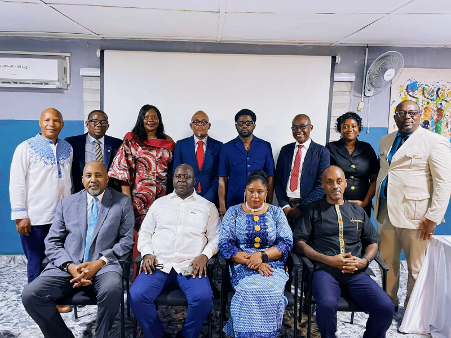
MONROVIA –The National Oil Company of Liberia (NOCAL) and the judiciary have commenced a week-long training to adequately prepare and build the capacity of circuit and specialized court judges and develop a legal and policy framework for the oil and gas sector of the country.
By Obediah Johnson
The training is being conducted by the judiciary, through the James A. A. Pierre Institute with funding from NOCAL.
Speaking at the start of the training on Monday, April 27, the President and Chief Executive Officer of the National Oil Company of Liberia (NOCAL), Fabian Michael Lai, noted that the exercise would strengthen Judges on how oil and gas are actually formed.
He stated that though Judges are not geophysicists or petroleum engineers, they should learn enough to know when a company is lying about why they drilled a dry well.
Lai maintained that Judges would learn how to ask critical questions on seismic data, logs and know exactly where oil is.
He added that the training would also educate the Judges on how petroleum rights are acquired, who grants and approves these rights and what happens when those rights are transferred without oversight.
Lai maintained that these questions are not theoretical questions, but they are questions that would adequately prepare Judges for future cases in the oil and gas sector.
“You will learn Liberia’s exploration history. Where did we drill?. What was found? What remains. Because a judge who knows the past cannot be misled in the present.”
He pointed out that though the Liberian Constitution states that natural resources belong to the people, Judges would gain knowledge on what does that mean even in a 300-page contract and who owns the oil at the wellhead, and export and sale.
Lai emphasized that the participants would clearly understand these clauses to spot when the people’s wealth is being signed away.
He observed that oil has weakened many nations not because the resource was cursed—but because of secrecy, weak oversight, and compromised systems.
This, he assured, will not be Liberia’s story as the while the participants sit on the bench.
He stressed that the payment of royalties, bonuses, profit sharing, taxes, deductions, cost oil vs. profit oil are words which sound boring in the sector.
However, Lau added that, when a company tells Judges that they are losing money, and from spreadsheet are claiming a US$50 million “management fee” to a shell company in the Cayman Islands, Judges will know exactly what questions to ask.
He disclosed that the training will examine key clauses in the law including stabilization, force majeure, indemnity, assignment, change of control.
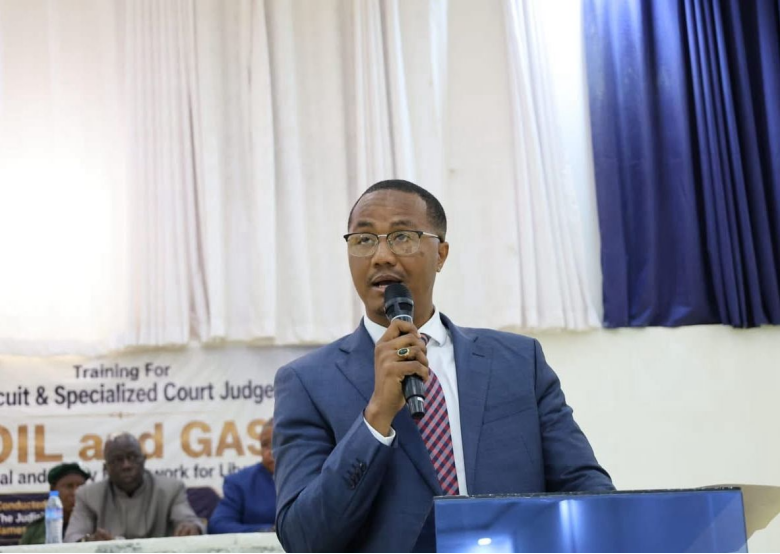
Lai said these are not just legal terms—but they are also pressure points.
“These are the places where companies hide the landmines. A stabilization clause says, “If Liberia changes its laws, we don’t have to follow them.” A force majeure clause says, “If we have a problem, we can stop paying you for years. After this training, you will read those clauses and smile. Because you will know exactly how to interpret them against the company.”
He said those underestimating Liberia may bring their fancy brochures and expensive lawyers and their broken English translations of contracts, but by the end of this training, Judges would be well equipped to point out violations of the Petroleum Law of 2016.
“Let me tell you something, Your Honors. I have sat across the table from oil executives from London, from Houston, from Nigeria. From everywhere. They are smart. They are aggressive. And they assume that Liberia is an easy place, that our laws are weak, our judges are tired, and our people are divided. They are wrong. They are wrong because of you. They do not see what is happening here. Judges choosing to prepare. To understand. To strengthen the rule of law.”
Lai emphasized that when oil comes, the companies will test Judges by filing motions, appealing and offering hospitality.
He maintained that some companies would even threaten to leave or do everything in their power to move the dispute out of Liberia and into a private arbitration room in Geneva, but Liberian Judges should stand firm to recognize that such dispute happened on Liberian soil and the court has jurisdiction over the matter.
“Every judge in this room took an oath. You swore to do justice without fear or favor. You swore to uphold the Constitution. You swore to be faithful to the Republic. That oath was not written for rubber plantations. It was not written for petty theft. It was written for moments exactly like this, when a nation stands on the edge of vast wealth and must decide: will we be a nation of laws, or a nation of men?
The oil is coming. Maybe in two years, maybe in five. But it is coming.”
He encouraged Judges to be nationalistic and uphold the rule of law in the discharge of their duties.
“We are not here to tell you how to rule. We are here to make sure that when you rule, you rule with your eyes wide open, your mind sharp, and your conscience clear. Go ask hard questions. Go challenge our presenters. If they say something you do not understand, stop them. If they say something you think is wrong, tell them.
Support Independent Journalism
Your support helps FrontPage Africa continue delivering independent, credible, and impactful journalism. Every contribution strengthens our ability to investigate, inform, and hold power accountable while keeping quality journalism accessible to our readers.
Support our journalism or subscribe to receive the latest FrontPage Africa stories and updates.