
Monrovia, February 25, 2026 – The Liberia Petroleum Refining Company (LPRC) has categorically denied allegations circulating on social media accusing the company of collecting and mismanaging Government of Liberia (GOL) taxes.
By Emmanuel Weedee-Conway
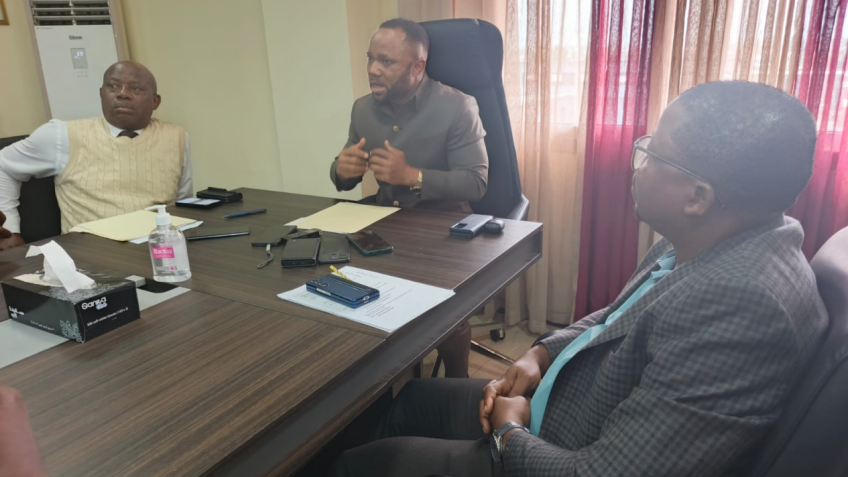
Speaking at a news conference held at its head office on the Bushrod Island, Mr. Amos Tweah, Managing Director of the state-owned petroleum company clarified that contrary to the report, the entity does not collect government taxes and operates strictly within its legally defined mandate as a terminal operator.
Clear Separation of Responsibilities
The LPRC boss pointed out that under Liberia’s revenue administration framework, institutional roles are clearly separated.
Tweah indicated that company collects approved statutory petroleum service and operational fees, but all government taxes including customs duties, excise taxes, and other statutory levies, are assessed and collected solely by the Liberia Revenue Authority (LRA).
“The LRA maintains sole jurisdiction over the determination and collection of taxes, duties, and levies. LPRC acts strictly as the terminal operator and does not collect Government of Liberia taxes under any circumstance,” he told reporters.
How the Petroleum Revenue Process Works
Accordingly, to enhance public understanding, the LPRC head outlined the petroleum importation and revenue framework with the first step being the Laycan Request.
Under the first procedure, he said licensed importers initiate the process by submitting a laycan (loading/unloading window) request to LPRC.
The request, he explained, specifies the product type — PMS (gasoline), AGO (diesel), or Jet Fuel — along with volume and expected arrival timeline.
The second process is to discharge and verify, noting that upon vessel arrival and approval, petroleum products are discharged into the company’s Product Storage Terminal (PST).
At this stage, Tweh furthers that an Outturn Report is generated to reconcile shipped quantities against actual received volumes, recorded in both metric tons and U.S. gallons.
Step 3, he noted has to do with allocation and transfer order wherein the importer issues a Transfer Order (TO) authorizing stock movement to designated distributors and specifying allocated quantities.
Assessment of LPRC Service Fees
The LPRC MD asserted that at this stage, the entity then assesses operational service fees, which may include storage, vessel discharge, laboratory testing, inspectorate services, and handling charges.
“These are strictly service-based operational fees, not taxes,” he stressed.
Accordingly, he clarified that all applicable taxes are assessed and collected directly by the LRA in accordance with national revenue laws, and importers remit tax payments directly to the LRA, which also maintains oversight authority at the PST.
Lifting of petroleum products, the LPRC head argues, cannot occur if government taxes remain unpaid — even where all LPRC service fees have been settled.
“Before lifting products from the PST, importers must settle all applicable LPRC service and storage fees. Thereafter, Delivery Orders (DO) are issued specifying the quantity, product type, and destination retailer, authorizing physical lifting.”
“Baseless and Misleading” Claims
In furtherance of his response to the allegations, Tweh described the claims as “baseless, misleading, and unsupported by factual evidence.”
“LPRC does not collect government taxes and therefore cannot mismanage tax revenues,” Tweh accentuated, adding that such claims reflect a misunderstanding of Liberia’s petroleum revenue administration structure.
Commitment to Transparency
Tweh, along with other top management of the LPRC, reaffirmed its commitment to transparency, accountability, and compliance with national laws.
Deputy Managing Director Jacob expressed support for transparency and accountability as he described the online and social media publication as a smear campaign marked by unprofessionalism intended to derail the good works of the entity.
Mr. Smith joined his boss to encourage media institutions, civil society organizations, and the public to seek clarification from appropriate authorities regarding petroleum pricing, statutory service fees, and tax collection procedures.
Support Independent Journalism
Your support helps FrontPage Africa continue delivering independent, credible, and impactful journalism. Every contribution strengthens our ability to investigate, inform, and hold power accountable while keeping quality journalism accessible to our readers.
Support our journalism or subscribe to receive the latest FrontPage Africa stories and updates.