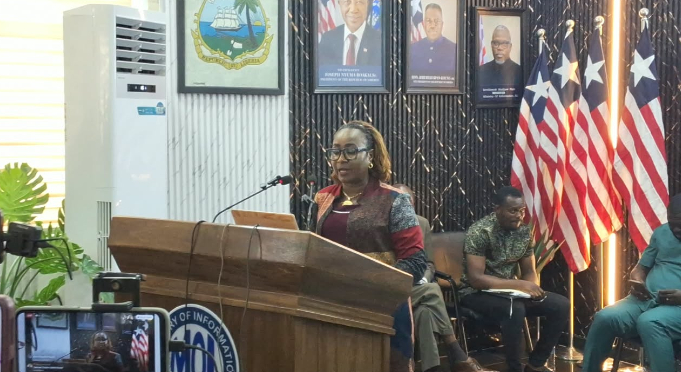
Monrovia – The Director-General of the Civil Service Agency (CSA), Dr. Josiah F. Joekai, has raised alarm over what he described as deep-rooted gender inequality in Liberian workplaces.
By Jaheim T. [email protected]
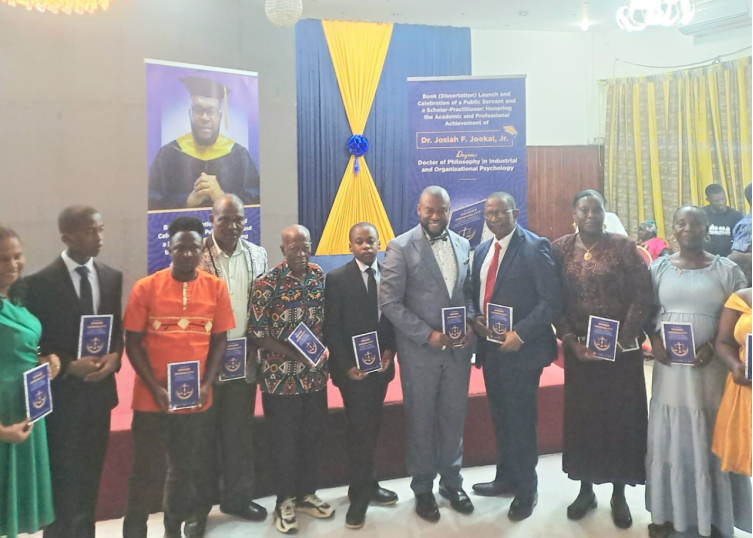
Dr. Joekai made the assertion in Monrovia at the official launch of his new book, The Effect of Gender Inequality in Liberian Workplaces: Implications for Employee Performance and Well-Being, a scholarly work drawn from his Ph.D. dissertation in Industrial-Organizational Psychology completed at Adler University in the United States.
Addressing academics, public officials, development partners, and gender advocates, Dr. Joekai said the book was intentionally written not as a purely academic contribution, but as a practical intervention aimed at confronting systemic inequities embedded in Liberia’s public and private institutions.
“This work matters deeply for Liberia,” Dr. Joekai said. “Gender inequality in the workplace is not just a social justice issue. It is a performance problem, a human-capital utilization problem, and a governance problem that directly affects productivity, morale, institutional legitimacy, and national growth.”
According to him, workplaces that marginalize women through unequal pay, limited advancement opportunities, and unsafe environments inevitably suffer from low motivation, reduced engagement, and declining organizational performance.
The book launch also served as a celebration of Dr. Joekai’s academic milestone and his recent selection as the 2025 Graduate Commencement Speaker of Adler University, an honor he described as a reaffirmation of his belief that scholarship must be linked to service and societal impact.
“I did not pursue this doctorate for prestige,” he told the audience. “I pursued it with the conviction that research must serve humanity. Knowledge that cannot shape policy, reform systems, or improve people’s lives has limited value.”
Dr. Joekai disclosed that the study adopted a qualitative, phenomenological research design, focusing on the lived experiences of nine professional women working across public administration, non-governmental organizations, education, health, and related sectors in Monrovia. Through in-depth interviews, the research captured realities often concealed behind formal workplace policies.
The findings revealed five dominant themes: blocked career advancement, entrenched gender stereotypes, pay inequity, weak enforcement of workplace policies, and persistent workplace harassment. Dr. Joekai said each of these factors directly affects employee performance, psychological well-being, and institutional effectiveness.
“This research confronts a brutal truth,” he said. “When women are underpaid, denied advancement, subjected to stereotypes, or made to work in unsafe environments, organizations underperform and nations ultimately pay the price.”
He further criticized what he termed “paper equality,” where gender-friendly policies exist in theory but lack enforcement in practice.
“Policies without enforcement only create the illusion of fairness,” Dr. Joekai warned. “Meanwhile, lived realities remain unchanged, trust in leadership erodes, and workplace cynicism deepens.”
Drawing a clear link between his academic work and his current leadership role at the CSA, Dr. Joekai said the research has become a guiding framework for his approach to public-sector reform.
“My responsibility at the CSA is fundamentally about people systems,” he explained. “How the state recruits, evaluates, motivates, and protects its workforce. This Ph.D. is not separate from my leadership role; it is a practical blueprint for building stronger, fairer, and more productive public institutions.”
He cited ongoing reforms centered on merit-based recruitment, organizational justice, performance management, psychological safety, and employee well-being as areas where evidence from his research is already being applied.
Dr. Joekai called on policymakers, public institutions, and private organizations to treat gender equity as a strategic development priority rather than a symbolic gesture.
“If we can build workplaces where women are paid fairly, promoted transparently, protected from harassment, and empowered to contribute fully,” he said, “Liberia will gain not only justice, but excellence.”
Serving as Chief Patron and Chief Launcher of the book, Professor Robert M. Kpoto described the publication as a timely and critical contribution to Liberia’s development discourse. He praised Dr. Joekai as a scholar-practitioner whose work successfully bridges academic research and real-world reform.
“We are not only here to recognize a book,” Prof. Kpoto said. “We are acknowledging an intellectual intervention into one of the most serious yet inadequately addressed challenges facing our workplaces and our society.”
He emphasized that gender inequality should not be viewed solely as a women’s issue, but as a national development concern with far-reaching consequences.
“A society that underutilizes half of its population cannot compete, cannot innovate, and cannot sustainably develop,” Prof. Kpoto cautioned.
Highlighting the book’s methodological strength, Prof. Kpoto noted that its value lies in its balanced and evidence-based approach.
“This work does not accuse blindly,” he said. “It diagnoses carefully and prescribes responsibly. In this case, scholarship does not inflame; it illuminates.”
Support Independent Journalism
Your support helps FrontPage Africa continue delivering independent, credible, and impactful journalism. Every contribution strengthens our ability to investigate, inform, and hold power accountable while keeping quality journalism accessible to our readers.
Support our journalism or subscribe to receive the latest FrontPage Africa stories and updates.