Monrovia – A preliminary report on the Revenue Component of the Draft FY2026 National Budget by the Committee on Ways, Means and Finance (WMF) predicts a scary sign in achieving the proposed US$1.2 billion.
By Emmanuel Weedee-Conway
The committee has been convening hearings to examine the revenue component of the Draft FY2026 National Budget. The sessions focused on revenue forecasts, institutional presentations from key agencies and State-Owned Enterprises (SOEs) and the identification of policy challenges and strategic actions necessary to support the ambitious fiscal targets for the coming year.
Major Institutional Presentations and Key Findings
As contained in the Committee’s report, the Ministry of Finance and Development Planning (MFDP) and the Liberia Revenue Authority (LRA) presented key fiscal reform proposals aimed at strengthening government revenue generation.
During their institutional presentations, the Committee disclosed that officials from both entities highlighted the draft Tax Amendment Act and the proposed Tax Expenditure Management Act as central tools intended to modernize tax administration and reduce revenue leakages.
As part of the recommendations, the Committee furthered that both MFDP and LRA called for the transfer of weak revenue-generating streams from several State-Owned Enterprises (SOEs) to the LRA.
At the same time, the MFDP and LRA reported to the Committee that the Assets Recovery Fund has been projected at US$10 million; though they cautioned that the reliability of this projection remains uncertain, citing the need for clearer mechanisms to ensure transparency and consistent inflows.
Inconsistencies In LPRC’s Reports
The Committee revealed that there were inconsistencies in reporting of the Liberia Petroleum Refinery Company (LPRC) with FY2025 assessment at US$5M and remittances reported at US$799,139.
For FY2026, the Ways, Means and Finance Committee stated that projections were increased to US$11.2 million, but its committee directed LPRC to submit missing financial statements and levy statistics by November 28, 2025.
Budgetary Increment for Maritime Unlikely
Liberia Maritime Authority (LiMA) indicated it is nearly meeting its FY2025 assessment of US$14M; however, due to global shipping uncertainties, the WMF committee recommended maintaining this assessment for FY2026, despite MFDP/LRA’s push for a US$20 million target.
NPA and SOE’s Incomplete Reports
The Committee asserts that the National Port Authority (NPA) presentation was incomplete and lacked required financial documents, prompting the committee to request resubmission with FY2024 and FY2025 financial statements.
Also, the Committee observed that presentations by several state-owned enterprises or SOEs and Administrative Agencies of the Executive, were also incomplete and lack required financial documents.
That prompted the Committee to reschedule those SOEs and Administrative Agencies and they resubmitted their presentations.
Revenue Mobilization Seems Difficult
Accordingly, the Committee indicated that achieving the FY2026 target might be challenging given underperformance in FY2025, including the relaxation of the Minister of Justice to enforce LRA viewing and garnishing rights of accounts of SOEs that are noncompliant in remitting their contributions to the national budget.
Without urgent reforms, improved enforcement, and restructuring of SOES, the Committee fears that the US$1.2 billion goal may not be met.
Other Key Findings
After a rigorous cross examination of presentations MFDP, LRA, and SOEs as well as revenue generating administrative agencies, the Committee established that the assessments for the Liberia Petroleum Refining Company (LPRC) and National Port Authority (NPA) are unrealistic considering their historical trends for budget contributions and that the WMF committee is considering a fair assessment.
It also establishes that assessments for the National Fishery and Aquaculture Authority (NAFAA), Liberia Telecommunications Authority or LTA, and Liberia Maritime Authority or LIMA are overly ambitious and more legislative actions are required to adjust their assessments to reflect realistic projections.
It also found out that the Liberia National Road Fund Authority assessment is also seen as being ambitious and ambiguous considering collections of petroleum levy tax on importation when there are arguments from importers that collections should be done on lifting.
The Liberia National Lottery Authority and the Liberia Immigration Services shockingly reveal their potential of raising additional beyond their current assessments. Upon ratification and passage of the current Total Energy, Oranto, and Ivanhoe agreements before the legislature, there will be possibilities of additional revenue streams that are not appropriated within the 2026 draft national budget.
Recommended Actions
Predicated upon these hurdles, the Ways, Means and Finance Committee has recommended the inclusion of fast-tracking revenue legislation, transferring SOE collections to LRA where underperformance is evident, and establishing compliance benchmarks.
It stressed the need for transparency and accountability in the process having observed that disparities in SOE reporting is undermining fiscal credibility.
To address this, the Committee recommended the need for mandatory audited statements, standardized revenue classifications, and penalties for late or inaccurate reports are necessary.
There are also sectorial risks in this regard; hence, the Committee noted that conservative forecasting is advised for volatile sectors with requirements for risk-adjusted projections and sensitivity analyses from SOEs and some revenue generating Administrative Agencies.
While MFDP and LRA advocate higher targets, the Committee skepticism highlights the need for better alignment. Establishing a Revenue Coordination Taskforce and conducting quarterly joint reviews are recommended.
Recommendations to Strengthen Policy
Key among the recommendations is the call for the Legislature to fast-track passage of the Tax Amendment Act and the Tax Expenditure Management Act.
This, the Committee opined, would provide LRA with stronger enforcement powers and help curb systemic leakages that continue to undermine revenue performance.
The Committee also called for the reduction sweeping State-Owned Enterprise (SOE) reforms, including the transfer of revenue collection functions from underperforming SOEs to the LRA, as well as the establishment of regular quarterly oversight hearings to ensure compliance and accountability.
The report at the Committee among other things called for more disciplined forecasting, urging the adoption of risk-adjusted, conservative revenue projections that must undergo independent validation before being included in the national budget.
Executive Agencies In Hot Water
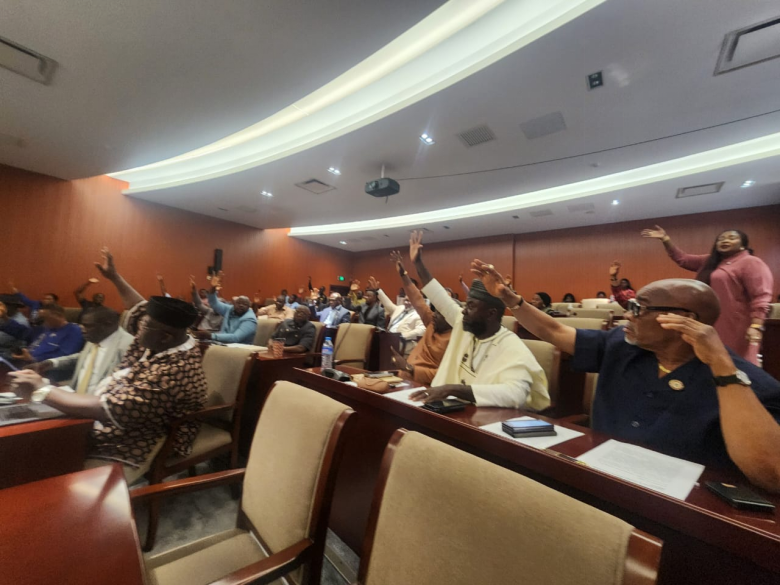
In a connecting development, the Plenary of the House of Representatives has voted to cite all SOEs and line ministries and agencies of the government under contempt for their delinquency in appearing before regular budget hearings by the House of Representatives.
The decision grew out of a motion by Nimba County Electoral District 7 Representative, Musa Hassan Bility, following a report by the Committee on Ways Means and Finance, in which it stated that several agencies of government including SOEs, have reneged on appearing at the revenue hearing.
These agencies and SOEs, the Chairman of the Committee, Representative P. Mike Jury of Maryland County District #2 stated, have rather chosen the Senate’s hearing over the House, which has the sole constitutional authority to do so.
Following reading of the report and deliberation by Chairman Jury and colleagues, the motion was proffered by the Nimba County lawmaker and seconded by Grand Gedeh District #1 Representative Jerimiah Sokan to invite these government functionaries to show cause, why they shouldn’t be held in contempt for failing to appear for the House Revenue Hearings despite being invited.
The motion was then tested into a voting process with members of the House unanimously accepting the decision.
Support Independent Journalism
Your support helps FrontPage Africa continue delivering independent, credible, and impactful journalism. Every contribution strengthens our ability to investigate, inform, and hold power accountable while keeping quality journalism accessible to our readers.
Support our journalism or subscribe to receive the latest FrontPage Africa stories and updates.