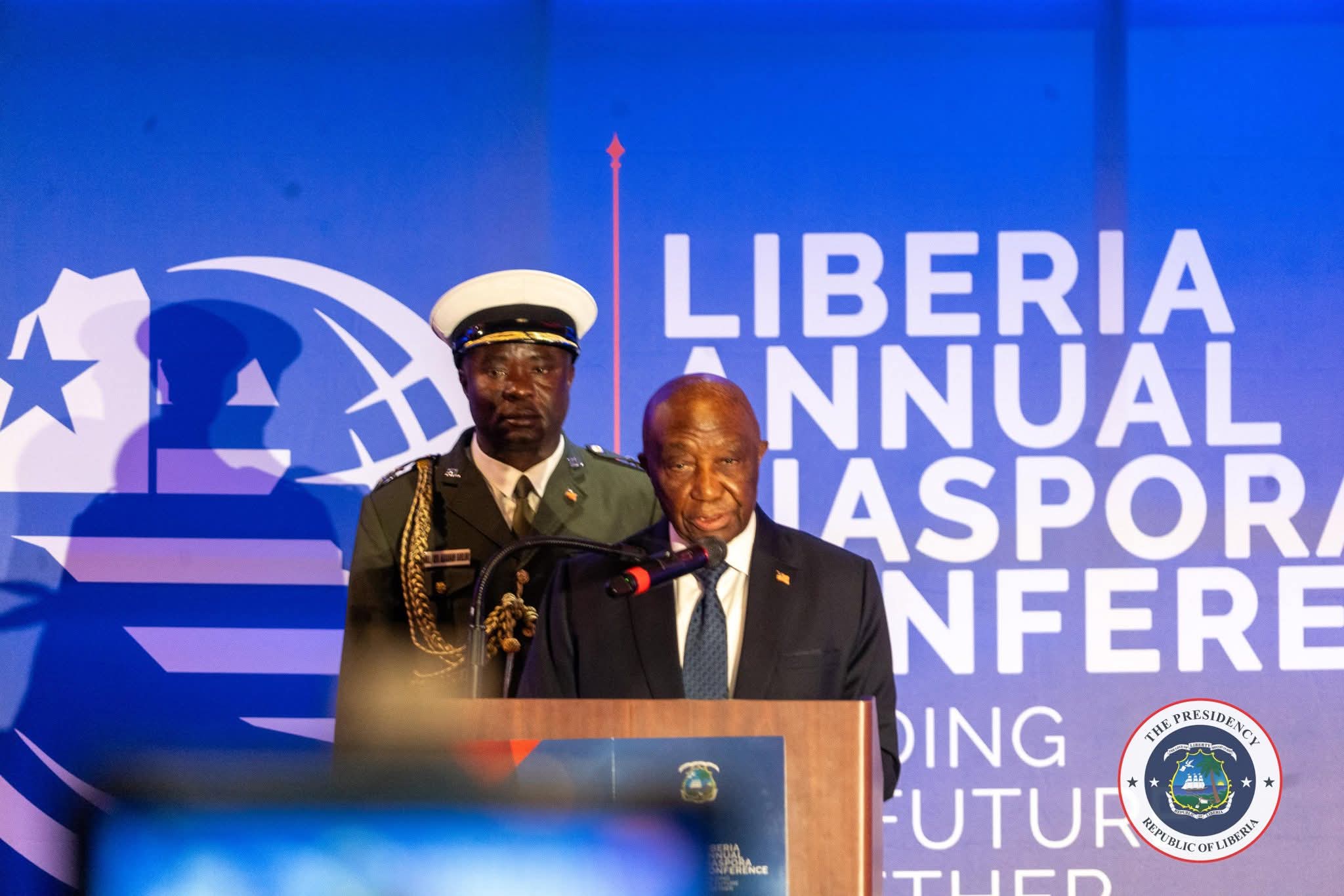
Washington, D.C., USA – At the inaugural Liberia Annual Diaspora Conference, President Joseph Nyuma Boakai assured Liberians abroad that they will not be “mere observers” but key partners in shaping Liberia’s transformation agenda.
By Emmanuel Weedee-Conway
Speaking under the theme “Renewing Liberia Together: Building a Future of Opportunity for All,” President Boakai underscored the pivotal role of the Liberian Diaspora in driving national renewal. He noted that the country’s challenges can be overcome when Liberians, both at home and abroad, commit to reversing past setbacks.
The Role of the Diaspora in National Renewal
Boakai described the Diaspora community as a “vital force” in building an inclusive, equitable, and prosperous Liberia. He praised their sacrifices, especially through remittances, which he said have “kept families fed, children in school, and homes together.”
“Now that you have given fish, teach us to fish,” he urged, calling on Diaspora Liberians to bring their expertise, networks, and resources to support private sector growth and national development.
The 2025 conference brought together Liberians from North America, Europe, Africa, Asia, the Caribbean, and beyond, highlighting the global strength and diversity of Liberia’s Diaspora community.
A Two-Way Partnership
President Boakai acknowledged that meaningful partnership requires mutual commitment. He assured the Diaspora of his administration’s dedication to creating a transparent and accountable environment that protects investments and fosters opportunities.
“We understand that partnership is a two-way street,” he said. “My Administration is committed to establishing an enabling environment—through improved infrastructure, healthcare, education, utilities, and security—and to working with you on initiatives such as a Diaspora Investment Fund.”
National Renewal and Transformation
Referencing Liberia’s recent election to a non-permanent seat on the United Nations Security Council, Boakai described it as a “defining moment” in the country’s journey of renewal.
“We have to restore our waning glory in the global community,” he declared, citing ongoing reforms under his government’s ARREST Agenda—Agriculture, Roads, Rule of Law, Education, Sanitation, Tourism, and Technology. The agenda, he stressed, aligns with Liberia Vision 2030 to build a capable and inclusive state while transitioning to a lower middle-income country.
Boakai emphasized that progress is already visible in healthcare, education, infrastructure, agriculture, and governance, though he admitted that more must be done—and urgently.
Governance Reform
On governance, President Boakai argued that Liberia’s recurring crises are deeply rooted in mismanagement and lack of accountability.
“The days of benevolent leadership are gone,” he asserted. “A small number of people unjustly used state institutions for personal gain at the expense of the majority. We must reform governance to give voice and power to citizens across all counties.”
He vowed to pursue decentralization, constitutional reforms, and participatory governance to move beyond Monrovia-centric decision-making.
Economic Transformation
Turning to the economy, Boakai noted that over a third of Liberians live in poverty despite the country’s abundant natural resources. He called for a shift from an extractive economy to one that adds value, promotes local ownership, and prioritizes agriculture.
“We must replace growth without development with growth that delivers development,” he said, stressing the need to reinvest profits in ways that benefit the majority.
Social Inclusion and National Reconciliation
Addressing inequality, Boakai highlighted Liberia’s history of social, ethnic, and generational divisions that continue to undermine unity.
“Our system has long deprived many of a voice in their own affairs,” he said. “We must confront these inequalities honestly and dismantle them systematically.”
The President reaffirmed his commitment to peace and reconciliation as cornerstones of Liberia’s future.
“Overlooking impurity and expecting peaceful coexistence is like plaiting hair without first picking the louse,” he cautioned. “Since 2003, we have been on a difficult journey of rebuilding trust, reconnecting communities, and redefining our identity. To move forward, we must confront our painful past and build a future rooted in truth, justice, and compassion.”
Support Independent Journalism
Your support helps FrontPage Africa continue delivering independent, credible, and impactful journalism. Every contribution strengthens our ability to investigate, inform, and hold power accountable while keeping quality journalism accessible to our readers.
Support our journalism or subscribe to receive the latest FrontPage Africa stories and updates.