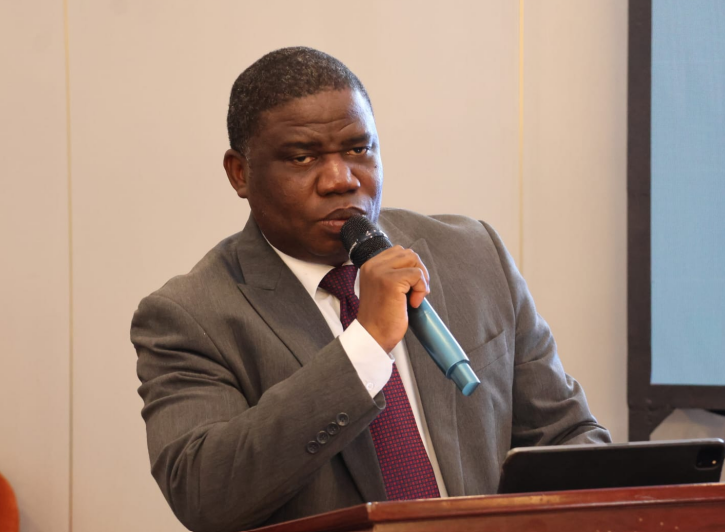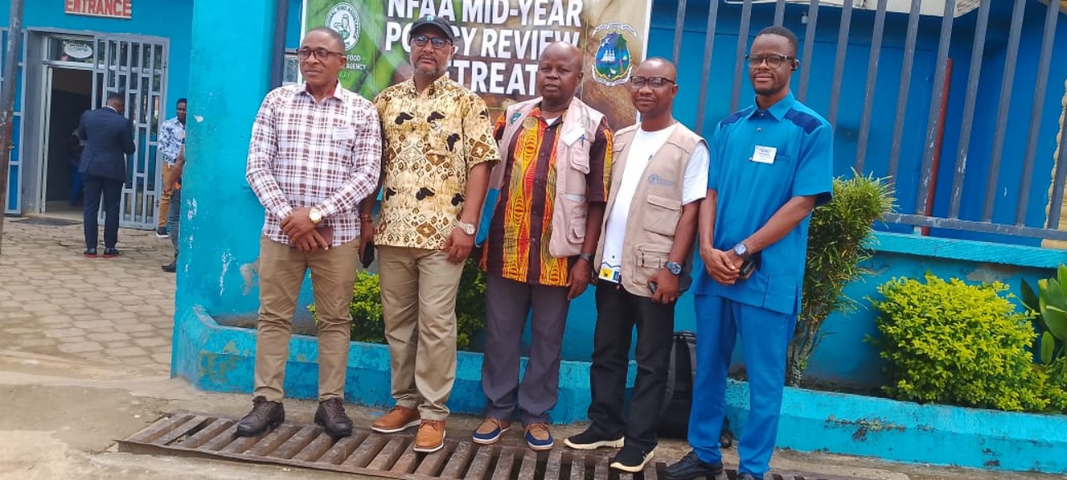

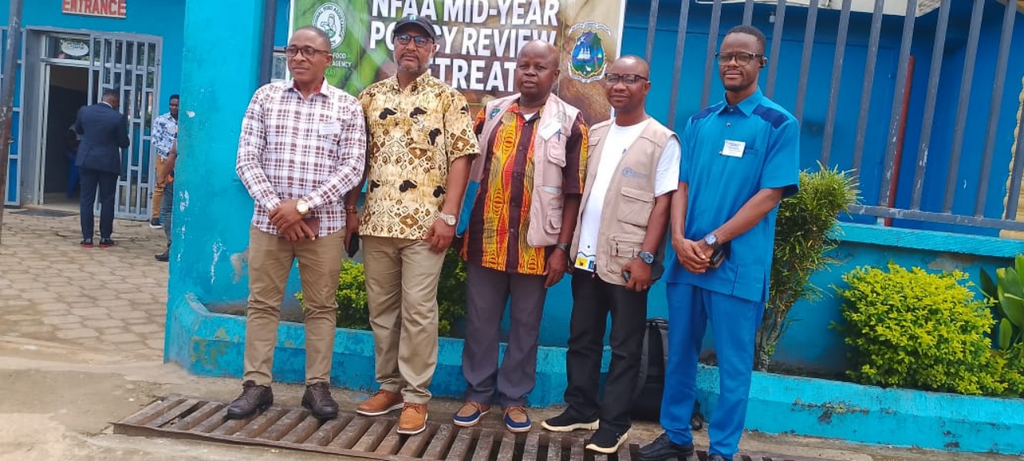
Ganta, Nimba County — The National Food Assistance Agency (NFAA) is reviewing its strategic and annual work plans and preparing to scale up county-level interventions in 2027, Director General Borkai A.M. Sirleaf said during a five-day mid-year retreat in Ganta City, Nimba County.
Director General Sirleaf told participants the retreat’s purpose is to compare planned activities with actual delivery, identify gaps and adjust priorities for the remainder of the year and for next year.
“When you develop a strategic plan, somewhere during the middle of the year you have to come back and review,” he said. “You look at what is happening, what will not happen, or what you think you can do and what you have done.”
The retreat brought together senior staffs including workers of the NFAA and partners in a conference setting framed by charts, timelines and action matrices pinned to flip charts and projector slides. Sessions combined plenary reports with small working groups that examined district- and county-level case studies, monitoring data, and expenditure records. Staff used the time to map shortfalls, reassign responsibilities and set concrete milestones for quarter three and four.
Director General Sirleaf acknowledged the importance of government support since the NFAA’s establishing law passed in 2024, citing government-provided vehicles, office space and utilities. Still, he stressed the agency cannot rely solely on state funding.
“Government has really helped us, we have vehicles, billing, electricity, office equipment from the United Nations Development Program ( UNDP) but you cannot depend on government for everything,” he intimated.
He described the outreach-first approach that leverages partnerships with international agencies, civil-society actors and private citizens. As an example of grassroots support,
He also described a Liberian woman in the United States who responded to an NFAA Facebook post and began sponsoring two blind girls who had been abandoned as infants and placed in a care facility in Gardnersville, Montserrado County.
“Those are the kind of things we’re asking Liberians to do,” he said, appealing to citizens to support vulnerable brothers and sisters.
Looking ahead to 2027, the NFAA has aligned its programming with the government’s Agenda for Inclusive Development (AAID) and plans to intensify outreach across multiple counties.
The director general said the agency has already visited roughly a dozen counties, delivering food assistance to prisons, hospitals and schools in places including Kolahun, Bong, Nimba, Totota, Robertsport, Cape Mount and Bomi.
Field teams documented scenes of crowded hospital wards and prison holding areas where food relief eased immediate shortages, and visited schools where midday feeding programs helped students concentrate and remain in class.
In many counties, NFAA staff coordinated with local chiefs and health workers to identify households most in need and to plan distribution points that minimize travel for vulnerable families.
Sirleaf described the NFAA’s mandate as inherently intergovernmental and cross-cutting, requiring collaboration with UN agencies and bilateral partners to expand capacity.
He singled out the United Nations Development Programme (UNDP), the Food and Agriculture Organization (FAO) and the World Food Programme (WFP) as central to the agency’s work.
He credited UNDP with supplying start-up equipment such as printers, computers and generators; FAO with funding the strategic planning process; and WFP with technical cooperation on programming and joint site visits.
“Partnerships give us scale and technical depth,” he said, noting that joint assessments and pooled data-sharing make targeting more efficient and reduce duplication with other humanitarian actors.
When asked what the public should expect from the NFAA’s 2027 budget, Sirleaf emphasized that the agency will operate within whatever resources the government allocates and will publish receipts and activity reports.
“We’re not there to force government If government gives us $500,000, $1 million, $2 million, we will work within that money,” he said. Transparency measures were highlighted as central to the agency’s approach. NFAA maintains attendance and sign-in sheets for meetings, requires photographic and written evidence of activities, and publicly displays budgets and reports on its website, nfaa.gov.lr. The agency recently scored 87 percent on the president’s performance management contract, narrowly missing its 90 percent target; Sirleaf said the agency now aims for 95 percent through improved monitoring and service delivery.
Tracing the NFAA’s history, Sirleaf said the agency was first created by executive order in the 1970s to run school-feeding and community food-assistance programs but lost capacity during Liberia’s civil conflict.
He described the present leadership’s efforts as a restoration of a once-dormant institution. “We took an organization that was dead,” he said, noting upgrades to the agency’s head office, staffing, and online presence that signal a renewed focus on results.
Staff at the retreat described a culture shift toward results-oriented planning, with clearer tasking, tighter reporting lines and a demand for evidence. Sirleaf praised his team’s commitment and discipline: “With the team I have, we are very prepared. They don’t like failing, and I don’t like failing.”
Beyond nationwide planning, agency officials emphasized community engagement as central to successful interventions. NFAA teams are working to build local referral mechanisms with health clinics, school authorities and prison officers so that food assistance complements, rather than displaces, local services. In some counties, the agency plans small-scale pilot projects that combine food support with livelihood training and school attendance incentives designed to reduce chronic vulnerability.