Five political parties – the ANC, CDC, ALP, CMC and NDC – are reviewing a draft action agenda on women’s priorities in healthcare, agriculture, farm-to-market access and trade. The agenda, developed by Sister Aid Liberia with NIMD support, will guide the parties’ legislative advocacy through their caucuses once validated.
Monrovia – Five of Liberia’s political parties are meeting in Monrovia today to review and validate a draft action agenda aimed at putting women’s priorities at the center of party commitments and legislative advocacy.
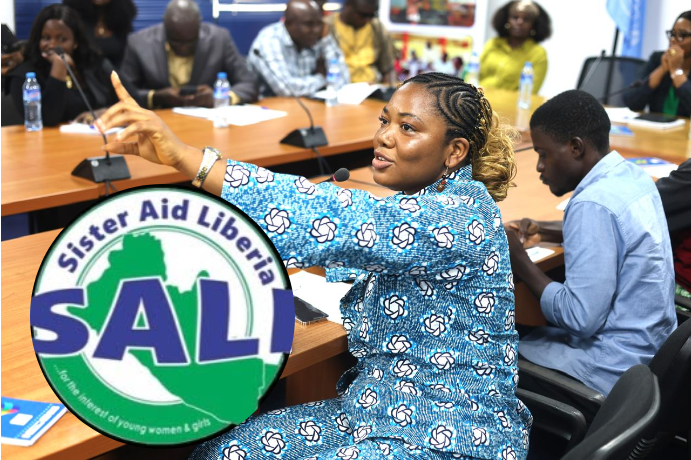
The daylong session, organized by Sister Aid Liberia (SALI) with support from the Netherlands Institute for Multiparty Democracy (NIMD), is taking place at the Platinum International Hotel in Congo Town from 9 a.m. to 5 p.m.
SALI is a women-led national non-governmental organization based in Monrovia and Paynesville, dedicated to advancing women’s rights, political inclusion and leadership capacity building.
The session is part of a project titled “From Dialogue to Action: Advancing Women’s Priority through Political Accountability and Legislative Engagement,” which seeks to push parties to adopt women’s concerns as formal commitments and to hold them accountable for following through.
Ahead of today’s validation, SALI held separate dialogues with the Alternative National Congress (ANC), the Congress for Democratic Change (CDC), the All Liberian Party (ALP), the Citizen Movement for Change (CMC), and the National Democratic Coalition (NDC). Those discussions focused on women’s priorities in healthcare, agriculture, farm-to-market access, and trade. Consultants then used the information gathered to draft the agenda now before participants.
Once validated, the document is expected to serve as a working tool to guide the parties’ legislative advocacy through their respective caucuses.
Building on earlier dialogue
Today’s meeting follows a broader multi-stakeholder forum held under the same theme. On June 19, SALI brought together lawmakers, government officials, political parties, development partners, civil society groups, women’s leaders and technical experts in Monrovia to identify policy and legislative responses to issues affecting women. A key result of that forum was a national action agenda meant to serve as an advocacy framework for engaging the country’s political leadership. At that gathering, Agriculture Minister Dr. Alexander Nuetah stressed that lasting progress in the sector depends on empowering women.
The SALI initiative is one of a string of cross-party dialogues NIMD has backed since it began working in Liberia in January 2024, with a focus on increasing women’s and youth participation in politics and decision-making.
In April 2025, ahead of the Nimba County senatorial by-election, NIMD brought together 17 youth representatives from the youth wings of six registered parties, including the ALP, CDC and NDC, and the young politicians signed a peace pact committing to promote peaceful messages before, during and after the vote. In February this year, an inter-party youth dialogue organized with the Federation of Liberian Youth drew 22 youth leaders from more than 10 parties represented in the Legislature. Most recently, on September 28, youth wing representatives met to discuss electoral reform, temporary special measures and inclusive representation.
SALI has also worked to rebuild cross-party solidarity among women politicians. Earlier this year, about 25 members of the revived Coalition of Political Parties Women in Liberia met in a push to set aside party differences and work toward better representation for women. “The men will not do this,” SALI acting executive director Amelia Siah Siaffa said at the time. “Women have to demand the space.”
A persistent gap
The push comes as women remain sharply underrepresented in Liberia’s Legislature. Women won just 10.7 percent of legislative seats in the 2023 election, lower than two decades ago. In the Senate, women hold just two of 30 seats.
Voluntary pledges have largely failed to close the gap. In May 2023, the National Elections Commission signed a memorandum of understanding with 25 parties and coalitions committing them to field at least 30 percent women candidates. Only two smaller parties, the Transformation Party and the Reformers National Congress, met that threshold.
Advocates are now looking to the Legislature. The House of Representatives has passed an electoral reform bill that would require parties to put at least 30 percent women on their candidate lists for legislative elections, but the measure has been in the Senate since May. Women’s groups have warned that a provision in the bill would still let the Elections Commission accept a party’s list if it shows “good cause” that it could not meet the threshold despite its best efforts.
Organizers hope the validated action agenda will give party caucuses a shared reference point for pressing women’s issues on Capitol Hill as the country looks ahead to the 2029 elections.
Support Independent Journalism
Your support helps FrontPage Africa continue delivering independent, credible, and impactful journalism. Every contribution strengthens our ability to investigate, inform, and hold power accountable while keeping quality journalism accessible to our readers.
Support our journalism or subscribe to receive the latest FrontPage Africa stories and updates.