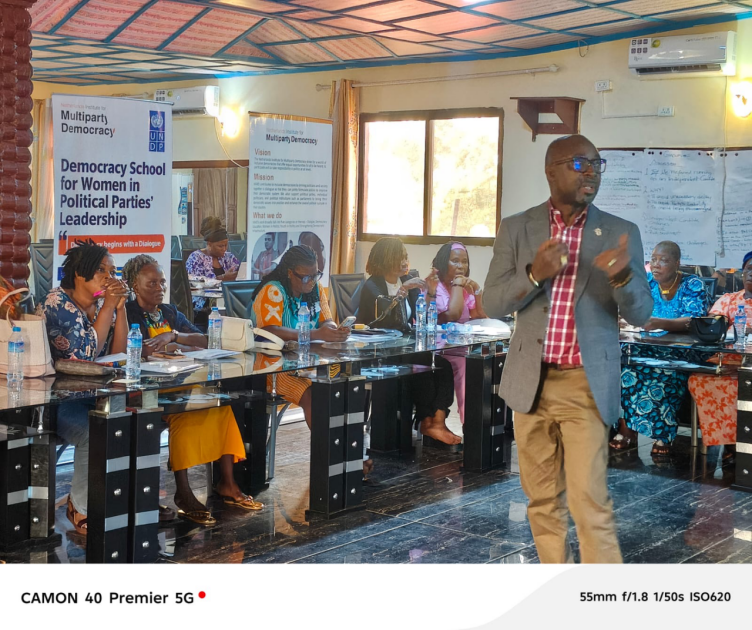
BUCHANAN, Grand Bassa County — Twenty-six women leaders representing political parties across Liberia are participating in a weeklong leadership-development program aimed at strengthening their influence in local governance, public decision-making and political accountability.
The program, organized by the Netherlands Institute for Multiparty Democracy (NIMD), with support from the United Nations Development Programme (UNDP) Liberia, is being held in Buchanan City, Grand Bassa County.
It provides a cross-party platform for women leaders to deepen their understanding of local governance, exchange experiences and identify practical ways to influence decisions affecting their communities.
A key session, facilitated by Naymote Partners for Democratic Development Executive Director Eddie D. Jarwolo, focused on “Understanding Local Government Structures and Opportunities to Address Gender Issues.”
The session examined the evolution of local governance in Liberia, county-government structures, barriers to women’s participation, and emerging opportunities for women to assume greater leadership roles in public decision-making.
Participants explored the responsibilities of County Administrations, County Councils and local-development structures, while examining how women political leaders can engage in public consultations, influence County Development Agendas, monitor county budgets and development projects, and hold public officials accountable.
The discussions emphasized that women’s political participation must extend beyond elections and campaigning to the institutions where development priorities are set and public resources are managed.
Jarwolo stressed that local governance is where citizens experience the practical impact of democracy, including decisions on roads, schools, healthcare, markets, sanitation, security and economic opportunities.
“For Liberia, inclusive decentralization is not only about bringing government closer to the people; it is about bringing women closer to power, resources and decisions,” Jarwolo said.
He further challenged political parties to ensure that women who mobilize voters and support campaigns are also represented when policies, budgets and development priorities are determined.
“Women cannot continue to carry political parties during campaigns and remain absent when policies, budgets and development priorities are decided,” he said. “Women must be represented, heard and empowered to influence the local-governance decisions that shape their lives and communities.”
Jarwolo noted that women’s extensive experience in peacebuilding, conflict resolution and community leadership gives them valuable insight into the needs of local communities.
He said their increased participation in local governance could strengthen public trust, improve the responsiveness of local institutions and ensure that development priorities reflect the realities of families and communities.
The session also underscored the need for political parties to remain active in communities between elections, rather than limiting their engagement with voters to campaign periods.
Participants were encouraged to study their respective County Development Agendas, engage County Councils, participate in development-planning processes and monitor government commitments to local communities.
They also received simplified copies of the County Development Agendas to support their engagement with county-level development priorities.
The program further encouraged participants to build cross-party alliances around shared community concerns and advocate for reforms that expand women’s leadership from the community level to the national stage.
Jarwolo called on political parties to establish transparent pathways for women’s advancement at the community, district, county and national levels.
He said parties should invest in women’s political education, support qualified women for elected and appointed positions, and encourage members to remain connected to citizens between elections.
Emphasizing that “all politics is local,” Jarwolo said political credibility depends on leaders’ ability to understand citizens’ concerns, engage legitimate institutions and pursue measurable results.
He urged women political leaders to become more visible in county-governance processes by following budget allocations, monitoring development projects and assessing whether government commitments are delivering tangible benefits to ordinary citizens.
The session concluded with a call for women’s leadership to become more prominent in political parties, County Councils and development-planning processes, stressing that meaningful democratic participation requires women to have a voice not only in choosing leaders but also in shaping the decisions that affect their communities.
About the Facilitator
Eddie D. Jarwolo is Executive Director of Naymote Partners for Democratic Development. He holds a master’s degree in Public Sector Management and is an alumnus of The Hague Academy for Local Governance in the Netherlands. He has published on local governance, peacebuilding, and democratic development in Liberia.
Support Independent Journalism
Your support helps FrontPage Africa continue delivering independent, credible, and impactful journalism. Every contribution strengthens our ability to investigate, inform, and hold power accountable while keeping quality journalism accessible to our readers.
Support our journalism or subscribe to receive the latest FrontPage Africa stories and updates.