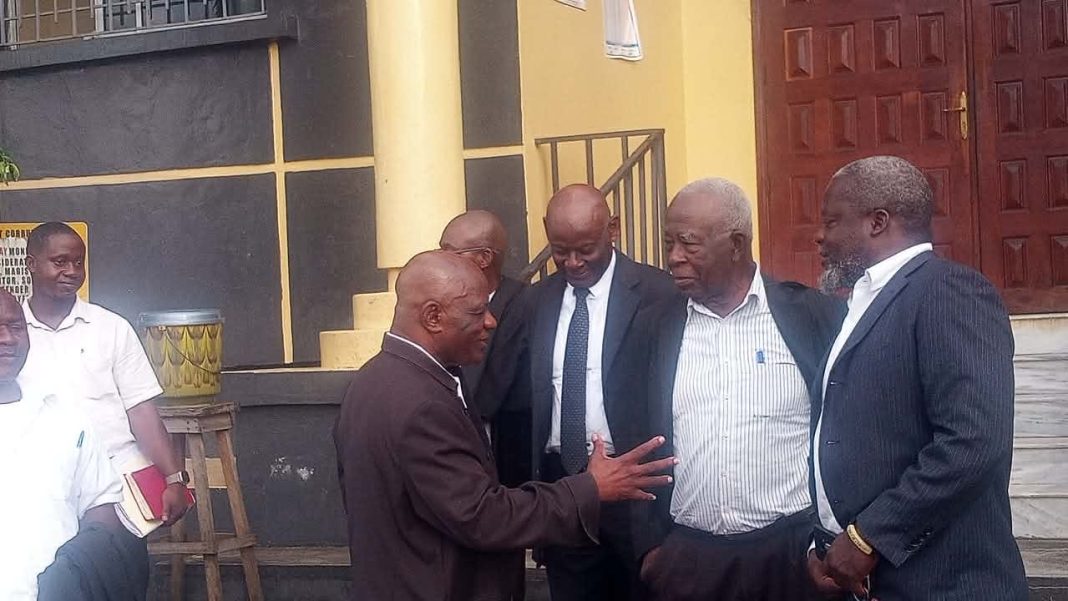


A Liberian rubber farmer and exporter has renewed calls to President Joseph Nyuma Boakai to immediately repeal Executive Order #166.
Executive Order #166 places ban on the exportation of unprocessed rubber.
However, Mr. Charles Bamakpeh, CEO of Meawon Liberia Incorporated points out that the ban is crippling livelihoods and threatening to hand control of the sector to foreign companies.
Speaking in a podcast Thursday morning, Bamakpeh, indicated that the June 26 order has left warehouses full and contracts unfulfilled.
“My company alone has a 2,000 metric ton contract that was due for delivery in July,” Bamakpeh asserted.
“Today, I have rubber sitting in my warehouse that cannot be shipped. My international partners are demanding delivery because end users are waiting. But we are stuck.”
No Grace Period, No Consultation
Bamakpeh furthered that the directive came with no grace period for existing exporters.
“The Ministry of Agriculture knows we exist. They issue our export certificates and certificates of origin. If a ban was necessary, there should have been a grace period to allow us to clear existing contracts.”
He argued the policy reverses the August 2, 2025 approach, which allowed exports with a 2% surcharge of about $150 per ton, something which he explained, was manageable.
Allegations of Market Monopoly
Bamakpeh accused proponents of the order of lobbying the Ministry of Agriculture to push Liberian businesses out and create a monopoly.
“The purpose of this order appears to be to push Liberian exporters out of business so that a few companies can control the market,” he maintained.
“For years, we Liberian exporters have gone back into the field and paid farmers higher prices; sometimes $800 per ton when others offered $700. That competition is what kept prices stable.”
Bamakpeh warned that without competition, they will manipulate the price-setting committee and drive prices down and as such, farmers will suffer.
Dispute Over Processed Rubber
CEO Bamakpeh also challenged the definition of “unprocessed” rubber in the order, stressing that cup lump becomes CBR after coagulation, and TSR-20 after further processing.
“Who uses TSR-20 in Liberia? No one. Bamakpeh said. TSR-20 is shipped to Malaysia, China, the U.S., and Kenya, where it is used to manufacture tires that are then sold back to us at high prices.”
He cited a Firestone pickup tire at $250 and a truck tire at $700 as examples, and dismissed claims that companies would build tire factories in Liberia soon.
“A modern tire factory costs over $2 billion to build. You cannot build one with one or two million. These promises are a scam to keep exploiting this country.”
Call for Open Market
Bamakpeh intoned that the ban affects not just exporters but farmers, brokers, and transporters from motorcyclists to pickup truck drivers.
“Rubber is not an illegal commodity. Let the market be open and fair. Tax everyone according to their category,” he urged.
“My appeal to you, Mr. President, is simple: repeal Executive Order #166. Cancel it for the sake of Liberian rubber farmers, brokers, and exporters.”
Bamakpeh also called on the Legislature and Executive to replace the order with “a new policy that protects and grows the Liberian rubber industry.”
Support Independent Journalism
Your support helps FrontPage Africa continue delivering independent, credible, and impactful journalism. Every contribution strengthens our ability to investigate, inform, and hold power accountable while keeping quality journalism accessible to our readers.
Support our journalism or subscribe to receive the latest FrontPage Africa stories and updates.