Summary:
- ACD Vocational Training Institute in Gbarnga has trained hundreds of young people, especially women, over 25 years after starting with one borrowed sewing machine, creating pathways to employment and self-reliance without government or donor funding.
- Despite its success, ACD faces challenges including high training costs, limited equipment and unpaid student fees, mirroring broader struggles in Liberia’s vocational training and small business sectors.
- Experts say ACD’s self-sustaining model offers a blueprint for workforce development throughout the country, showing how local ownership and market partnerships can succeed without donor dependency.
By Nukanah Kollie with New Narratives
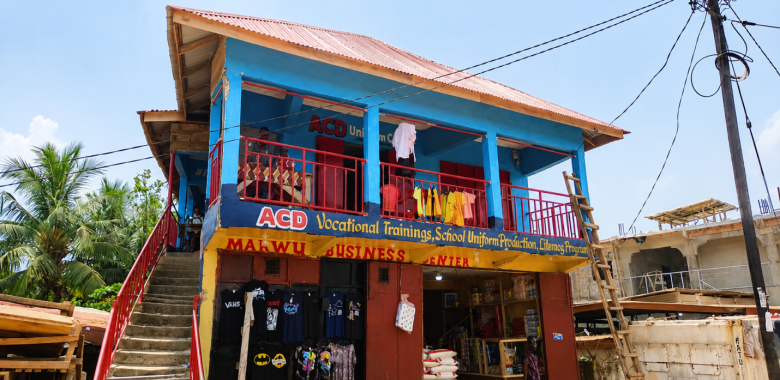
GBARNGA, Bong County —A bright blue two-story building stands in central Gbarnga, overlooking Broad Street. Red railings surround the balcony, where freshly sewn school uniforms hang beneath a sign reading, “ACD Vocational Training, School Uniform Production, Literacy Program.”
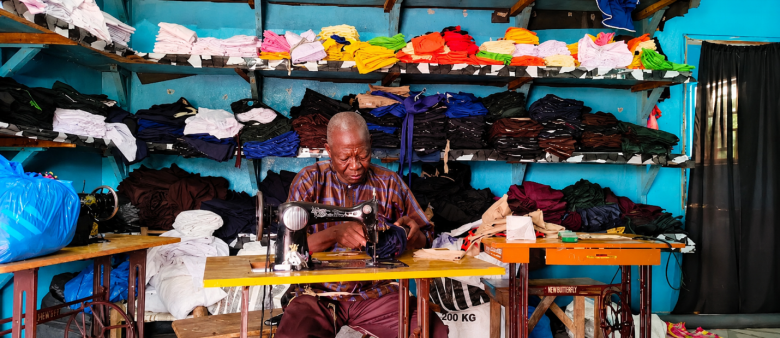
Inside, shelves hold colorful fabrics as sewing machines hum across the center. Founder Joseph N. Kamara, 66, sits on a wooden bench behind a black sewing machine, a measuring tape around his neck, turning cloth into uniforms while leading the self-financed vocational campus he has built over 25 years.
“I think the best thing to do for our people is impact knowledge in them,” said Kamara as he inspected a uniform completed by one of his employees. “When we talk about empowerment, I think the best empowerment is what gives them skills.”
Kamara has grown Accelerated Career Development Incorporated, known as ACD, which from a single borrowed sewing machine in 2001 into a two-campus institution that produces school uniforms sold across the region and creates opportunities for hundreds of women and young people.
Today, the school trains students in professional tailoring, driving, satellite installation, catering, hairdressing and weaving. It has grown at a time when experts say practical skills training is increasingly important in Liberia. The 2022 Liberia Population and Housing Census found that more than half of rural Liberians have no formal education, while rural literacy stands at 44 percent.
Nationally, Liberia’s vocational training sector has grown through international partnerships. A mid-term evaluation of the €25 million ($29 million) Youth Rising Project which ran from 2018 – 2024 rated the program as “satisfactory” but flagged heavy reliance on outside funding and gaps in graduate support.
Liberia’s private sector is dominated by small businesses. The World Bank’s 2024 Liberia National Establishment Census counted more than 40,000 businesses nationwide, 86 percent of them micro-enterprises. Development experts say their growth is a key factor in job creation and economic stimulation. But the World Bank has found that entrepreneurs continue to face limited access to finance, high interest rates and unreliable electricity.
Abraham Tumbey, a staff member at the UN Development Program, said vocational training is critical to addressing Liberia’s youth and female unemployment in a post-conflict economy where formal education cannot scale fast enough to absorb the labor force.
A School Built Almost Entirely By Women, For Women
Roughly 90 percent of ACD’s students are women, many of them single mothers. Kamara said the imbalance is intentional. The last Demographic and Health Survey in 2020 found that women head about one in three Liberian households, carrying the burden of supporting their families alone. Of the 107 students who have completed ACD’s full three-year tailoring program since 2001, about 96 percent have been women.
“Many of the men, they born by women, they leave the children with them, they go by their business, and the women struggle,” Kamara said.
For many women, the training was less about learning a trade than reclaiming independence. Patience Kollie, 40, a mother of three, completed ACD’s tailoring course before becoming an instructor in 2019 after the father of her children left the family.
“I want to tell all women out there who may be facing hard times,” she said. “Whether ACD can help you or people can help you, if you are serious, you can even pay your school fees yourself.”Martha Paye, 26, a mother of two and eight months pregnant, became an instructor in 2022 after her partner abandoned the family.
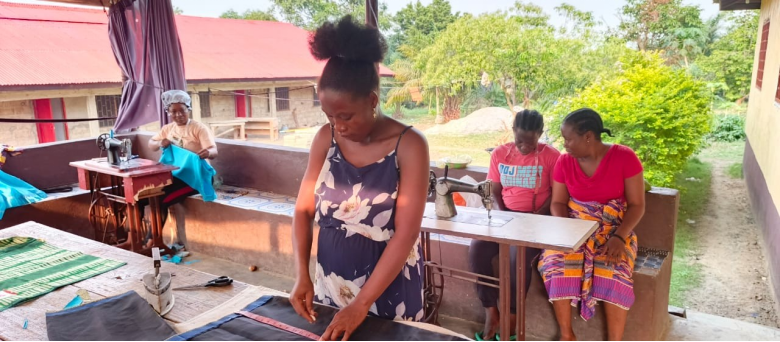
“I decided to come to ACD to learn something, at least to help myself, because there was no support,” she said. “If I say I won’t go to school, we shall not have anybody to send me to school, and it will be suffering for myself.”
Korpo Boakai, another graduate turned instructor, said the training transformed her life.
“I able to support my home,” she said. “I’m trying to do something good for my children, and I change my life. I able to support my three children.”
Beyond tailoring: uniforms, employment and a growing footprint
The institution has relied on commercial bank loans seven times over the years to sustain and expand operations rather than turning to donor funding. He said the key to his success has been being careful with money.
“When you are doing business, you don’t play with the business money. We have always been very careful with it, not to tamper with it. We also go around looking for contracts, and the people we are training are our manpower.”
Kamara said professional tailoring is the course ACD can guarantee leads to work because graduates are absorbed into the school’s own production operations, including a uniform business that has grown into a storefront on Broad Street.
Tumbey said connecting graduates directly to production contracts turns capability into capital.
“Training alone does not put food on the table, market access does,” he said.
The scale is significant. Kamara said ACD partnered with the American Institutes for Research on a contract to produce 17,500 sets of school uniforms distributed across Bong, Lofa, Margibi and Grand Bassa counties. The school has also trained students in Bong, Margibi, Montserrado and parts of Lofa County.
It manufactures graduation gowns annually for Cuttington University. Workers, paid every two weeks based on output, earned a combined US$4,320 producing gowns and hats for Cuttington in June 2025 alone.
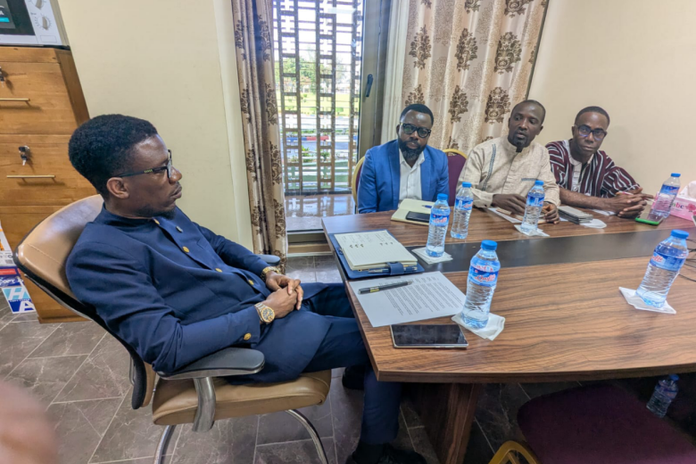
Aaron G.V. Juahkollie, Executive Director of the Foundation for International Dignity, said ACD has achieved what many vocational institutions struggle to do: survive without unreliable and unpredictable donor funding.
“The sustainability of any organization is what matters,” he said. “With the fact that they are sustaining themselves up to now, I think they are to be emulated, and government needs to look at them too, especially for the skills they are providing to women in the community.”
He pointed to ACD’s uniforms, tax compliance and 25 years of operation as proof of its credibility.
Persistent struggles faced by all small businesses
Without support from government or donors building the business has been challenging.
“Every day we beg, we go online, we look for people to help this program,” Kamara said.
He listed recurring challenges: high material costs, difficulty paying instructors and students struggling to complete tuition. Students unable to pay can work off fees once advanced enough to contribute to production.
Students echoed those concerns, describing a lack of personal sewing machines and difficulty accessing water.
“We don’t have, money and water around here,” Paye said. Like everyone here. She is hoping some benefactor will step up. “If they can help us with a water pump… that can help us to carry our school far, we’ll be happy.”
Tumbey has recommended that government make available low-interest micro-loans for small businesses like ACD, along with government investment in rural infrastructure – roads, electricity, water access – and tax incentives for businesses that hire and train young people.
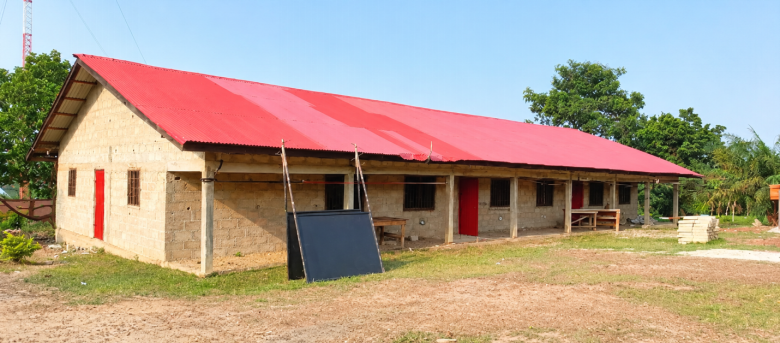
A school uniform for the future
Kamara said ACD’s ambition is to expand uniform production into a full factory capable of supplying government schools nationwide.
“Our first target is government schools,” he said. “We want to target government schools so that any government school in the republic… everything about school uniform, we’re going to produce.”
Tumbey called ACD an example other Liberian entrepreneurs could replicate, proving a movement does not require a massive grant; it can begin with a single borrowed machine.
ACD’s growth continues largely through word of mouth and Kamara’s outreach on local radio, where he encourages young people, particularly women, to enroll.
“If you don’t have any skill in your head, you have no hope,” he said. “But if you get skill in your head as you’re moving, you have hope that you will get something to do.”
Twenty-five years after beginning with one borrowed sewing machine, Kamara’s experiment has become far more than a tailoring school. It is a business, a training center and a source of opportunity for women and young people who might otherwise struggle to find a livelihood.
“You live by what you learn,” Kamara said.
This story is a collaboration with New Narratives as part of the “Investigating Liberia” Reporting Project. Funding was provided by the Swedish International Development Cooperation Agency. The donor had no say in the story’s content.
Support Independent Journalism
Your support helps FrontPage Africa continue delivering independent, credible, and impactful journalism. Every contribution strengthens our ability to investigate, inform, and hold power accountable while keeping quality journalism accessible to our readers.
Support our journalism or subscribe to receive the latest FrontPage Africa stories and updates.