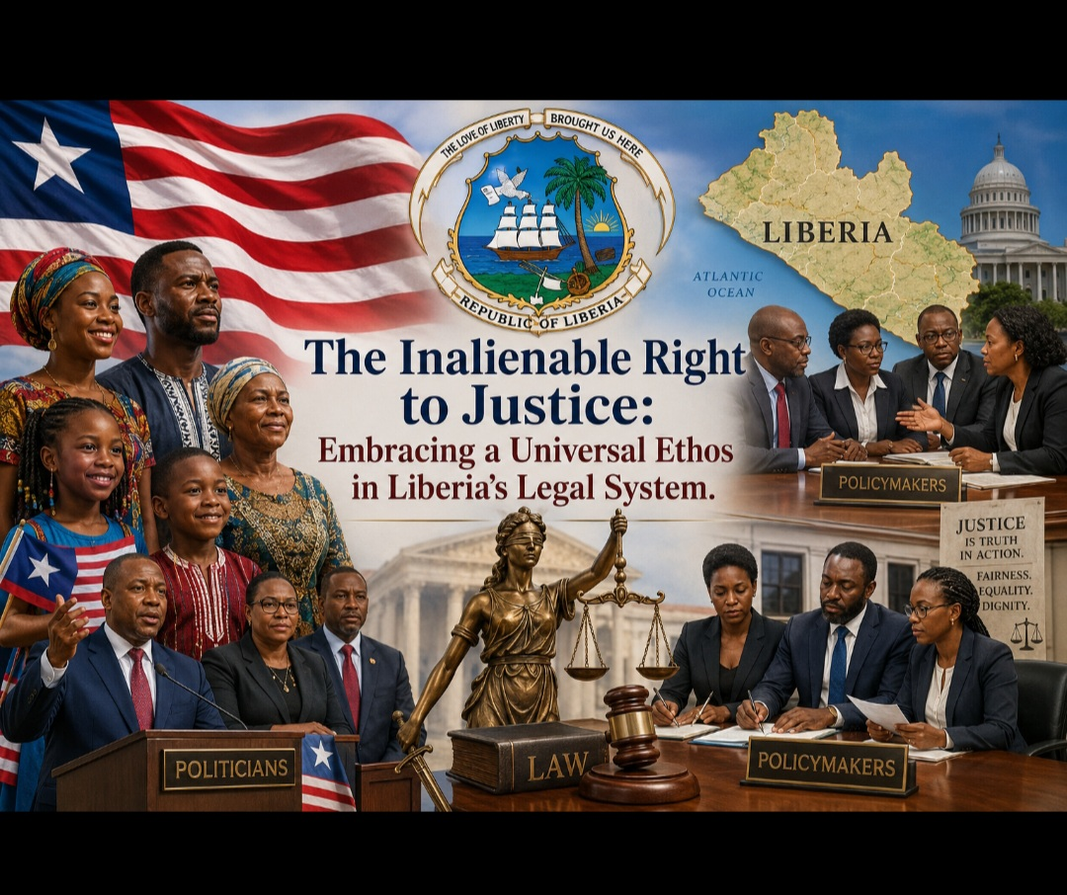

Austin S Fallah: “Justice is not a slogan to be shouted in the streets or a weapon to be used against political opponents. In a nation governed by law, justice requires patience, evidence, due process, and respect for the courts. Liberia must learn to let the law speak louder than empty political rhetoric.”
Austin S Fallah: “The inalienable right to justice belongs to every Liberian, friend or foe, government official or ordinary citizen. We can not demand justice for ourselves while denying it to others. A truly democratic Liberia must embrace one universal standard of justice for all.”
Austin S Fallah: “When allegations arise, responsible citizens should seek truth through lawful institutions, not replace evidence with slogans or judgment with political excitement. Liberia’s strength will not be measured by how loudly we accuse one another, but by how faithfully we allow the law to take its course.”
Austin S Fallah: “Patriotism is not the reckless condemnation of another Liberian before the courts have spoken. Patriotism is respecting the Constitution, trusting due process, and demanding accountability without abandoning fairness. Let justice be pursued with courage, but also with restraint and dignity.“
Austin S Fallah: “A new Liberia cannot be built on rumor, political vengeance, or empty declarations of guilt. It must be built on the universal principle that no one is above the law and no one is beneath its protection. Let us replace slogans with substance, anger with wisdom, and accusations with evidence, and allow justice to take its rightful course.”
In the kaleidoscopic realm of social justice, where the principles of equality and equity contend for dominance, one question reverberates with alarming urgency: If justice is truly impartial, should feminism and gender sympathy inform its execution?
As a resurgent Liberia stands at the proverbial crossroads—with President Joseph Boakai, Vice President Koung, and the coalition government steering the ship —an opportunity looms that must not be squandered.
This moment, situated in the second quarter of the 21st century, is a call to arms for a modern understanding of justice that transcends the constraints of class, gender, and political influence.
It requires a vision of justice that flows unfettered across the vast expanse of our motherland, a vision as relentless and boundless as the Atlantic Ocean itself.
What is justice, if not an unyielding commitment to uphold the rights of every individual, regardless of their societal standing?
It is fundamentally an aporia to assert that laws should only serve the downtrodden.
To segment justice into comfortable compartments risks undermining its very essence.
True justice must be enshrined in the belief that it serves a pluralistic society; it should not be a mere balm for wounds but rather a clarion call for collective responsibility and universal dignity.
Thus, it is not sufficient for justice to cater only to specific groups, be they feminists, the economically disadvantaged, or marginalized communities, while ignoring the broader landscape of humanity.
Justice must resonate with everyone, transcending the divides engineered by economic disparity or social standing.
The contemporary challenges that Liberia faces necessitate a comprehensive re-evaluation of its legal framework.
Under the enlightened leadership of President Boakai, the effort to craft a just society is indeed a salutary ambition that can bear fruit if pursued with sincerity and introspection, as it has been in recent times and will continue.
Laws must be created to encompass all citizens, ensuring that justice does not become a mere playground for tribalism, partisan politics, sectionalism, or countyism.
Such barriers incite division among the citizenry, diluting the purpose of justice and turning it into a vitriolic tool weaponized by political maneuvering and power struggles, as has been done in the past.
The concept of justice as more than a partisan game must be deeply ingrained in Liberian consciousness.
Justice can not simply masquerade as an instrument for political advancement; it must be perceived as a stabilizing force in society.
This idea rejects the notion of selective justice, a concept that appears temporary and transient, more performative than substantive, as Liberians saw in the past.
Liberians must rally around the principle that true justice is devoid of favoritism, empty political slogans, good-for-nothing rhetoric, or partiality, becoming a bulwark against oppression and tyranny in all its forms.
Liberians must examine the dynamic relationship between feminism and justice.
While feminism must amplify women’s voices and address systemic gender inequalities, it must also be framed within universal justice.
A justice system informed by gender sympathy is vital; however, to assign it a singular and exclusive role risks alienating other marginalized experiences that co-exist within the socio-justice landscape.
It is a delicate balance that requires pursuing justice for oppressed demographics while avoiding apathy toward the struggles others face.
Achieving this is no simple undertaking, and it requires courage and commitment from leaders and society at large.
They must act not as arbiters of selective justice but as facilitators of equity for all.
The coalition government under the leadership of President Boakai and Vice President Koung has an invaluable opportunity to establish a judiciary that safeguards the rights of women and men, youths and elders, rich and poor alike, which they are doing.
The winds of change blowing through Liberia’s legal landscape are rife with potential, provided they are harnessed effectively and cascaded through policies and practices that reflect an earnest dedication to neutrality and fairness.
Moreover, the fight against drug trafficking and its criminal networks within Liberia exemplifies the urgency and necessity of an impartial justice system.
The drug cartels that have seeped into the fabric of society are a visceral reminder of the degenerative forces that threaten to undermine the nation; therefore, anyone criminally involved must be held to account.
To confront this challenge, Liberians must collectively confront these entities’ manipulation of justice.
A justice system that is equal for all citizens must approach crime through a lens of unwavering scrutiny.
Drug traffickers and their accomplices must reckon with the full weight of Liberian jurisprudence, uninhibited by questions of social hierarchy or political association.
Liberia stands poised to redefine its narrative, to be something more than a historic victim of division and strife.
By nurturing a contemporary legal framework, one that exists above the fray of commonplace prejudices, Liberians embrace a future rooted in justice that is both restorative and transformational.
Justice should not be an abstract ideal whispered within academic circles; it must permeate citizens’ everyday lives, reinforcing the bonds of community and kinship.
The pursuit of justice in Liberia must also encompass compassion and understanding, recognizing that pontificating ethics can not fill the void created by injustice.
It must push the boundaries of empathy and extend beyond superficial engagement.
The legal system must be as multi-faceted as the challenges Liberians face.
It requires every air-breathing Liberian at home and in the diaspora to engage dialectically, acknowledging and integrating diverse perspectives that repeatedly clash in the society.
In doing so, they cultivate a justice that is informed by the complexities of their lived experiences.
To expound on the notion of dual citizenship, both in terms of legal status and moral obligation, is essential when discussing this new dawn of governance.
Emphasizing mutual accountability encourages each citizen to uphold the civic principles of justice while remaining vigilant and proactive against injustices they witness.
Engaging through community outreach initiatives that foster dialogue among diverse segments of the population can mitigate the fears and grievances that often surface in the collective psyche.
Embracing this new wave of justice under the leadership of President Boakai and Vice President Koung demands more than a superficial commitment; it necessitates action.
Each citizen must also see themselves as a steward of justice, a guardian of their neighbors’ and compatriots’ well-being.
To cultivate a legal environment conducive to true justice requires a long-term investment in education, positive advocacy, and unremitting diligence.
The very fabric of justice in Liberia hangs in the balance.
It can become a tool for selective justice or a profound catalyst for unity and equity.
The opportunity to forge a new path has emerged at a critical juncture in our history.
Let us champion a justice system robust enough to encompass individuals from all walks of life, unraveling the chasms formed by tribalism and systemic oppression and promoting a collective sense of responsibility.
Together, everyone must see justice flow like the bountiful tides of the Atlantic Ocean, limitless, unyielding, and impartial, until it envelops the very essence of the nation and identity.
Only then can Liberians truly dare to call ourselves a society committed to justice for all.