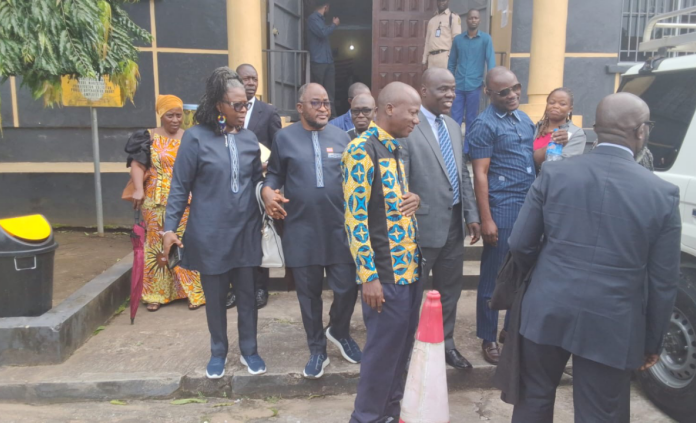
MONROVIA – Former Foreign Affairs Minister Dee-Maxwell Saah Kemayah and 12 other former government officials are set to face trial Monday, August 17, in Criminal Court “C” over allegations surrounding the handling of Saudi-donated rice intended for disaster victims.
By: Willie N. Tokpah
But as the long-awaited trial approaches, the defendants have consistently rejected the central allegations against them, insisting that the indictment does not establish criminal responsibility and that the evidence should be tested in open court.
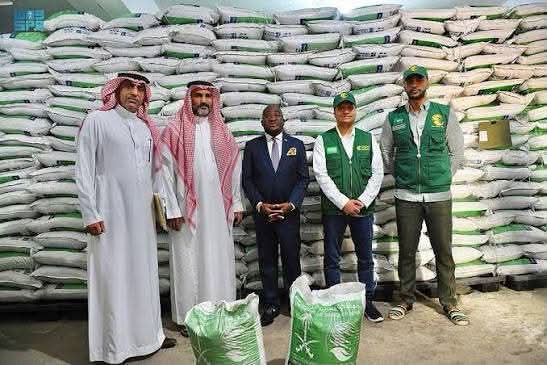
The case concerns 29,412 bags of 25-kilogram rice donated by the Kingdom of Saudi Arabia in April 2023 for vulnerable and disaster-affected Liberians.
Asset Recovery and Property Retrieval Taskforce, AREPT, alleged that 25,054 bags, valued at approximately US$425,918, were unlawfully diverted, misapplied or distributed without proper authorization.
Kemayah, however, has maintained that he did not steal, receive or personally benefit from the humanitarian rice.
Following his arrest in June 2025, he described the government’s action as a “public witch-hunt” and questioned the strength of the evidence against him. He called for the case to be handled through a fair and transparent judicial process.
Kemayah’s Defense: No Control Over Saudi Funds
Kemayah’s position received additional attention after he noted that documents showed that the financial component of the Saudi humanitarian assistance was handled directly by the Saudi humanitarian authorities and the vendor, Fouta Corporation.
He noted that the documents indicated that the rice was supplied as humanitarian assistance rather than being purchased with funds placed under Kemayah’s personal or ministerial control,” noting, “Fouta Corporation correspondence also showed payments originating from the Saudi side.”
Further accounts indicated that Kemayah participated in the public handover and distribution process alongside government officials and Saudi representatives.
According to those accounts, he instructed officials that the rice should benefit vulnerable Liberians and should not be taken for personal use by public officials.
Those developments have become an important part of the defence narrative as the former minister prepares to answer allegations that he participated in the diversion of the rice.
The indictment nevertheless alleged that Kemayah and other officials held meetings concerning the rice and that Kemayah influenced the transfer of 13,895 bags from the National Disaster Management Agency to the General Services Agency. Prosecutors say that action improperly interfered with NDMA’s statutory responsibility for disaster assistance.
Those allegations remain accusations.
They have not been established as facts by a court.
Mary Broh Also Rejects Allegations
Similarly, Former GSA Director-General Mary T. Broh, another prominent defendant, has since also strongly rejected the government’s case.
Broh reportedly described the indictment as “sad and laughable” and said she had no history of corruption during her years in public service. She further maintained that documents being relied upon by investigators had already been provided to the government.
Broh also threatened legal action against the Government of Liberia over what she considered defamatory allegations contained in the government’s case.
Her position, like Kemayah’s, is that the allegations must be subjected to evidence and judicial scrutiny rather than treated as established wrongdoing.
Wayfa Ciapha Challenges Investigation
Another defendant, Wayfa F. Ciapha, has also mounted a detailed defense.
Ciapha, identified by prosecutors as the purported CEO of the Group of Seventy-Seven, publicly declared: “I did not steal or mismanage any rice.”
She reportedly submitted a 48-page defense explaining the movement of the rice and tracing the distribution process through government institutions, including the Vice President’s Office, NDMA and GSA.
Her position directly challenges AREPT’s assertion that the rice was distributed through an unauthorized conspiracy.
From Arrest and Prison to Courtroom
The case first generated attention in June 2025 when law enforcement arrested several of the defendants following the issuance of the indictment.
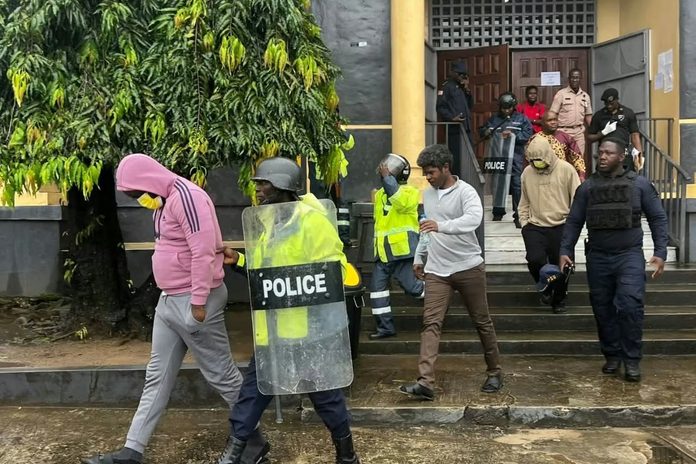
Kemayah, Broh and former NDMA Executive Director Henry O. Williams were among those arrested and taken before Criminal Court “C.” They were subsequently transferred to the Monrovia Central Prison, where they spent several hours before being released.
The defendants were released after their lawyers secured arrangements involving human sureties rather than conventional cash bonds.
A court arrangement allowed the accused to remain at liberty while the case proceeded through the judicial process.
The detention generated considerable political and public reaction.
Kemayah’s political party, the Movement for Economic Empowerment, condemned his arrest and characterized the action as politically motivated and undemocratic.
The former minister himself maintained that his detention did not establish guilt and insisted that the government should prove its allegations through evidence.
Trial Finally Set to Begin
After more than a year of legal proceedings and delays, Criminal Court “C” ruled on August 11, 2026, that the case should proceed to trial.
The proceedings are scheduled to begin at 9:00 a.m. on Monday, August 17.
The defendants face charges including theft of property, economic sabotage, misuse of public money, property or records, illegal disbursement and expenditure of public money, misapplication of entrusted property, abuse of office and criminal conspiracy.
The prosecution’s case will seek to establish that the defendants collectively participated in the unlawful diversion or misapplication of the donated rice.
For Kemayah and his co-defendants, however, the trial will provide their opportunity to challenge the allegations through evidence, cross-examination and legal argument.
AREPT has described the proceedings as an important stage in Liberia’s asset-recovery campaign, saying investigations and indictments must ultimately be subjected to judicial scrutiny before criminal responsibility and possible restitution can be determined.
The Taskforce has also said it remains committed to due process, defendants’ rights and judicial independence.
Support Independent Journalism
Your support helps FrontPage Africa continue delivering independent, credible, and impactful journalism. Every contribution strengthens our ability to investigate, inform, and hold power accountable while keeping quality journalism accessible to our readers.
Support our journalism or subscribe to receive the latest FrontPage Africa stories and updates.