Monrovia-The Center for Human Rights and Democracy (CeHRD) has called on the Government of Liberia to revisit and strengthen its National Security Strategy to prevent future border tensions and safeguard national sovereignty.
By J.H. Webster Clayeh, [email protected]
On Thursday, the Center for Human Rights and Democracy urged the Liberian government to strengthen, expand, and build the capacity of national security institutions to deter further violations within its territory.
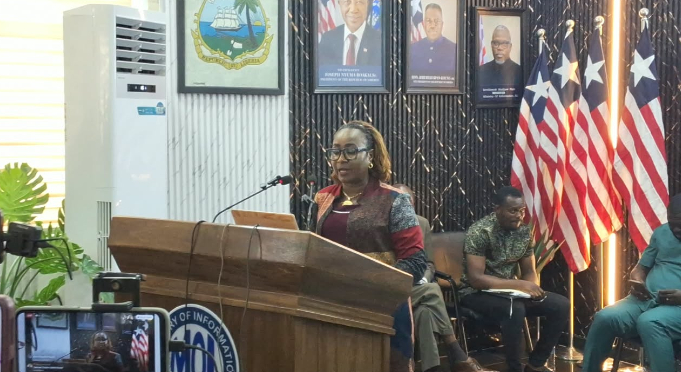
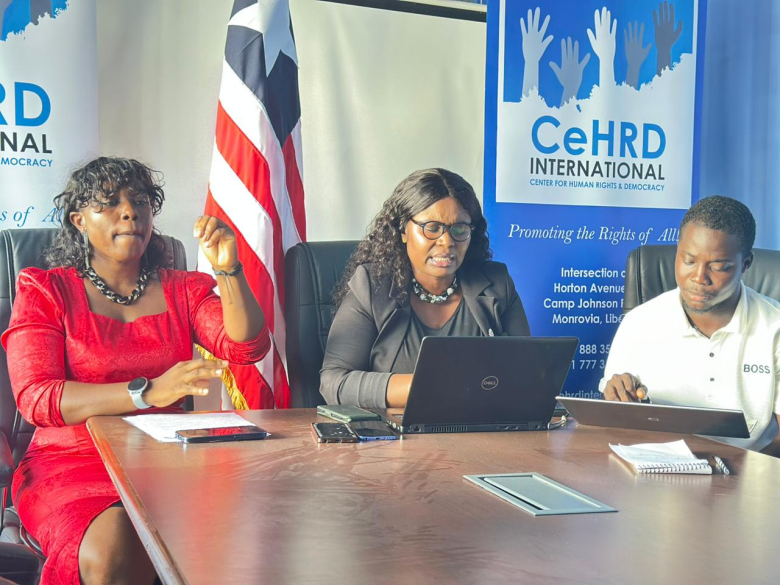
Speaking at the organization’s head office on Camp Johnson Road, CeHRD Head Danieletta Sleyon emphasized that while diplomatic engagement remains important, Liberia must remain prepared for possible future border tensions with Guinea.
“We recommend an urgent revisit to Liberia National Security Strategy, particularly strengthening; expanding and building capacity of national security institutions to project deterrence against future threats to Liberia’s cherishing values,” Madam Sleyon said.
She further stressed the broader regional importance of this approach: “CeHRD International believe that this approach will uphold sovereignty, reinforce solidarity among MRU member states, and honor the historical precedent of predecessors in prioritizing peace over profit, while upholding Liberia’s sovereignty and protecting our territorial integrity. These strategies can include allocating a larger portion of the national budget to military spending, securing additional funding through government loans or bonds, and seeking foreign military aid or assistance.”
According to the Center, these initiatives are crucial for the Liberian military to maintain operational effectiveness and contribute meaningfully to national security and development.
CeHRD raised alarm over recent tensions along the Liberia–Guinea border, particularly reports that Guinean soldiers crossed into Lofa County near the Sorlumba border and claimed the land as Guinean territory.
The organization described this as a direct threat to Liberia’s sovereignty and civilian safety, as well as a violation of regional agreements.
“The Center for Human Rights and Democracy sees as a threat to Liberia’s sovereignty, civilian safety and a contradiction of the October 3, 1973 Declaration of the Mano River Union (MRU),” Madam Sleyon said.
The Mano River Union (MRU) was established in 1973 by Liberia and Sierra Leone, later expanding to include Guinea in 1980 and Côte d’Ivoire in 2008.
Madam Sleyon highlighted the purpose of the union: “The aims was to promote economic cooperation, regional integration, and mutual development among its member states serving as a platform for regional peace, security, and economic growth.”
While acknowledging Liberia’s post-war progress, CeHRD noted that the country still faces fragile peace conditions and weak state presence in border regions.
The organization expressed concern about limited government presence in the Liberia–Guinea borderlands, particularly in relation to: Rule of law,
Good governance, Human rights protection, Peacebuilding and reconciliation Makona Basin and Regional Cooperation.
CeHRD highlighted the importance of the Trans-boundary Committee for the Makona Basin, established in 2019 under MRU auspices with support from the International Union for Conservation of Nature (IUCN).
The committee serves as a platform for Joint investigation, Environmental monitoring, and Conflict resolution.
The organization also welcomed the Liberian government’s decision to suspend unilateral mining along the Makona River but called for further action.
“While we appreciate the government of Liberia suspension of any unilateral mining along the Makona River until a transparent, independent assessment is conducted, we recommend a speedy regional (MRU) cooperative investigation into the alleged illegal of mining along the Makona River and to hold the actors who are involved accountable for their actions,” she said.
CeHRD emphasized the importance of involving local communities and civil society organizations in maintaining peace and cooperation in the region.
“With the involvement of civil society organizations and local government participation in dialogue with communities in the Makona Basin, we believe, it’s very pivotal to maintaining friendly relations among the communities along the Makona River to maintain cohesion,” Madam Sleyon added.
The Center also recommended expanding regional coordination mechanisms, Extend the mandate of the Trans-boundary Committee for the Moa/Makona Basin, Establish a regional task force of technocrats and civil society organizations, Monitor and report illegal activities in the Makona Basin.
The Center for Human Rights and Democracy reaffirmed that strengthening national security, enhancing regional cooperation, and promoting accountability are critical steps toward maintaining peace, protecting sovereignty, and preventing future border conflicts within the Mano River Union.
Support Independent Journalism
Your support helps FrontPage Africa continue delivering independent, credible, and impactful journalism. Every contribution strengthens our ability to investigate, inform, and hold power accountable while keeping quality journalism accessible to our readers.
Support our journalism or subscribe to receive the latest FrontPage Africa stories and updates.