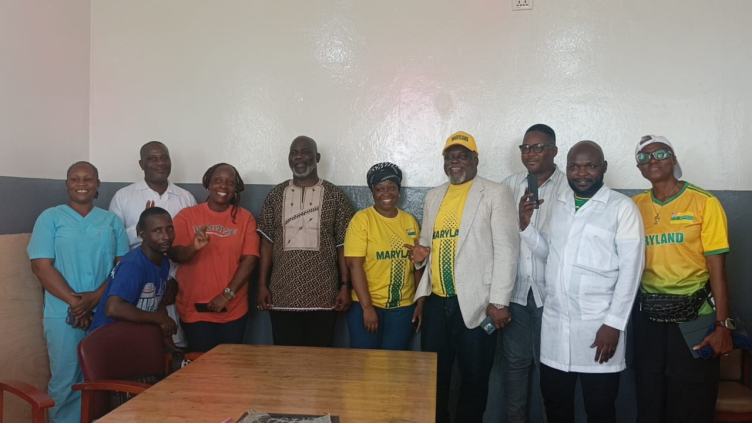
HARPER, Maryland County — Electricity has become one of the most urgent challenges facing the J.J. Dossen Memorial Referral Hospital, as county health authorities warn that unreliable and costly power supply is threatening the delivery of critical health services in Maryland County. The concern was raised by Maryland County Health Officer, Dr. Siedoh Freeman, during an engagement with House Speaker Richard Nagbe Koon and his delegation on Saturday, December 20, 2025, at the hospital in Harper.
By: Peter P. Toe, Jr, Contributing Writer
Dr. Freeman used the meeting to present a detailed overview of the pressing needs of J.J. Dossen and other health facilities across the county, describing a health system under growing strain due to limited infrastructure, logistical gaps, and rising operational costs.
Among the priority needs outlined were staff quarters for eight health facilities, inadequate space at J.J. Dossen Memorial Referral Hospital, the lack of reliable water sources and hand pumps for seven facilities, the need for two ambulances, the construction of three new health facilities, the installation of five incinerators estimated at USD$ 5,000 each, the establishment of an oxygen plant projected to cost between one hundred fifty thousand and two hundred thousand United States dollars, staff transportation, and the hospital’s escalating electricity burden.
Despite the wide range of needs, Dr. Freeman stressed that electricity stands out as a life-saving necessity that the hospital can no longer sustain under current conditions. She explained that the monthly electricity bill for J.J. Dossen Memorial Referral Hospital, which serves as the primary referral center for southeastern Liberia, is estimated to range between four thousand and six thousand United States dollars, covering power for twenty-three service points within the facility.
According to Dr. Freeman, the situation has been worsened by a joint official circular issued by the Ministry of Finance and Development Planning and the Ministry of Mines and Energy, which mandates all public sector institutions, including public health facilities, to make budgetary allocations for electricity consumption and to transition to prepaid metering systems.
She noted that with limited budgetary allocations to the county health sector, meeting electricity payment obligations has become increasingly difficult and unsustainable.
She emphasized that electricity is fundamental to uninterrupted health service delivery, particularly for maternal and newborn care, laboratory diagnostics, vaccine storage, emergency response, and the general operation of the hospital. Dr. Freeman warned that without stable and reliable power supply, the hospital’s ability to provide essential medical services would be severely compromised, placing lives at risk.
“This hospital cannot run without electricity, as it is the first and largest referral facility in this region,” Dr. Freeman stated, while appealing for urgent national intervention to address the power crisis facing public health facilities in Maryland County.
House Speaker Richard Nagbe Koon acknowledged the concerns raised by the county health officer and described the challenges as serious and deserving of attention.
During the engagement, he committed to purchasing a mini bus to support staff transportation at the hospital, while explaining that many of the other needs presented, including infrastructure expansion and utilities such as electricity, would require broader government budgetary intervention and policy-level support.
Support Independent Journalism
Your support helps FrontPage Africa continue delivering independent, credible, and impactful journalism. Every contribution strengthens our ability to investigate, inform, and hold power accountable while keeping quality journalism accessible to our readers.
Support our journalism or subscribe to receive the latest FrontPage Africa stories and updates.