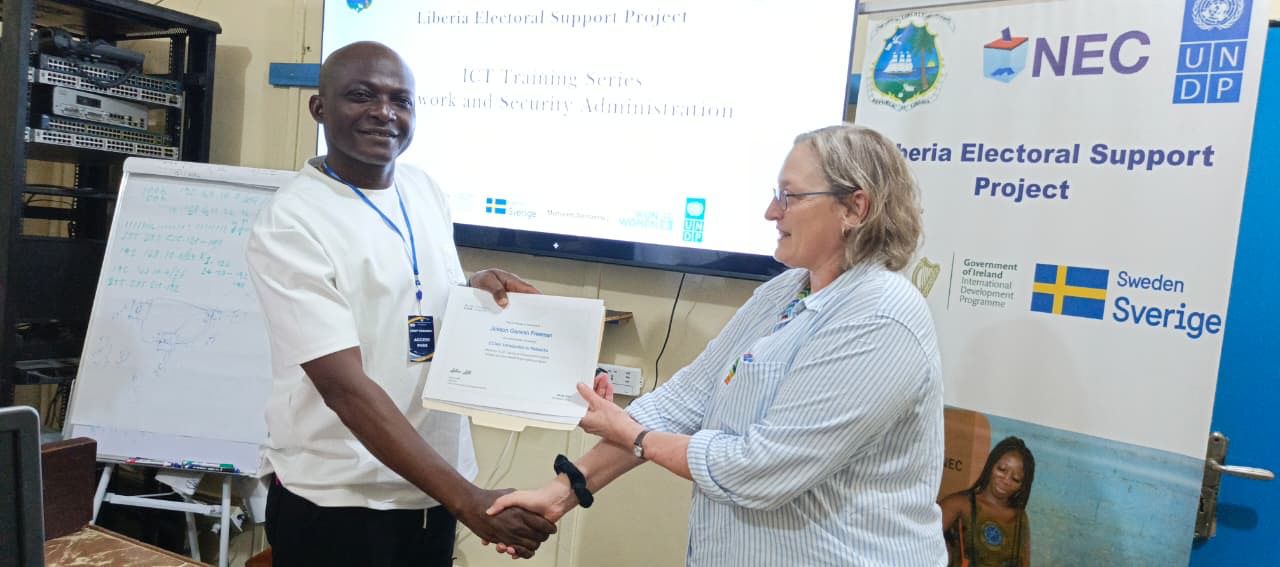
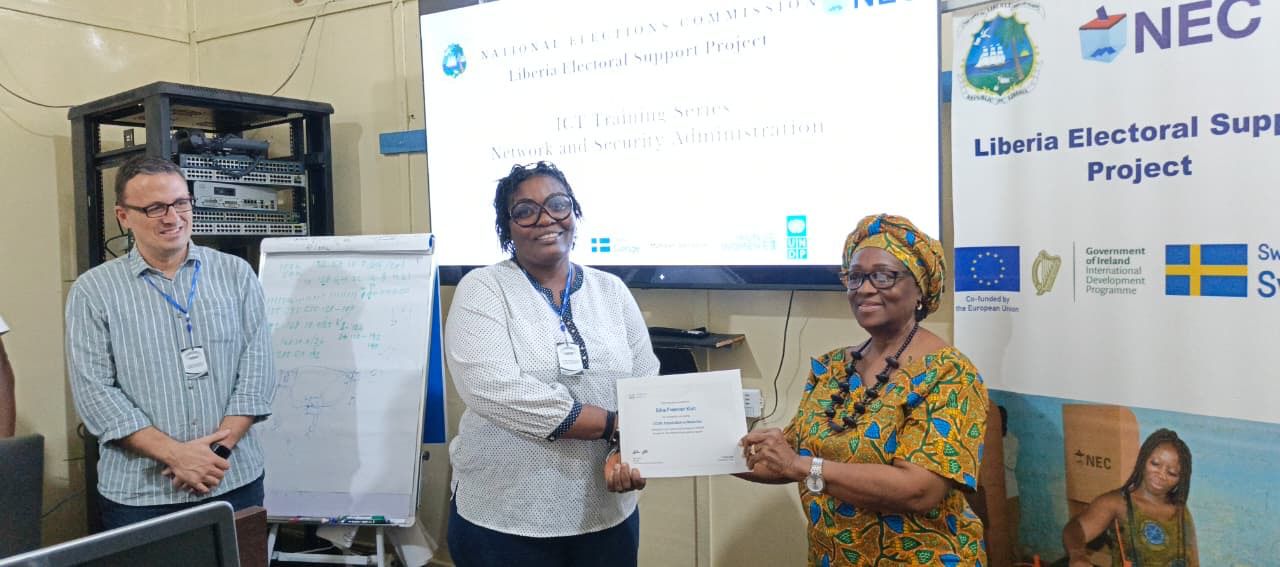
Monrovia – Fourteen (14) staff members of the National Elections Commission (NEC) have been certified after successfully completing an intensive Information and Communications Technology (ICT) training series in Network Administration and Security.
The training, conducted under the globally recognized Cisco curriculum, concluded with a certification ceremony held at Stella Maris Polytechnic University in Monrovia. The program forms part of NEC’s ongoing efforts to strengthen institutional capacity in secure networking, data management, and cybersecurity, in line with international best practices for electoral management bodies.
Speaking at the ceremony, Phillip I. Toe, Deputy Director of NEC’s Data Center Section, highlighted the foundational concepts covered during the training, particularly the importance of IP addressing and robust networking infrastructure in modern electoral operations.
“Every communication between a computer and another device is facilitated through an IP address and interconnected networks. For systems to communicate effectively, servers, routers, and switches must work together. This training helps us better understand how these devices interact to support NEC’s operations,” Mr. Toe explained.
James Dogbey, NEC’s Director of Information Technology, emphasized the strategic significance of the program, noting that it advances the Commission’s capacity to operate at higher industry standards.
“This training brings NEC closer to operating at advanced industry levels. It will significantly improve encryption, end-to-end visibility, and real-time monitoring of data traffic between headquarters and field offices. For the first time, we will be able to clearly track how data moves across our systems, strengthening security and accountability,” Mr. Dogbey said.
He added that the training equips staff to make informed decisions about future ICT infrastructure investments and enhances NEC’s ability to take full ownership of its data center operations.
Participants described the training as practical and impactful. Edna Freeman, Deputy IT Director, said the hands-on approach added tremendous value to participants’ skills.
“We worked extensively with Cisco Packet Tracer, switching, and real network activities. The training has significantly improved our practical skills, particularly in connecting and managing switches,” she noted.
Jickson Freeman of the Electronic Broadcasting Section highlighted the global credibility of Cisco-based systems.
“Cisco systems are globally trusted for high-level security, including during major international events. Completing this training positions NEC to deploy secure, high-end networking solutions capable of protecting electoral systems from intrusion,” he said.

Delivering closing remarks, NEC Chairperson Madam Davidetta Browne Lansanah underscored the importance of teamwork and continuous learning in effective network management.
“No one works alone in networking. It requires collaboration and shared responsibility to ensure systems are not only installed but function effectively. This training strengthens team building and peer support, ensuring that knowledge is shared and applied across the institution,” she said.
Madam Lansanah expressed appreciation to UNDP and development partners for their continued support of NEC’s digital transformation and staff development.
“This is only the first level. We look forward to the second, the third, and even higher academic and professional achievements. We are grateful to UNDP and our development partners for supporting NEC’s digital transformation and professional growth,” she added.
The ICT Training Series was supported through the UNDP Liberia Electoral Support Project, reinforcing NEC’s commitment to secure, credible, and technology-driven electoral processes.
The project promotes inclusive, transparent, and accountable governance and is implemented by UNDP in partnership with UN Women, the Netherlands Institute for Multiparty Democracy (NIMD), and NEC, with support from the European Union, Ireland, and Sweden.
Support Independent Journalism
Your support helps FrontPage Africa continue delivering independent, credible, and impactful journalism. Every contribution strengthens our ability to investigate, inform, and hold power accountable while keeping quality journalism accessible to our readers.
Support our journalism or subscribe to receive the latest FrontPage Africa stories and updates.