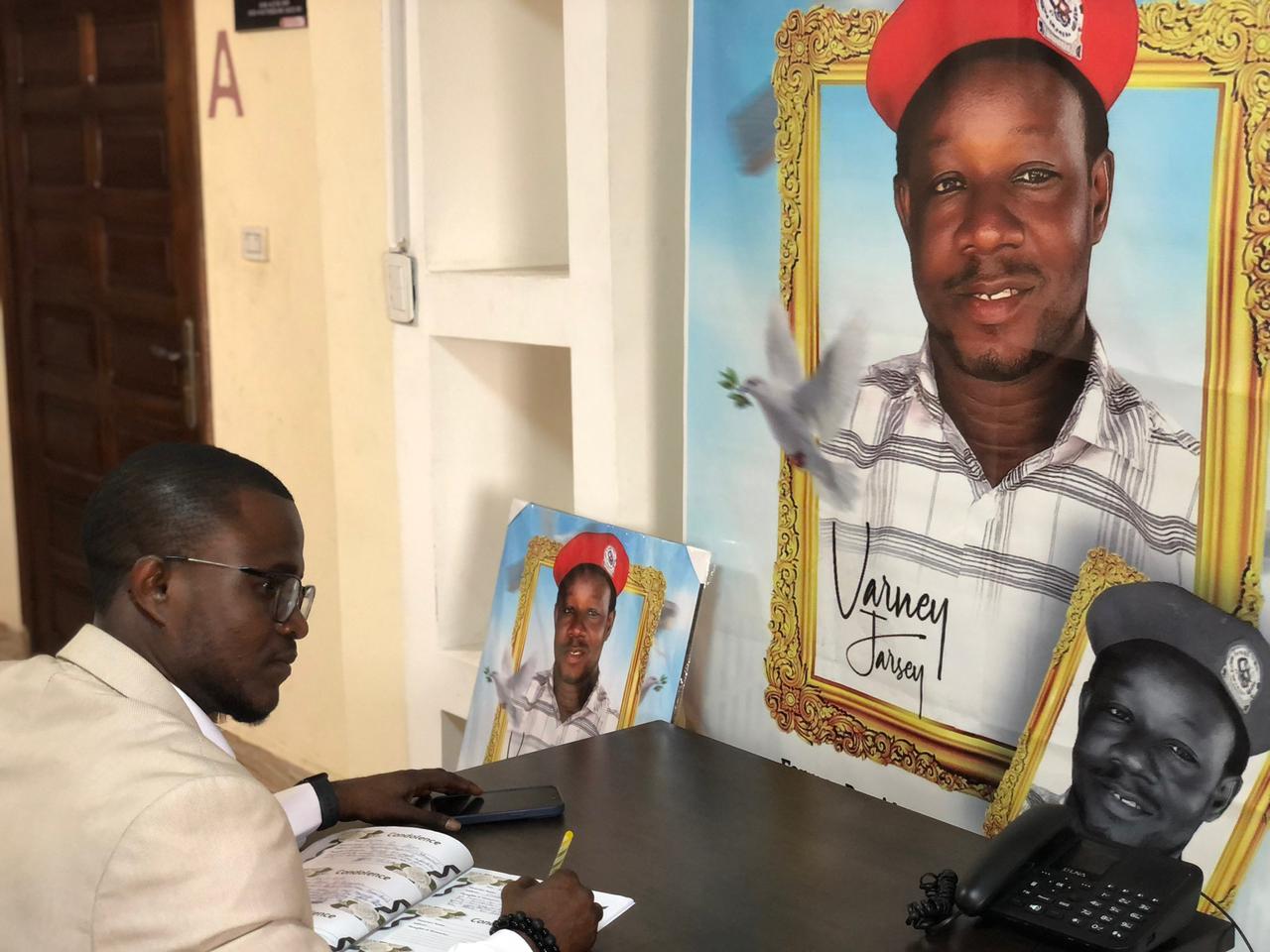
When I think of Varney, one word comes to mind: accessibility. He was a force of generosity, giving more of himself to people and progressive causes than anyone I have known in the youth and student community. His mission was simple: to help wherever he found a need. He empowered student leaders and fought for a better Liberia with equal conviction. And for me, it started with a single, open door. As a curious high schooler attending an event at the University of Liberia’s auditorium in 2009, Varney’s welcome didn’t just open an office; it opened my world to the possibilities of leadership, advocacy, and service.
By Ahmed K. Konneh, A Liberian Social Entrepreneur and Founder of DjaraPharma
Before I met Varney, my world was the classroom; after, it was the struggle for Liberia’s soul. He handed me a copy of Paulo Freire’s ‘Pedagogy of the Oppressed,’ and for the first time, I understood that education wasn’t just about memorizing facts, but a tool for liberation. He followed it with Shakespeare’s ‘Julius Caesar,’ a stark warning of how noble ideals can be shattered by ambition and political naivety. But he insisted my political education would be hollow without a proper local context, and so he steered me to the writings of Dr. H.B. Fahnbulleh. Through these texts, chosen with a mentor’s care, my curiosity was forged into a political consciousness.
I had long admired both the late Tom Kamara, founder of the New Democrat newspaper, and Dr. H.B. Fahnbulleh. Yet, I often clashed with Varney over what I saw as a flaw in H.B.’s style: his tendency to attack opponents personally in his writings and debates. As a matter of principle, I believe our focus should always remain on the strength of our argument, not the stature of the arguer. I frequently complained to Varney about how Dr. Fahnbulleh’s rebuttal, ‘Now They Know,’ crossed that line in its response to Tom’s provocative articles, ‘Sparking the Debates: Getting Liberated’ and ‘Let More Branches Spread.’ However, my perspective was challenged when I asked Tom Kamara himself about H.B. He spoke not of their intellectual feud, but of the immense sacrifices H.B. and his father had made for Liberia, reflecting on the heavy price they paid in defense of the Liberian people. When I told Varney about this, we both valued the profound principle Tom had demonstrated: the ability to credit an opponent’s patriotism and sacrifices, irrespective of personal or intellectual disputes. In Liberia’s political and intellectual climate, where such grace is scarce, I was heartened to find that Varney, too, reflected this same exceptional integrity.
While he was sharpening my mind with these books and debates, he was also introducing me to the front lines of national student politics. I started my journey in his office on Camp Johnson Road as an
informal office boy/personal assistant for a short period before relocating to Fendell to pursue a degree in Biology and Chemistry, which I didn’t complete. During my brief stint at LINSU, I went with Varney almost everywhere: Late-night meetings with student leaders, regular speaking engagements, leadership functions, and negotiations with government officials. I later travelled with him to Ghana for a youth leadership conference that reshaped my path from activism to broader service through social entrepreneurship.
Although Varney inspired my journey for nation building, this conference provided me with the vehicle, social entrepreneurship. During the conference, I had a brief encounter with Emmanuel Dei-Tumi’s, the founder of the Foundation for Future Leaders’ group, who had organized the conference. Dei Tumi’s success in building a national youth development and entrepreneurship organization inspired my vision for SMART Liberia. While this conference gave me a new vehicle for change, it was the intellectual and moral foundation Varney had built in me that prepared me to be one of its drivers. Long before Ghana, my political education had been shaped by the pages of books and the films we analyzed together.
As my debate coach, Varney weaponized film, using the screen as a canvas to teach me how to argue with conviction and act with principle. Our syllabus was a curated collection of stories and speeches that forged my political conscience. We analyzed the tragic ambition in Julius Caesar and Macbeth, the defiant leadership in Lean On Me, and the revolutionary fire in the speeches of Kwame Nkrumah, Ahmed Sekou Toure, Nelson Mandela, Malcolm X, Thomas Sankara, Patrice Lumumba, Amilcar Cabral, Augustinho Neto, Steve Biko, among others. But no film was more central to our discussions than The Great Debaters. It was my favorite, not just for its story, but for the role it created for me. Varney began calling me “Happy, Mr. Konneh,” a nickname modeled directly on a powerful scene where Coach Tolson (Denzel Washington) challenges a timid James Farmer Jr. (Denzel Whitaker).
Here is that specific part of the dialogue:
Melvin B. Tolson: “Who is your opponent?” James Farmer Jr.: “Henry Lowe.”
Tolson: “No. Your opponent is injustice. Your opponent is oppression. Now, who is your opponent?”
James Farmer Jr.: “Injustice and oppression.” Tolson: “Now, say it again!”
James Farmer Jr.: (With more force) “Injustice and oppression!”
Tolson: “Now, I want you to say it like you mean it! Now, who is your opponent?!” James Farmer Jr.: (Shouting) “Injustice!”
Tolson: (Moving in close, his tone becoming quiet and intense) “James Farmer Jr can
you tell us what happened to your father when he was a boy… down in Georgia? Who
put a gun… to his father’s head… and made him pull the trigger… for no reason… other than the fact that he could?”
(James is visibly shaken, his eyes filling with tears.)
Tolson: “And who made my father… walk from… Tyler, Texas… to Okmulgee, Oklahoma… because they lynched his father… and he had to go claim the body? Huh? Who?”
James doesn’t verbally answer. The horror and anger from this history became the “passion” that Tolson was looking for. He then delivers his next rehearsal with the fire and power of a sermon, finally understanding that he is debating against a system capable of such profound injustice.
This scene from The Great Debaters was a constant conversation starter for me and Varney. He would greet me with, “Happy, Mr. Konneh,” his own passion a living example of the very coaching Tolson embodied. Varney taught me that the core of any argument isn’t found in the what, but in the how and why. Data can be dismissed. A fact can be ignored. But a truth, delivered with the unwavering conviction that comes from understanding the human stakes – the kind of conviction James Farmer Jr. found when confronted with the brutal history of injustice – can change a mind, and in doing so, change a world.
Varney didn’t just want me to be correct; he wanted me to be compelling. This was a lesson he would soon have to apply not in a debate hall, but in the face of a profound personal and political defeat. I was there the night he returned from his defeat in the LINSU presidential race on his first attempt. The man who walked in was hollowed out by the sting of betrayal from those he called friends, the loss itself seeming less painful than the deception. We sat in that room, stewing in a shared grievance, expecting our leader to mourn with us. But within days, Varney was not just back on his feet; he was in motion. He transformed our shared disappointment into a new, more determined energy, rallying students and articulating his vision for the country with a clarity that felt sharper, more urgent, than before the election. The loss wasn’t an end, it was a recalibration.
This was not an isolated event, but a pattern of his character. When a wrongful rape accusation led to over a year behind bars, a period designed to break his spirit, it instead tempered his resolve. He emerged from that darkness not with bitterness, but with a fiercer, more determined fire. We plotted his campaign for the All Africa Student Union Presidency in the quiet hours, our strategy sessions burning midnight oil in the offices of SMART Liberia. And from the depths of that injustice, he rose to claim a continental victory.
Even in the face of terminal sickness, Varney’s spirit remained unvanquished. His hope was a stubborn, radiant force. He spoke not of an end, but of the next battle, the next lesson, the next comeback he was certain would come. Varney did not just preach resilience and courage; he embodied them. He was a lesson in how to fall, how to rise, and how to lead, not from a pedestal, but from the trenches of life’s greatest challenges.
True courage is often misunderstood. We see it in the resilience to withstand defeat, but Varney demonstrated a rarer, more profound form: the courage required in victory and leadership. His strength was not that of a clenched fist, but of an open hand. He possessed the humility to collaborate with former opponents, even when it came at a personal cost, because for him, collective progress was the only victory that mattered. This was a leader utterly secure in his own mission and thus unthreatened by the brilliance of others. In fact, he actively sought it out. In a society that often dims its brightest lights, Varney empowered them to shine, elevating individuals with more formal education and technical expertise and trusting them to deliver. I witnessed this firsthand when he placed Dr. Klon Hinneh, a science nerd with no political experience, at the helm of a national high school quiz competition. It was a risk, and it was a resounding success. Varney had the courage to identify potential, even in those who disagreed with him, and to hand them the torch.
This was a testament to his massive heart and his expansive vision. His tent was not a small, exclusive circle of allies; it was a broad coalition built on potential, not pedigree. He was colorblind to tribe, deaf to partisan noise, and indifferent to your origin story. If you had a fire in you to achieve, Varney was there with fuel. This lifelong practice of building bridges, not walls, yielded an inevitable harvest. When an SOS went out during the early days of his illness, a friend expressed surprise at the broad coalition of former opponents who rushed to his support. I was anything but surprised. I had seen the seeds of that loyalty sown in a thousand acts of unconditional support.
In essence, Varney was the kind of leader Liberia has been missing at the national level for generations. He embodied the very qualities we ache for: he was imaginative, seeing a future that others could not; progressive, building it with the best minds he could find; and loving, empathetic, and compassionate in his dealings with all. In a political landscape defined by grudges, he was forgiving. In a nation fractured by division, he was unifying. He was, in short, the very archetype of the leader we need. And for that, he will be dearly, desperately missed.
Yet, to remember Varney only as a paragon would be to miss the true source of his power. He was not a saint, but a supremely human force. His profound certainty could, at times, harden into a stubbornness that isolated potential allies. And as a product of Liberia’s opaque student political culture, even he could not fully dismantle all its entrenched systems. These were not corrosive flaws, but the human texture of a man who fought tirelessly within a complex world. They existed alongside, and perhaps even magnified, the immense generosity and principle that defined his core.
It is precisely because he was so human, because he poured every last bit of that imperfect self into the fight, that he achieved a rare and monumental feat. Most of us say we want to leave the world on an empty tank, but a few of us actually succeed. I believe Varney was one of the few. He was the mentor who handed us ‘Pedagogy of the Oppressed,’ the coach who demanded we find the ‘passion’ to fight injustice, and the leader who, even after a stinging defeat, was back in days rallying students with a clearer, more urgent vision. He built a coalition not of allies only, but of potential, empowering those
who disagreed with him because for him, Liberia’s progress was the only victory that mattered. He fully expressed his beliefs without fear.
And so, when his time came, there was no reserve left, no unused potential. Varney didn’t just speak of the empty tank; he achieved it. The rest of us, the students, the activists, the young leaders of Liberia, are left with the echo of his mighty engine, a sound that compels us to push our own pedals to the floor.
Support Independent Journalism
Your support helps FrontPage Africa continue delivering independent, credible, and impactful journalism. Every contribution strengthens our ability to investigate, inform, and hold power accountable while keeping quality journalism accessible to our readers.
Support our journalism or subscribe to receive the latest FrontPage Africa stories and updates.