MONROVIA – The Liberia Drug Enforcement Agency (LDEA), the country’s main anti-narcotics institution, has become a mirror of Liberia’s deep institutional decay. Riddled with internal power struggles, public scandals, and allegations of complicity by government actors in the very crimes it is meant to combat, the LDEA today stands less as a symbol of hope and more as an emblem of failure in the country’s fight against illicit drugs.
By Selma Lomax | [email protected] & Obediah Johnson
The agency has once again found itself in the spotlight following the August 28 dismissal of its top three officials — Director General Anthony K. Souh, Deputy Director for Administration Gwee Forkpa, and Deputy Director for Operations Sebastian Farr.
President Joseph Boakai, citing “administrative reasons,” removed the leadership team just months after appointing them, in what many see as yet another desperate attempt to salvage the LDEA’s crumbling credibility.
“These dismissals are aimed at strengthening our collective resolve in achieving a country free of illicit drugs and substances,” President Boakai stated. His decision to bring in a temporary leadership team composed of officers seconded from the Liberia National Police (LNP) and the National Security Agency (NSA) marks the third major shake-up at the LDEA since he assumed office in early 2024.
But beneath these recurring leadership purges lies a far more troubling pattern — one in which the agency meant to be the watchdog of Liberia’s drug fight has become paralyzed by internal chaos, undermined by political interference, and infiltrated by the very criminal networks it is supposed to dismantle.
The LDEA’s downward spiral intensified in early 2024 when President Boakai appointed former police strongman Abraham Kromah as Director General. His appointment quickly turned controversial as Kromah clashed publicly with his deputy, Hassan Fadiga. Kromah accused Fadiga of insubordination and of leaking internal matters to social media, but Fadiga retaliated with explosive allegations — claiming that Kromah was protecting drug traffickers, appointing tribal allies to key positions without merit, and blatantly disregarding agency protocols.
What followed was unprecedented and a near-violent showdown at the agency’s headquarters, with Fadiga allegedly brandishing a firearm in the office. Police were called in to defuse the standoff.
Meanwhile, then-Deputy Director for Administration Gbawou Kowou and Fadiga brought further charges against Kromah, leading to the suspension of all three by President Boakai. The fallout reportedly led to a loss of confidence from international partners, including the U.S. State Department and the United Nations Office on Drugs and Crime (UNODC), both of which had previously supported LDEA programs.
Anthony K. Souh was appointed in late 2024 to stabilize the agency, but his short tenure quickly unraveled. His deputy, Sebastian Farr, authored a damning internal report accusing newly appointed senior officers Abraham Okai Payne and Aaron Karzon of widespread misconduct.
Farr’s letter detailed incidents where the officers allegedly conducted unauthorized raids, used unregistered semi-automatic firearms, extorted suspects, released detainees without proper procedure, and even attempted to bribe him. He also accused them of leaking sensitive agency documents to the public.
“The credibility of this agency is hanging by a thread,” Farr wrote. “If we continue to allow rogue officers to run operations unchecked, we risk losing whatever public trust remains.”
Instead of being addressed, Farr’s concerns were reportedly ignored, and the agency continued to operate in dysfunction — a trend that has plagued every leadership team at the LDEA over the past five years.
Even more disturbing are the growing allegations that elements within the government itself are complicit in Liberia’s drug trafficking problem. During a Ministry of Information press briefing in July 2025, then-Deputy Director Gwee Forkpa delivered a stunning rebuke of Liberia’s entire political establishment.
“If you go into the sectors, you will find somebody involved with drugs,” Forkpa said. “So when you’re fighting drugs, you’re fighting people everywhere.”
Forkpa criticized the operational capacity of the LDEA, stating that the agency is overwhelmed, underfunded, and largely manned by unpaid volunteers. “The system is very bad,” he said. “More than half of our officers are volunteers — no training, no pay, no logistics. How do you expect to fight organized crime with this kind of setup?”
His remarks were chilling not only in their substance but in their implication — that the very structure of the LDEA, and the political environment around it, is so compromised that genuine anti-drug efforts are nearly impossible.
Forkpa’s comments echoed those made years earlier by LDEA Commander Martha Massaley, who in 2022 told lawmakers that a sitting legislator had been caught trafficking drugs but was never prosecuted.
Massaley collapsed mid-testimony and never returned to complete her statement. Her sudden health crisis and silence afterward only deepened public suspicion of high-level cover-ups.
These statements have contributed to a growing public belief that the country’s anti-drug campaign is being deliberately sabotaged by those within the political elite. It’s a belief that has been further validated by recent developments.
Senator Amara Konneh, a prominent critic of the LDEA’s dysfunction, said the ongoing turmoil is damaging the Boakai administration’s image and undermining public trust.
“The LDEA saga is making President Joseph Boakai’s administration look increasingly ineffective in fighting drugs, and hopelessness is spreading among citizens,” Konneh said. “Young users and individuals struggling with addiction, the true victims in this situation, need our support, not the neglect that has resulted from the mess at the LDEA.”
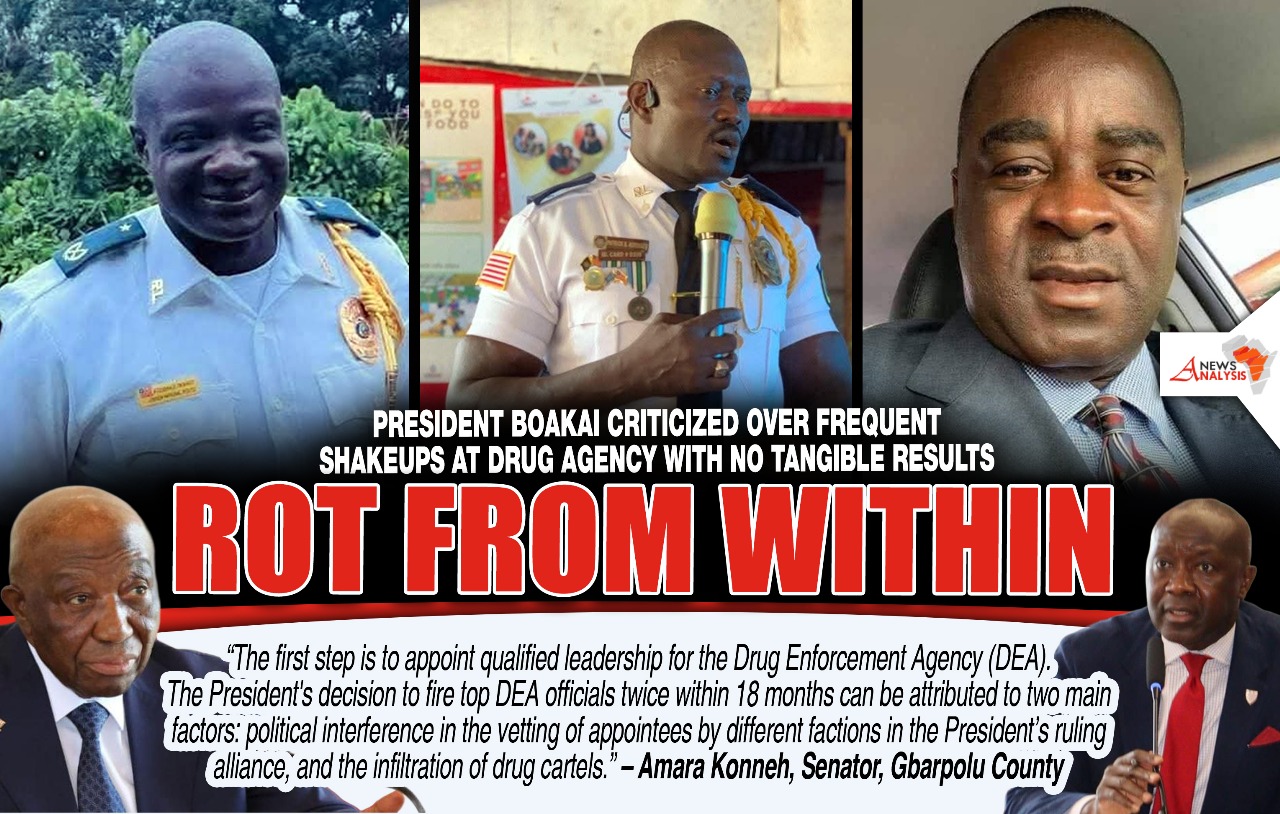
Senator Konneh said the recurring leadership changes at the agency are a symptom of deeper problems. “The President’s decision to fire top LDEA officials twice within 18 months can be attributed to two main factors that political interference in the vetting of appointees by different factions in the President’s ruling alliance, and the infiltration of drug cartels.”
He pointed to a particularly troubling case involving LDEA officers at Roberts International Airport (RIA), who arrested a Liberian woman for drug trafficking and livestreamed the incident on Facebook — a move that drew public praise for its transparency.
“Those officers should have been honored and promoted for their vigilance,” Senator Konneh said. “Instead, they were suspended and transferred from the airport. Meanwhile, the LDEA Deputy for Administration, who bravely exposed the involvement of powerful government officials in the illicit drug trade during a live MICAT Press Conference, has been fired. The cartel is at work.”
In the face of mounting public frustration, the Boakai administration has pledged to spend US$3.5 million on drug rehabilitation and prevention programs. But civil society groups and health providers say only a small portion of that funding has reached frontline services.
Meanwhile, a 2023 UNFPA report found that one in five Liberian youth use narcotics, and there are more than 866 known drug dens operating in Monrovia alone.
Tensions boiled over earlier this year during the nationwide “Say No to Drugs” protest, which saw tens of thousands of citizens — particularly women and youth — flood the streets of Monrovia demanding action. The protest called for stiffer laws, more accountability, and an overhaul of the LDEA. While the event garnered significant media attention, it also highlighted the growing divide between public expectations and government response.
In an apparent effort to rebuild trust, President Boakai has appointed an interim leadership team composed of officers from outside the agency. DCP Fitzgerald T. M. Biago of the Liberia National Police is now the Officer-in-Charge, supported by NSA’s Ernest T. Tarpeh and ACP Patrick B. Kormazu.
The President has also directed the Ministry of Justice to conduct a comprehensive 90-day review of the LDEA’s structure, mandate, and operational effectiveness. However, critics are already questioning whether this will produce lasting change or simply become another bureaucratic exercise with no real accountability.
As Liberia confronts its drug epidemic, the fate of the LDEA is becoming a litmus test for whether the government can reform a broken institution or whether the agency will continue to serve as a cautionary tale of how corruption, political interference, and impunity can destroy even the most critical national agencies.
Support Independent Journalism
Your support helps FrontPage Africa continue delivering independent, credible, and impactful journalism. Every contribution strengthens our ability to investigate, inform, and hold power accountable while keeping quality journalism accessible to our readers.
Support our journalism or subscribe to receive the latest FrontPage Africa stories and updates.