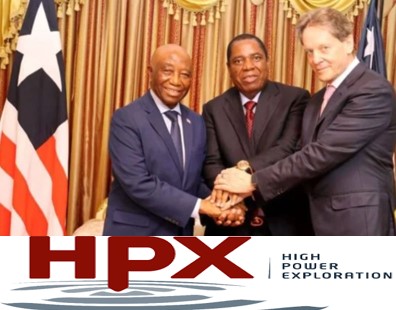
Monrovia, Liberia — High Power Exploration (HPX), a mining firm backed by billionaire Robert Friedland, is facing intensifying scrutiny over its push to secure rail access through Liberia to export iron ore from Guinea’s Nimba deposit. Critics, including industry analysts and regional policymakers, now question the feasibility—and motives—of HPX’s proposed $5 billion Liberian infrastructure project, arguing it clashes with Guinea’s historic stance on resource sovereignty and a transformative new rail project on its own soil.
By Alexander Jones, Investigative Correspondent
A Legacy of Resistance: Guinea’s 60-Year Stance
For over six decades, successive Guinean governments have refused to permit the export of their iron ore through neighboring Liberia, insisting that mining firms invest in domestic infrastructure to process and transport resources. This policy, rooted in economic nationalism, aimed to ensure Guinea retained control over its mineral wealth—a principle that appeared to weaken temporarily under the administration of former President Alpha Condé.
In 2019, Condé’s government signed a bilateral agreement allowing small-scale miners in Guinea to use Liberia’s rail and port systems. However, Condé’s regime was ousted in a 2021 military coup, and the new junta-led government has since signaled a return to Guinea’s traditional priorities.
The Trans-Guinean Railway: A Game Changer
The geopolitical landscape shifted dramatically in 2023 when Guinea’s new government secured a landmark deal between mining giant Rio Tinto and Singapore-based Winning International Group to construct the Trans-Guinean Railway. This 650-kilometer line, now 80% complete, will directly link Guinea’s Simandou iron ore reserves—the world’s largest untapped deposit—to a new deepwater port in Conakry. Officials project the $15 billion infrastructure megaproject will be operational by late 2025.
Crucially, HPX’s Nimba mine lies just 130 kilometers from the Trans-Guinean rail corridor. Analysts argue that connecting to this line would be far more cost-effective than building a 240-kilometer rail through Liberia to the port of Buchanan—a project HPX abruptly announced in 2024 without publishing feasibility studies or financing details.
“Economically, this makes no sense,” said Mamadi Trawally, a Conakry-based mining economist. “Why spend $5 billion in Liberia when Guinea’s own rail system could be leveraged at a fraction of the cost? This looks less like a serious proposal and more like a pressure tactic.”
HPX’s Credibility Crisis
HPX has repeatedly claimed it will ship 25 million tonnes per annum (mtpa) of Guinean ore through Liberia, insisting it has “assurances” from Guinean authorities. Yet when pressed by Liberian officials to provide documented proof of the new junta’s approval, the company has failed to produce evidence.
This silence has fueled accusations of deception. “HPX is selling a fantasy,” said James Flomoku, a Liberian activist leading oversight efforts for affected communities. “The Condé-era agreements are dead. Guinea’s new leadership has made it clear: their resources will transit their infrastructure. HPX either shows us a valid pact with Conakry or stops misleading our people.”
The firm’s abrupt pivot to Liberia has also raised eyebrows in Washington, where HPX has lobbied for U.S. government support. “There’s no logical reason Guinea would greenlight a rival rail project that undermines their own $15 billion investment,” a U.S. State Department official told our correspondent on condition of anonymity.
Liberia at a Crossroads
Liberian President Joseph Boakai’s administration now faces mounting pressure to reject HPX’s proposal unless concrete proof of Guinea’s consent emerges. Civil society groups warn that the project risks becoming a white elephant, leaving Liberia burdened with debt and half-built infrastructure if Guinea blocks ore transit.
“HPX wants Liberia to gamble billions on a railway Guinea could veto overnight,” said Abigail Weedor of the Liberian Civil Society Initiative. “We’ve seen this script before: foreign firms make grand promises, then vanish when profits dip. Let Guinea’s own rail prove itself first.”
The Call for Transparency
As the Trans-Guinean Railway nears completion, regional observers argue the burden of proof lies squarely with HPX. “The reset button has been hit in Guinea,” said Conakry political analyst Aissata Diallo. “HPX must adapt to the new reality—or admit this was never viable.”
For now, Liberia awaits answers.
Support Independent Journalism
Your support helps FrontPage Africa continue delivering independent, credible, and impactful journalism. Every contribution strengthens our ability to investigate, inform, and hold power accountable while keeping quality journalism accessible to our readers.
Support our journalism or subscribe to receive the latest FrontPage Africa stories and updates.