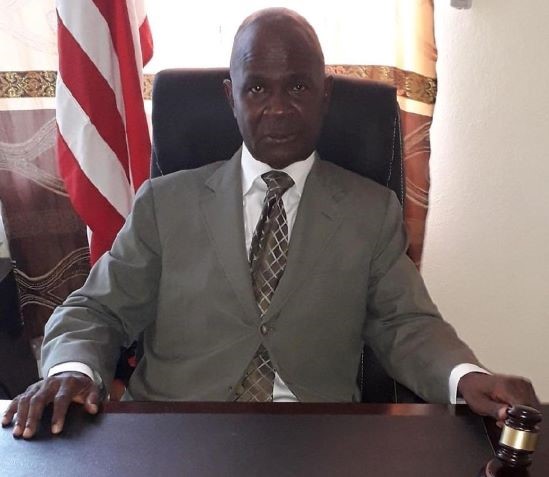
Salutation
Welcome to the 3rd quarterly session of court, the August 2024 Term of Court.
Research shows that weakness in the justice sector of Liberia, of which our Judiciary is a part, was one of the major causes of the Liberian 14-year civil war. For example, judicial corruption, research has shown, “can be attributed to the long years of very low remuneration and generally poor working conditions of judicial officers and staff. The justice system is therefore not seen as a prestigious place to work and the low pay does not attract the talented professionals.”1
The Executive and Legislative the branches of Government are the ones that make budgetary appropriation for the Judiciary. It is indisputably evident, then, that the Legislature and the Executive are the cause of “the long years of very low remuneration and generally poor working conditions of judicial officers and staff.” Therefore, the cause of judicial corruption and the discouragement of many talented professionals to accept the judgeship are primarily attributable to the Legislature and the Executive.
“Low remuneration and poor working conditions of judicial officers and staff undermine judicial independent-impartial administration of justice and the rule of law, the 3rd pillar of our new Government’s ARREST Agenda: Agriculture, Roads, Rule of Law, Education, Sanitation and Tourism agendas.
Notwithstanding these research-based findings which are common knowledge to the Government, particularly the Legislature and the Executive, that indeed participated in that research along with our international partners; yet, Liberia has continued to lag far behind regarding adherence to the rule of law, particularly as it relates to judicial independence as guaranteed under Article 72(a) of our Constitution, supplemented by Section 13.4(2) of the Judiciary Law and the Judiciary Financial Autonomy Act (2006). Therefore, I am compelled to briefly deliver this Judge’s Charge on the topic: Government’s ARREST Agenda: With Particular Emphasis on the Rule of Law Agenda – A Perspective of the Court.
As I have always maintained, the work of judges, including magistrates, universally, is all about and rests primarily upon judicial independence. Judicial independence are those things that enable judges to decide cases impartially devoid of undue external influence from sources like the legislative and the executive branches of government, and/or internal improper interference from sources like colleague and/or superior judges. Judicial independence is an antecedent and prerequisite of judicial impartiality in the administration of justice. Judicial Independent-impartial administration of justice is fundamental and indispensable to the rule of law, the 3rd pillar of Government’s lofty ARREST Agenda. Each of these 6 pillars is indispensable and a desideratum of national economic development and prosperity. But amongst all of them, the Rule of law agenda is fundamental and a prerequisite of, and opens the gateway to the others; for, the rule of law is the foundation cornerstone of a peaceful and orderly society for the ease of doing business in any nation; the ease of doing business in a country ensures business investment; and business investment ultimately yields national economic development and prosperity.
Deficiency in adherence to the rule of law can lead to anarchy. How can our Government carry out its Agriculture, Roads, Education, Sanitation and Tourism agendas in a state of anarchy and lawlessness – in the absence of adherence to the Rule of Law agenda? The Liberian 14-year war answers this question.
- Roads and Agriculture Agendas
Circuit-riding in the administration of justice, that is taking the court and justice to the doorstep of the people dates way back from biblical days2 to the evolution of the Anglo-American common law tradition,3 which tradition our country Liberia has adopted. Accordingly, our law mandatorily provides that: “The Chief Justice of the Supreme Court shall assign, on a rotation system, a Circuit Judge to each quarterly session of the various circuits”4 in the sixteen (16) judicial circuits across the fifteen (15) counties of Liberia, from the 1st and 6th Judicial Circuits of Montserrado County to the 2nd Judicial Circuit of Grand Bassa County through the 16th Judicial Circuit of Gbarpolu County.
Bad roads, especially in the rural counties, hinder, among other things, agricultural activities, the first of our ARREST Agenda. Also, and for the purpose of this Judge’s Charge, bad and many a time impassable roads, hinder circuit-riding – carrying the court and justice to the doorstep of the people – and thus impeding the administration of justice – the rule of law, the 3rd pillar of the ARREST Agenda which, I submit, ought to be given first priority amongst the other five (5) pillars of the ARREST Agenda since, as I have stated, the rule of law agenda is the gateway to the others and not the reverse.
Thankfully, since I became a Circuit Judge eleven (11) years ago, this 2024 year is the first time I ever travelled from Monrovia to the 15th Judicial Circuit of River Gee County on circuit-riding without hindrance from bad and impassable road. Thank God! I ardently thank and appreciate the Government for the Roads along with the Agriculture Agenda, indistinguishable from “yellow machines.”
- Sanitation and Tourism Agendas
In support of Sanitation, the 5th pillar of the ARREST Agenda, by authority of Article 75 of our Constitution, the Supreme Court of Liberia has promulgated Rule 6 of the Rules and Regulations for the Governance of the Magistrate and Traffic Courts setting aside Mondays in every week for trials of cases arising out of the Sanitary Act and City Ordinances of Liberia. The Sanitation pillar of the ARREST Agenda therefore synchronizes with Magistrate Court’s Rule 6. In the spirit of coordination, the County Superintendent and the City Mayor and I have conferred regarding the sanitary condition of River Gee County; and we have mutually agreed to work coordinately in vigorously enforcing the Environmental Sanitation provisions of the Health Law, Title 33, vol. 5, Liberian Code of Laws Revised, along with the City Ordinances. Principals of schools, communities’ leaders, transport unions, and traditional leaders have been especially invited here to take final notice that the Sanitation Law and City Ordinances shall be vigorously and effectively enforced. Your cooperation is required.
The Sanitation pillar of the ARREST Agenda, among other things, enhances the scenic and environmental beauty of our Country for the attraction of tourism, the 6th pillar of the ARREST Agenda.
Also, in my May 2018 Judge’s Charge I enumerated the several research-based types of harmful nature littering of plastic bags has to the human environment. Time cannot permit me to enumerate these again. Our law, like those of other countries, aims at curing harmful environment by the imposition of punishment (fines, community service or imprisonment) on violators of our environmental sanitation law and city ordinances. All City Mayors of River Gee County are therefore requested to submit the lists of all violators to the magistrate courts for prosecution. And the Magistrate Courts shall, as required under Rule 6 of their Courts’ Rules, set aside Mondays in every week for the summary trials of cases arising from violation of our environmental sanitation law and city ordinances.
You, prospective violators of our environmental sanitation law and city ordinances, have the option of choosing between punishment of fines, community service or imprisonment, on the one hand; or, on the other hand, saving your US$100 or its LD19,500 equivalent fine for other purpose and enjoying your freedom of movement.
- Education and Rule of Law Agendas
Many people think that The Rule of Law, the 3rd pillar of the ARREST Agenda, specifically as it relates to adherence to principle of judicial independence, guaranteed under Article 72(a) of the Constitution – protection of judges’ salaries against reduction, and section 13.4(2) of the Judiciary Law as well as the Judiciary Financial Autonomy Act (2006) which supplement Article 72(a) of the Constitution, is for the benefit of judges. NO! Therefore, I am impelled to give a brief education/history, the 4th pillar of the ARREST Agenda, on the principle of judicial independence – those things that enable judges/magistrates to efficiently and effectively perform their constitutional and legal duties.
Judicial independence as regards protection of judicial compensation is not for the benefit of judges/magistrates per se. Accordingly, the South Carolina Supreme Court has held that: “Judicial independence is not for the protection of judges, although it is often thought of in that context today. The principle of judicial independence is designed to protect our system of justice and the rule of law, and thus maintain public trust and confidence in the courts. With judicial independence, the winners are everyone.”5 Also, the United States Supreme Court has admonished that all judges affected have the obligation to resist any attempt to directly or
indirectly diminish their compensation in violation of the Constitution, not for the private advantage or benefit of judges, “but in the interest of preserving unimpaired an essential safeguard adopted as a continuing guaranty of an independent judicial administration for the benefit of the whole people.”6
The protection of judges’ salaries or compensation against reduction “has its root in the longstanding Anglo-American tradition of an independent judiciary,7 a tradition Liberia adopted in Article 4(1) of the 1847 Constitution, and later in Article 72(a) of the 1986 Constitution.
The English Act of Settlement passed in 1701 was “designed to correct abuses prevalent under the reign of the Stuart Kings.”8 That statute had provision making the salaries of judges ascertained and established9 by law; rather than by the will and pleasure of the King. 59 years later, the English Parliament passed an act in 1760 prohibiting the reduction of judges’ salaries, which law was applicable to colonial judges10 in the thirteen (13) colonies of America.
Unfortunately a year thereafter, in 1761, King George III of England illegally made the salaries of judges dependent on his will and pleasure.11 King George’s violation of this law was one of the major objections in the Americans’ 27-count petition declaring their independence from Great Britain on July 4, 1776. Count 9 of that petition stated: “He [King George III] has made judges dependent on his Will alone, for … the amount and payment of their salaries.”12
Therefore, in 1787 when the framers of the United States Constitution were deliberating on the salaries of judges, they were not only cognizant that the illegal reduction of their judges’ salaries by the King was a major reason for declaring their independence from Great Britain; they also realized, as the minutes of the framers’ deliberation show, that contingencies like inflation can vary and decrease the value of money.13 Therefore, to maintain the real salaries of their judges, the American people mandated in Article 3(1) of their Constitution that: “The Judges … shall receive a Compensation which shall not be diminished during their Continuance in Office”14 [sic]. This means whenever inflation decreases the value of money, the government is under constitutional duty to adjust/increase judges’ salaries to counter inflation and thereby maintaining the real salaries of judges; otherwise, the government would be in breach of the constitution.
This constitutional protection clause of judges’ compensation was adopted in Article 4(1) of our 1847 Constitution, and later in Article 72(a) of the 1986 Constitution with the proviso: “except under a national program enacted by the Legislature.” This also means that our Government must adjust/increase the salaries of Liberian judges and magistrates when inflation decreases same in order to offset inflation and thereby maintaining their real salaries;15 except, according to the US Supreme Court, “[n]ational emergency or serious economic conditions affecting the general welfare … make the adjustments inappropriate”16 – under which circumstances the salaries remain as they were, but not further reducing directly the dollar amounts of those salaries.
The exception clause in Article 72(a) of our present 1986 Constitution, I submit, was adopted from the US Supreme Court’s decision in United States v. Judge Hubert L. Will et al., decided on December 15, 1980, eight (8) months and two (2) days after the Liberian April 12, 1980 coup when our 1847 Constitution was suspended and later replaced by the 1986 Constitution.
It must be noted that from September 24, 1789 when the Federal Judiciary was inaugurated up to now (2024) Congress, consistent with their Constitution, has always increased their judges’ salaries annually to offset inflation.17 Even during the Great Depression (1929-1939) when Congress passed the Appropriation Act (1933)reducing salaries, that law exempted judges18 because the constitutional protection clause prohibited the diminution of their salaries. During that period of the Great Depression, according to the Chief Justice of the Supreme Court of Liberia, Louis Arthur Grimes: “The salaries of judges were not then reduced.”19
There is far less what Liberian judges and magistrates are demanding from the Government as compared to that which they are constitutionally and statutorily entitled. For instance, the Government does not adjust judicial compensation annually to offset inflation as constitutionally required. Also, Liberian judges ought to be relatively the highest paid officials amongst lawmakers and cabinet ministers as per precedence in the United States, which is not the case in Liberia. Yet, Liberian judges are silent.
Now, besides reducing judges’ salaries amid our silence, the Executive and the Legislature, via budgetary appropriation, have gone to the extent by reduce those logistics required for us to perform our duties efficiently and effectively. The Government argues that the Judiciary’s budgetary appropriation is made on the basis of availability of funds – an argument devoid of any constitutional and legal basis. In fact, the constitutional protection clause of judges salaries, as interpreted in 2012 by the Federal Circuit Court of Appeals, judges are constitutionally entitled to an automatic cost-of-living adjustments (COLAS) pursuant to the US Constitution and the Ethics Reform Act (1989),20 which Constitution and Act correspond to the Liberian Constitution, Article 72(a) thereof, and Section 13.4(2) of our Judiciary Law along with Canon 6 of the Judicial Canons of Liberia.
From 2009 to present the US Congress has decided not to increase the salaries of their rank-and-file lawmakers, Senators and Representatives; while the Congress continues to increase their judges’ salaries annually to counter inflation as constitutionally required. For instance, before 2009, US Rank-and-File Senators and Representatives and US Federal District Judges earned $174,000.00 annually.21 But from 2010 to now (2024) the annual salary of US Senators/Representative is still $174,000.00 per year,22 while District Judges now earn $243,300.00 annually.23 In fact, research shows that judges are relatively the highest salary-paid officials vis-à-vis lawmakers and cabinet officials in the US, a country whose constitutional system Liberia has adopted, particularly regarding the constitutional protection of judges’ compensation.
I therefore call on the Liberian Government to follow the precedent of the US Government as our Constitution and theirs, particularly the judicial compensation clause, are the same.
The continued violation of Article 72(a) of the Constitution, Section 13.4(2) of the Judiciary Law and the Judiciary Financial Autonomy Act (2006) undermines the Rule of Law, pillar 3 of the Government’s ARREST Agenda; and, indeed, this is a constitutional violation this Government, I submit, intends to arrest.
Judicial independence, guaranteed under Article 72(a) of our Constitution and supplement by Section 13.4(2) of the Judiciary Law and the Judiciary Financial Autonomy Act (2006), is a universal principle of international law. For example, United Nations Human Rights’ Basic Principles on the Independence of the Judiciary (1985), Section 1 thereof, provides that: “The independence of the judiciary shall be guaranteed by the State and shrined in the Constitution or law of the country.24 It is the duty of all governments and other institutions to respect and observe the independence of the judiciary.”25 Section 7 of this international law also mandates that: “It is the duty of each Member State to provide adequate resources to enable the judiciary to properly perform its functions.”26
Under domestic and international laws, only judges as opposed to lawmakers and cabinet officials, are guaranteed protection of their compensation against reduction for reasons stated in this Judge’s Charge. Unfortunately, in practice, the contrary obtains in Liberia. This state of affairs has got to change! We MUST respect the Rule of Law, pillar 3 of the ARREST Agenda, as it relates to Article 72(a) of our Constitution, Section 13.4(2) of the Judiciary Law, the Judiciary Financial Autonomy Act (2006), and Canons 4 & 6 of the Judicial Canons of Liberia.
Besides the judicial independence-impartiality-rule of law purpose that the judicial compensation protection clause of Article 72(a) of our Constitution serves, there is other related purpose it serves: It ensures that prospective judges/magistrates who abandon their private practice of law which is more often than not lucrative27 than the judgeship, the compensation of the new position of the judgeship will not diminish later; and that able lawyers of the legal profession will be attracted to the judgeship and thereby enhancing the quality of the administration of justice.28
Yes, the National Legislature rightfully passed a law prohibiting judges/magistrates from engaging in the practice of law.29 Also under the Judicial Canons of Liberia, judges/magistrates are prohibited from engaging in the practice of law, directly or indirectly, and engaging in any business pursuit.30 In consideration of these prohibitions against judges, the sovereign people of Liberia through the supreme and organic law of the land, our Constitution, Article 72(a) thereof, prohibits the Government from reducing their compensation.
Amid the legal prohibition limiting judges’ sources of income, the unconstitutional cutting of their salaries violates the human rights of both judges/magistrates and their families.
In the interest of judicial independence and not only that of judges, some judges and I filed a class action in 2021 against the Government challenging the unconstitutional reduction of our remuneration in October 2019. More than a year ago, the leadership of the National Association of Trial Judges of Liberia (NATJL) pleaded with us to voluntarily discontinue our lawsuit and abandon possible institution of a human rights-based lawsuit, along with a provisional attachment remedy, against the Government before an international human rights court. In consideration thereof, the NATJL agreed to file an IN RE petition before the Supreme Court of Liberia challenging the unconstitutionality of the National Remuneration Standardization Act (2019) – “Harmonization”. That petition was filed.
Whilst our President is trying to resolve the issue of the Judiciary’s unacceptable 2024 budgetary allotment, based on the Supreme Court’s objections, I urge the NATJL to superintend the IN RE petition before the Supreme Court so that a precedent case on this matter will be finally established for future generations and development of Liberian jurisprudence on judicial independence and the rule of law.
Indeed, judges and magistrates are under legal obligation to resist any unconstitutional attempt to directly or indirectly diminish their compensation as mandated by US Supreme case law; we, as priests of justice, amid “low remuneration and generally poor working conditions of judicial officers and staff”, more importantly, are under legal and moral obligation to eschew and resist those bad things, like the evil of judicial corruption, that undermine judicial independent-impartial administration of justice and the rule of law –our sacred calling and passion.
In conclusion and in passing, I submit that the Rule of Law also requires that all of us in post-war Liberia manage our speech and conduct in ways as not to breach the peace we have continued to enjoy after Liberia’s 14-year war which claimed the lives of 250,000 people, among other things. Our Constitution guarantees freedom of speech. Under the same Constitution, that freedom is not absolute. Liberia and “Most states have breach-of-the-peace laws that criminalize certain speech and conduct, including use of obscene, profane, vulgar, or abusive language in the public space.”31 Accordingly, abusive and offensively coarse, rude, crude, vulgar, profane and obscene speech, like the F-word and words describing another’s private parts, made to people “in a place to which the public or substantial group has access,”32 like TV and social media, is not constitutionally protected. Even lawmakers and judges who constitutionally enjoy immunity from arrest, respectively under Articles 43 and 73 of the same Constitution, can be arrested for breach of the peace. In the eye of the law, such speech or conduct is an offence against public order and not against the person or persons against whom such speech or conduct is made.
Finally, there are 21 cases on the trial docket – 10 criminal and 11 civil cases. Rule 7 of the Rules of the Circuit Court mandates that clearing of the trial docket shall be the foremost concern of the judge presiding. I charge that all court actors endeavor to fulfill this mandate to the best of our abilities.
With the power in me vest, I declare this Honorable Court formally open for the transaction of judicial business. The Clerk of Court is accordingly ordered to officially inform the Superintendent and Legislative Caucus of River Gee County. AND IT IS HEREBY SO ORDERED.
God bless this Honorable Court and save the State!
FOOTNOTES
1The Judiciary of the Republic of Liberia: Strategic Plan (2011-2012):The Challenges, p. 8.
2The Holy Bible: 1 Samuel, 7:15-17; Section 18, Magna Carta (1215); and Supreme Court/History of the [U.S.] Supreme Court/https://civics.supremecourthistory.org.
3United States v. Judge Hubert L. Will et al., 449 U.S. 200 (1980)
4Assignments of Judges to Circuit: Section 3.9, Judiciary Law, 4 LCLR
5Sagars-Andrewa v. Judicial Merit Commission (2010), South Carolina Supreme Court
6O’Donoghue v. United States, 289 U.S. 516 (1933)
7United States v. Will et al. (1980) cited supra
8Ibid.
9Ibid.
10Ibid.
11Ibid.
12Ibid. See also America’s Petition – Declaration of Independence, count 9 (July 4, 1776)
13Ibid.
14Constitution of the United States, Article 3(1).
15United States v. Will et al. (1980) cited supra.
16Ibid.
17Federal Judges Salaries (1789-2024): Wikipedia.
18O’Donoghue v. United States (1933) cited supra.
19Chief Justice Grimes’ Opening Address of the Supreme Court of Liberia, April 1935 Term, 4 LLR.
20Judge Peter Beer et al. v. United States, Federal Circuit Court of Appeal (2012).
21Annual Salaries of Top US Government Officials: Wikipedia.
22Salaries of US Congress (1789-2024): Wikipedia.
23Salaries of US Federal Judges (1789-2024): Wikipedia.
24United Nations Human Rights’ Basic Principles on the Independence of the Judiciary (1985), sections I and 7
25Ibid.
26Ibid.
27United States v. Will (1980) cited supra
28Ibid.
29Judiciary Law: Section 17.1(3) Prohibited Activities
30Judicial Canons 4 and 6: Judicial Canons of Liberia.
31Breach of the Peace: Wikipedia.
32Penal Law of Liberia, 4 LCLR, Sections 17.1(3) and 17.3(1)(b).
Support Independent Journalism
Your support helps FrontPage Africa continue delivering independent, credible, and impactful journalism. Every contribution strengthens our ability to investigate, inform, and hold power accountable while keeping quality journalism accessible to our readers.
Support our journalism or subscribe to receive the latest FrontPage Africa stories and updates.